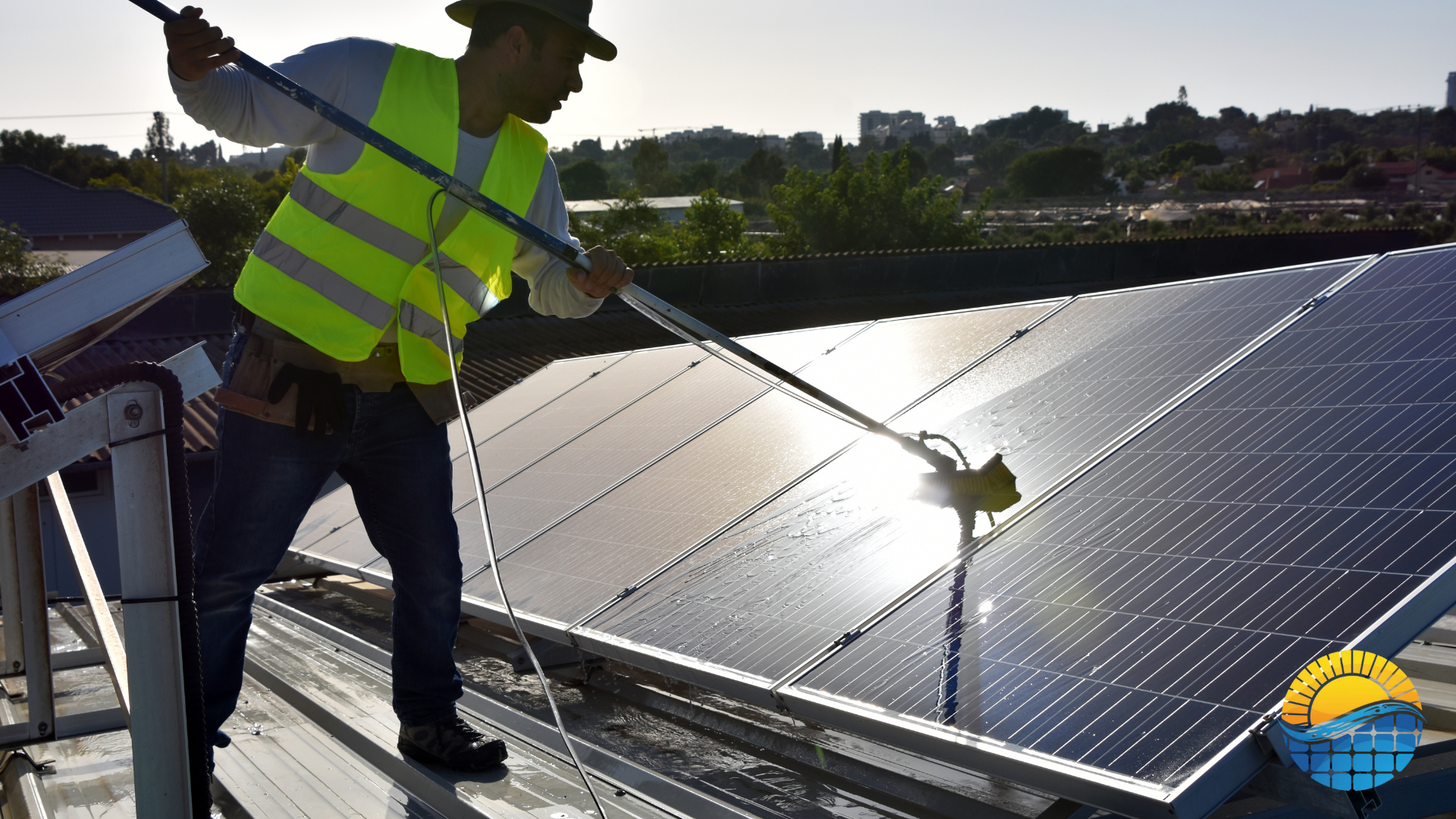
How To Clean Solar Panels Like a Pro: The Complete Guide
By Adam Walters, Founder, CleanMySolarPanels · June 21, 2025 · Updated November 22, 2026
Cleaning solar panels like a pro means working from the ground with purified water and a soft brush on a water-fed pole, on a cool morning, without soap or a pressure washer. An hour's work recovers the 5% of output soiling costs most homes, more in Phoenix, where pros recommend two to four cleanings a year.
The method is not a secret. What separates a professional clean from a Saturday with the garden hose is the water, the tool and the timing. NREL puts typical soiling losses at around 5% a year, 7% in dusty climates and 10% to 15% during pollen season. A professional visit, typically $110–$320, gets that back in an afternoon. This guide shows you how to get the same result yourself, when you should, and when you should not.
Should you clean your own solar panels at all?
Start here, because the answer decides everything else. The question is not whether you are handy. It is whether you can reach every panel with your feet on the ground.
Clean them yourself if:
- The array is on a single-storey roof, a ground mount, a carport or a pergola.
- The pitch is low enough that a pole brush can reach the top edge of every panel from the ground or a lawn.
- Nothing in the job needs your feet on the roof.
Hire a pro if:
- The panels are on a second storey or the eave is more than about 25 feet off the ground. Our guide to cleaning panels on a two-storey house explains why the gear needed to do it safely costs more than years of visits.
- The roof is steep, tile, slate or metal. A wet roof of any of those is a slide.
- You would have to step onto a panel to reach another. Walking on solar panels cracks cells you cannot see and voids most warranties.
The rule pros work to is simple: feet on the ground, water on the glass. Everything below assumes you can keep both.
The professional method, step by step
This is the sequence a water-fed pole crew follows on a residential roof. Nothing in it needs the system switched off, and nothing in it touches a panel with anything harder than a soft bristle.
- Read the manual first. Every major manufacturer publishes cleaning guidance and ties the warranty to it. REC's cleaning guide, for example, asks for ambient-temperature water, ideally deionised, applied with a garden hose or a soft brush on a pole, and bans pressure washers, steam, blades and metal sponges outright. Find your panel brand's equivalent before you start.
- Pick the moment. Early morning, late evening or an overcast day. The glass must be cool to the touch. Hot glass flashes water into mineral spots before you can rinse it, and REC warns that cold water on hot panels can crack them through thermal shock. In summer in Las Vegas, where pros recommend three to four cleanings a year, crews are often finished before 9 a.m.
- Walk the array from the ground. Look for cracked glass, lifted frames, hanging wires or nests. A damaged panel is a shock hazard when wet. If you see any of it, stop and call a pro.
- Rinse to lift the grit. Run water from the top edge of each panel downward until the loose dust, pollen and leaf litter are off. This matters more than it sounds: grit under a brush is sandpaper on the anti-reflective coating that the Department of Energy describes as the layer that stops glass reflecting away a third of the light.
- Brush with purified water flowing. With the pole fed from your DI filter, work each panel from the top edge down in slow overlapping strokes. Let the water do the lifting; the brush only breaks the film. Do not lean on the pole.
- Pure-water rinse, and walk away. Lift the brush a few inches off the glass and rinse each panel from top to bottom with purified water. Below about 10 ppm total dissolved solids there is nothing in the water to leave behind, so the panel dries spot-free on its own. No squeegee, no towel, no second pass.
- Inspect from the street. Clean glass looks dark and uniform. Any streak or pale patch is either a missed strip or a mineral mark from the rinse water, and both tell you to go back over that panel while the array is still cool.
That is the whole job. The thing most homeowners get wrong is the water.
Why pros use purified water, and what tap water leaves behind
Tap water carries dissolved minerals, mostly calcium and magnesium. When a drop dries on glass the water leaves and the minerals stay, as a white ring. Spread a hose over a 20-panel array on a warm day and you have painted the whole thing in a thin mineral haze that scatters light. Those spots are what our guide to rain and solar panels is really about: rain rinses, dries, and leaves its own residue.
TDS is the number that matters. Total dissolved solids, measured in parts per million, tells you how much mineral is in the water. Soft municipal water might read 50 ppm; well water or hard-water cities can read 300 ppm and up. Purified water for cleaning glass should read under 10 ppm, and most pros aim for 0 to 5. A handheld TDS meter costs $14: dip it in a cup of your tap water, then in the water coming out of your filter, and you know in ten seconds whether you are about to leave spots.
Hardness tells you how long a filter lasts. A deionising (DI) cartridge swaps mineral ions for hydrogen and hydroxide ions until its resin is spent. The harder your water, the faster that happens. In soft-water areas a small inline filter lasts several cleanings; where the tap reads over 300 ppm it may be exhausted before you finish the second roof. Check the output with the meter as you go, and stop rinsing with it the moment it climbs past 10 ppm.
DI alone versus RO/DI. A single DI filter is the right choice for a homeowner: cheap to buy, no plumbing, screws onto a garden hose. Reverse osmosis (RO) strips most of the minerals first and the DI stage polishes what is left, which makes resin last many times longer. That only pays off if you are using hundreds of gallons a week, which is why RO/DI systems sit on professional trailers and not on patios.
The gear, in three tiers
Prices below are from our gear pages, which link to each maker's own site. Buy for the roof you have.
| Tier | What you buy | Cost | Right for |
| Budget | 30 ft brush kit with telescopic pole ($98) + WaterSentinel inline DI filter ($33) + handheld TDS meter ($14) | About $145 | Single-storey roofs, ground mounts, soft to moderate tap water |
| Mid-range | 24 ft water-fed pole kit with inline filter and TDS meter ($271) | $271 | Larger single-storey arrays, anyone cleaning two or more times a year |
| Pro | XERO Pure RO/DI package with 30 ft carbon fibre Pro Pole ($2,648), or the Tucker Ultimate Residential Kit with 4-stage RO/DI ($3,199) | $2,648–$3,199 | Hard water, very large arrays, or anyone starting a cleaning business |
The budget tier is enough for most homes. A 30 ft pole reaches the top of a single-storey roof from the lawn, the inline filter screws between the tap and your hose, and the meter tells you when the filter is spent. Our guide to cleaning panels from the ground shows the setup.
The mid-range kit is a water-fed pole proper. Water runs up the inside of the pole and out through the brush head, so you rinse as you scrub, with the filter inline. It roughly halves the time per panel compared with a dry brush and a separate hose.
The pro tier is for hard water and ambition. Carbon fibre poles weigh a fraction of aluminium at the same length, which is the difference between a 30 ft pole you can control and one that controls you. RO/DI systems make purified water from the worst tap supply for a few cents a gallon. For one house they are overkill.
What the water costs per visit. The consumable is the resin. A $33 inline filter that lasts one to three cleanings, depending on your tap TDS, works out to roughly $11 to $33 per visit. Refilling a larger vessel from a $199 bag of mixed-bed resin brings that down to a few dollars a clean.
What never to use on solar panels
Every one of these shows up in a search for cleaning tips, and every one of them costs output, coating or warranty. We have tested the claims behind each in its own guide.
- A pressure washer. It forces water past the frame seals and can crack glass or delaminate cells. Our guide on pressure washing solar panels explains why manufacturers name it specifically in their warranty exclusions.
- Dish soap. It leaves a surfactant film that dust sticks to and that dries in streaks. See dishwashing liquid on solar panels.
- Vinegar. Acidic, and it does nothing to dust that water does not already do. See vinegar on solar panels.
- Car wash soap. Many formulas include wax or gloss agents that leave a haze. See car wash soap on solar panels.
- Abrasive pads, scourers, stiff brooms. The anti-reflective coating is thinner than the scratches they leave.
- Hard tap water on hot glass. It is the most common mistake and the one that makes a cleaned array look worse than a dirty one.
- A leaf blower on the glass. It drives grit across the coating at speed and does nothing about film. See leaf blowers and solar panels.
- Your own weight. Never stand, kneel or lean on a panel.
If you want something in the water for a greasy urban film, use a concentrate made for solar glass, use it sparingly, and finish with a pure-water rinse so nothing stays on the glass.
Stubborn soiling, by type
Plain purified water and a soft brush lift dust, pollen and light film. Some soiling needs a different approach, and the approach depends on what it is. The table pairs each with a city on this site where it is the main problem. Ground mounts have one more, mud splashed up from the rows; see stopping mud splash-back.
| Soiling | Where it is the main problem | What works |
| Bird droppings | Atlanta, where droppings from the tree canopy build June to August and pros recommend one to two cleans a year | Soak with purified water for several minutes to soften, then an enzyme remover and a gentle brush; never scrape dry |
| Tree sap | Beaverton, under Douglas fir and cedar, with pollen peaking April to June | Soften with a soaked cloth on the pole, then a purpose-made solar cleaner; see the tree sap guide |
| Pollen film | Gainesville, oak pollen February to April, pros recommend two to three cleans a year | Pure water and brush lift it easily while fresh; clean as soon as the pollen season ends |
| Salt crust | Honolulu, salt spray and trade-wind dust May to September, pros recommend two cleans a year | Longer pure-water soak before brushing; rinse the frames and clamps too, salt corrodes aluminium |
| Wildfire ash | Boise, ash in August and September, pros recommend two to three cleans a year | Rinse before brushing, ash is abrasive; see the wildfire ash guide |
| Hard-water spots | San Antonio, where a hose dries in minutes through the June to September heat and pros recommend two cleans a year | Re-wet with purified water and brush gently; stubborn rings need a pro's spot treatment, not an acid from the kitchen |
| Lichen and moss at the edges | Astoria, where damp keeps moss on the frames year-round and pros recommend one to two cleans a year | Soft brush along the lower frame on a dry day; see managing algae and moss |
Two notes on droppings, because they are the soiling that damages panels rather than just shading them. A baked-on patch shades a few cells, the rest of the string pushes current through them, and they overheat. Clean droppings as you find them, and if the birds are nesting under the array, proof it in the same week. A 32 oz enzyme bird dropping remover at $16 is the one bottle worth keeping next to the pole.
Safety: the ladder, the roof and the electricity
Pros do not get hurt cleaning panels because they treat three things as fixed rules.
The ladder. If you need one to reach the lawn-side of a pole, follow OSHA's portable ladder card: set the base one foot out for every four feet of height, extend it at least three feet above the point it rests on, keep three points of contact, and look for overhead power lines before you lift it. Have a second person foot the ladder. Never work from the top three rungs.
The roof. The only time a pro steps onto a roof is with a harness clipped to an anchor, and never alone. A fall-protection kit costs about $71, less than one visit, but a kit does not teach you where to anchor it. If the job needs you on the roof, that is the job to hire out.
The electricity. Panels make DC whenever there is daylight, including on an overcast morning, and you cannot switch the panels themselves off. You do not need to shut the system down for a routine wash; our guide on turning off the system covers the detail. What you must not do is open anything: no junction boxes, no connectors, no inverter covers. Keep water away from the inverter and the disconnects, and if you find damaged glass or exposed wiring, stop.
The sun. Not a safety rule in the usual sense, but the one most often broken. Full sun means hot glass, fast evaporation, spots and thermal shock. Wait for the shade.
How long does it take?
With a water-fed pole and purified water, a pro cleans a typical 20 to 25 panel residential array in 30 to 60 minutes, plus set-up. A homeowner with the budget kit should allow about twice that the first time, most of it spent learning how the pole handles at full extension.
Heavily soiled arrays take longer because soaking is part of the method. Fresh pollen film comes off in a pass. A year of baked dust in Fresno, where pros recommend three to four cleans a year, needs several wet-and-wait cycles before the brush does anything. If the array has never been cleaned, plan on a morning.
How to measure whether it worked
The monitoring app is your proof. Enphase, SolarEdge, Tesla and the others all log daily production, and the comparison you want is clear day before against clear day after.
- Note production on the last clear day before you clean, and the peak power reading around midday.
- Clean.
- Compare the next clear day. A sunny-day gain of a few percent is normal; in pollen season or after a dusty summer it can be double digits.
- Watch the next month. The rate at which output drifts back down tells you how often your roof actually needs cleaning, which is the number our frequency guide can only estimate from your city.
If you want the dollar figure rather than the percentage, our savings calculator turns a production gain into a yearly saving at your local rate. Not every drop is dirt: our guide to the signs your panels need cleaning separates soiling from shading, a tripped string and a tired inverter.
DIY or a pro visit? The honest comparison
A professional cleaning runs $110–$320 nationally, about $6 to $16 per panel. The budget kit is about $145 once, plus $11 to $33 of resin a visit. On price alone the kit pays for itself on the first or second clean. That is not the whole sum.
| Factor | DIY with the budget kit | Professional visit |
| Cost | About $145 up front, $11–$33 a visit after | $110–$320 a visit, less on a plan |
| Time | 1 to 2 hours the first time, under an hour after | About an hour, none of it yours |
| Result | Spot-free if your filter output stays under 10 ppm | Spot-free, with before-and-after photos |
| Risk | Low on a single storey from the ground; high anywhere else | Insured, harnessed, two-person on roofs |
| Extras | You notice what you notice | Inspection for cracks, loose wiring, nests, failed clamps |
| Payback | Gear pays back in one or two cleans on a reachable roof | Energy recovered covers the fee in dusty cities; elsewhere it is maintenance |
When doing it yourself is the right call. A single-storey roof or ground mount, a filter you check with a meter, two or more cleans a year, and the patience to wait for a cool morning.
When a pro is simply the right call. A second storey, a steep or tile roof, a very large array, a neglected one with years of baked-on film, a bird problem under the panels, or any job that would put you on the roof. In New York, where a visit runs $150–$350 and arrays sit on row-house roofs, no pole reaches from the pavement. Our worth-it guide runs the numbers city by city.
Mixing the two works well. Many homeowners do a quick pure-water rinse themselves after pollen season or a dust storm and book a pro once a year for the full clean and inspection. Pros that offer plans price each visit below the one-off rate and list those plans on their profiles.
Every city page on this site lists the local pros with their price band and the months when build-up is heaviest, from the dustiest in our Grime Index to the wettest. Find your city on our solar panel cleaning page, or request quotes from local pros and compare before you buy a pole.
Frequently asked questions
What is the best way to clean solar panels?
From the ground, with purified water and a soft brush on a water-fed pole, on a cool morning. Rinse to lift grit, brush each panel from top to bottom with the water running, then rinse with purified water under 10 ppm and let it air dry. No soap, no squeegee, no pressure washer.
Can I clean solar panels with a garden hose?
You can rinse with one, and a rinse after a pollen week or a dust storm helps. The problem is what tap water leaves when it dries: mineral spots that scatter light. Screw a $33 inline DI filter onto the hose and check the output with a TDS meter, and the same hose gives a professional result.
Do I need to turn off my solar panels before cleaning?
Not for a routine wash from the ground. The panels keep producing DC in daylight and cannot be switched off anyway; the inverter and disconnects are what a shutdown controls, and a wash does not touch them. Check your manufacturer's manual, keep water away from the inverter, and never open a junction box or connector.
What should you never use on solar panels?
Pressure washers, abrasive pads, stiff brooms, dish soap, vinegar, car wash soap, hard tap water on hot glass, a leaf blower on the glass and your own weight. Every major manufacturer's warranty names pressure washing, abrasives and harsh chemicals as exclusions, and the rest leave films or scratches that cost output.
Is deionised water really necessary?
For a spot-free finish, yes. Water under 10 ppm total dissolved solids dries leaving nothing behind, which is why pros skip the squeegee. Tap water at 100 to 300 ppm leaves a mineral haze over every panel. A handheld TDS meter costs $14 and an inline DI filter $33, so the upgrade is cheap.
How long does it take to clean solar panels?
A pro with a water-fed pole cleans a typical 20 to 25 panel array in 30 to 60 minutes. A homeowner with a budget kit should allow one to two hours the first time, less once the pole is familiar. Heavily soiled or neglected arrays take longer because the dirt has to soak before it will lift.
How do I get bird droppings off solar panels?
Soak them with purified water for several minutes until they soften, then use an enzyme-based dropping remover and a soft brush. Never scrape a dry patch, which drags grit across the coating. Clean droppings as soon as you see them, because a baked-on patch shades cells and can overheat them.
Can I clean solar panels in the sun?
No. Hot glass flashes water into mineral spots before you can rinse, and manufacturers warn that cool water on hot panels can crack them through thermal shock. Clean early in the morning, late in the day or on an overcast day, when the glass is cool to the touch.
Is it worth hiring a pro instead of doing it myself?
On a single-storey roof you can reach from the ground, a $145 kit pays for itself in one or two cleans. On a second storey, a steep or tile roof, a large array or one with a bird problem, a $110–$320 visit is cheaper than the gear, safer than the ladder, and comes with an inspection.
How often should I clean my solar panels?
Once or twice a year for most homes, two to four times in the desert Southwest and the Central Valley, and after any pollen week, dust storm or wildfire that leaves a visible layer. Your monitoring app tells you the real answer: when clear-day output drifts a few percent below its clean baseline, it is time.