How Should I Clean Wildfire Ash Off My Oregon Solar Panels?
By Adam, Founder, CleanMySolarPanels · May 1, 2026
Never dry-wipe wildfire ash off solar panels — the safe method is a heavy low-pressure pre-soak, a soft-bristle brush, and a deionized water rinse, done only after the smoke clears. Ash behaves like crushed pumice: drag a rag or broom across it and you scratch the anti-reflective coating and void the 25-year manufacturer warranty. Worse, when Oregon's morning dew mixes with the ash, it forms corrosive potassium hydroxide that etches the glass permanently.
Protect yourself before you protect the panels: the CDC advises a NIOSH Approved respirator for ash cleanup — a cloth or surgical mask does not filter smoke and ash particles.
Below: why ash is worse than dust, when to clean, why the garden hose fails, and the step-by-step professional method.
Why Wildfire Ash is Far More Dangerous Than Dust
To understand why you need to be so careful, you have to understand the microscopic anatomy of wildfire ash. It is fundamentally different from the standard airborne dust that blows around during the rest of the year.
When a forest burns, the resulting ash is composed of burnt wood, pulverized minerals, and carbon particulate matter. This creates three distinct, severe hazards for your solar array:
1. The Physical Hazard: Extreme Abrasion
Standard dust is relatively soft. Wildfire ash, however, is full of microscopic, jagged edges. On a microscopic level, ash acts exactly like crushed pumice stone. If you drag a dry rag, a stiff garage broom, or an abrasive sponge across a solar panel covered in ash, you are literally taking sandpaper to the glass. You will instantly create thousands of micro-scratches across the sensitive anti-reflective coating, permanently blinding your solar cells and voiding your 25-year manufacturer warranty.
2. The Chemical Hazard: The Lye Effect
This is the most time-sensitive, hidden threat to Oregon solar panels. Wildfire ash contains incredibly high levels of calcium and potassium. When ash is perfectly dry, it sits relatively harmlessly on the glass. However, the Pacific Northwest is famous for its heavy, damp morning dew.
When the morning dew (or a light, misty coastal rain) mixes with the heavy layer of ash on your roof, it creates a dangerous chemical reaction. The moisture turns the potassium-rich ash into potassium hydroxide—which is essentially a highly alkaline, corrosive lye paste. If this alkaline paste is left to bake onto the hot glass under the afternoon sun, it can slowly etch into the anti-reflective coating, causing irreversible chemical damage and permanent clouding of the glass.
3. The Electrical Hazard: Severe Hotspots
Ash doesn’t always fall evenly like snow. A clump of burnt leaves, heavy soot, or charred debris can settle on a specific corner of your solar array. Because this debris is completely opaque, it entirely blocks the sunlight from reaching the photovoltaic cells underneath.
This creates a severe electrical bottleneck. Because the rest of the panel is working hard to push electricity through the system, the blocked cells begin to overheat. These “hotspots” can reach temperatures high enough to permanently scorch the internal wiring of your panel, warp the backsheet, and even crack the glass from the inside out. To understand exactly how these bottlenecks drain your wallet and threaten your system, review our guide on how bad it is if you don’t clean your solar panels.
Timing is Everything: When Should You Clean the Ash?
When ash starts falling, your first instinct is to immediately climb on the roof and wash it off to protect your energy production. Do not do this.
Timing your post-fire solar maintenance PDX correctly is a matter of both personal safety and practical efficiency.
Rule 1: Never Clean During an Active Smoke Event
If the Air Quality Index (AQI) is in the red or purple (Unhealthy or Hazardous), stay inside. Physical exertion on a roof while breathing in toxic PM2.5 particulate matter is incredibly dangerous to your lungs. Furthermore, cleaning your panels while ash is still actively falling from the sky is a complete waste of time. Your panels will be coated again by the following morning.
Rule 2: Wait for the “All Clear” Winds
Monitor your local air quality reports via the Oregon Department of Environmental Quality. Wait until the active fires are contained or the prevailing ocean winds have pushed the smoke out of your valley. Once the sky is clear and blue, and the ash has stopped falling, it is time to schedule a deep clean.
Rule 3: Clean Before the Heavy Autumn Rains
Do not assume the impending November rainstorms will wash the ash away for you. As mentioned earlier, light rain or dew will just turn the ash into a corrosive cement. You must safely remove the abrasive ash before the winter weather locks it onto the glass.
The Dangers of DIY: Why a Hose and Soap Will Fail
Once the smoke clears, many Oregon homeowners try to save a few dollars by dragging a garden hose up a ladder on a Saturday afternoon. This is a massive mistake that frequently leads to ruined panels.
Here is why your standard household cleaning methods are the absolute worst way to handle cleaning smoke residue solar panels:
- The Pressure Washer Disaster: Never try to blast the ash away. As we explain in our comprehensive safety guide, if you pressure wash solar panels, you will instantly blow out the weather seals and destroy the anti-reflective coating.
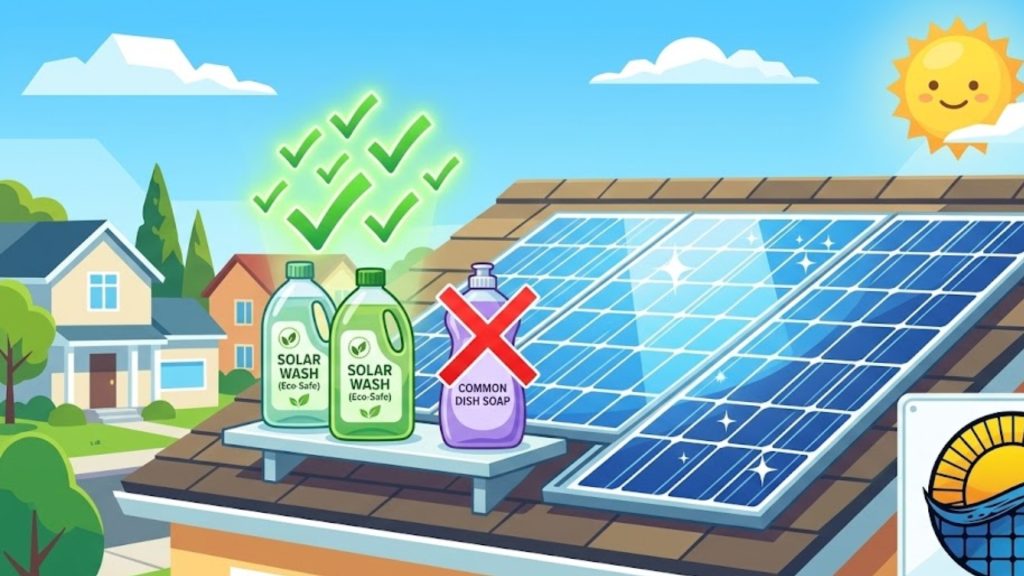
- The Dish Soap Mistake: Instead of using the best solar panel cleaning soap, homeowners often reach for dish detergent. Dish soap leaves a sticky, hazy film on the glass. If there is still lingering smoke in the air, that film will act like a magnet, trapping new ash directly against the panel.
- The Squeegee Scratch: Plunging a standard window squeegee across an ash-covered panel will drag the sharp, pumice-like minerals aggressively across the anti-reflective coating. You must always use the best soft brushes for solar panel cleaning to lift the ash gently.
- The Hard Water Bake: Oregon well water and standard municipal tap water contain dissolved minerals. If you spray cold tap water onto a hot, ash-covered panel, the water will evaporate instantly, leaving chalky white mineral stains baked onto the glass right alongside the ash.
Before you go near it: protect your lungs. Wildfire ash is fine enough to reach deep into the airways, and ash from burned structures can carry heavy metals and, in older buildings, asbestos. The CDC advises a NIOSH Approved respirator — a cloth or surgical mask does not filter smoke and ash particles, and neither does a one-strap nuisance dust mask. Wear gloves and long sleeves as well: wet ash is alkaline enough to irritate and burn skin. If you have asthma or any respiratory condition, this is a job to hand over rather than attempt. See the EPA’s wildfire guidance before any post-fire cleanup.
Step-by-Step: The Professional Method for Ash Removal
To safely remove abrasive, potentially corrosive wildfire ash, you must rely on specialized equipment. If you want to understand the comprehensive scope of this equipment, we detail it thoroughly in our complete guide to solar panel cleaning in Oregon.
When you hire a verified local professional, here is the strict, multi-step protocol they follow to ensure your panels survive smoke season undamaged:
Step 1: The Massive Pre-Soak
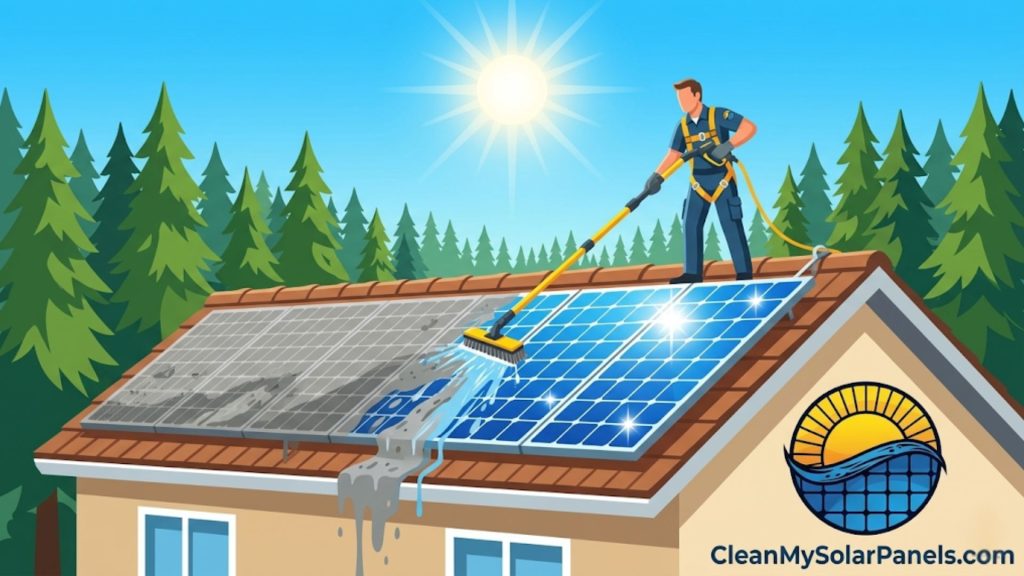
You can never, ever dry-wipe an ash-covered panel. A professional will start by gently flooding the entire solar array with a massive volume of low-pressure water. This heavy pre-soak serves two purposes: it cools the superheated glass down to a safe temperature to prevent thermal shock, and it naturally lifts and floats the largest, sharpest ash particles safely off the roof without any physical friction.
Step 2: Specialized Soft-Bristle Agitation
Once the loose, abrasive ash has been flooded away, the professional will use a specialized, ultra-soft, flagged-bristle brush. These brushes are specifically engineered to glide over the anti-reflective coating without scratching it. The technician will gently agitate the remaining sticky, dew-baked smoke residue.
Step 3: The Hardware and Frame Inspection
Professionals don’t just wash the glass. Ash is insidious; it gets everywhere. A thorough cleaning involves flushing the ash out of the aluminum panel frames and ensuring that the tracking mounts and junction boxes are clear of corrosive, highly alkaline ash buildup that could eat away at the wiring over the winter.
Step 4: The 100% Deionized Water Rinse
This is the most critical step. Professionals do not use standard tap water. They use Deionized (DI) Water Filtration Systems that strip 100% of the dissolved minerals out of the water supply. They pump this pure water through the carbon-fiber brush pole. Because the water is completely pure, it acts as a magnet for the microscopic smoke particulate. The panels are rinsed clean and left to air-dry completely spotless and streak-free.
Regional Post-Fire Challenges Across Oregon
Oregon is a massive state with highly varied microclimates. The type of ash falling on your roof, and how fast you need to clean it, depends heavily on where you live and how the local geography traps the air.
- Portland Metro & The Willamette Valley: The Willamette Valley is essentially a massive bowl. During late summer, temperature inversions trap wildfire smoke down at the surface level for weeks at a time. Here, wildfire ash mixes with standard vehicular exhaust and industrial smog to create a uniquely sticky, oily film. If you’ve been wondering if it is worth it to clean solar panels in Portland, removing this oily, ash-heavy barrier is exactly why professional maintenance pays for itself.
- Southern Oregon (Medford & Ashland): Southern Oregon frequently bears the brunt of the state’s longest and most severe smoke events. Because panels in this region can sit under thick, snow-like ash for weeks at a time, the risk of localized hotspots is incredibly high. Immediate post-fire restoration cleaning here is non-negotiable to protect the lifespan of the system.
- The High Desert (Bend, Redmond, Klamath Falls): In arid climates, ash mixes with fine, volcanic dust. Because there is very little morning dew, the ash stays incredibly dry and abrasive. However, the high winds typical of the high desert will blow this abrasive ash deep under the panels. Homeowners here must be hyper-vigilant to ensure zero dry-wiping occurs during the cleanup process and that the underside of the array is cleared to prevent fire hazards.
Post-Fire Hardware Maintenance: Check Your Inverter!
While cleaning the glass is the most obvious step, smoke season takes a toll on the rest of your solar system as well.
If you have a central string inverter mounted on the side of your house, it likely has internal cooling fans and air filters designed to keep the computer components from overheating. During a severe smoke event, these filters can become completely clogged with PM2.5 particulate matter and ash.
A clogged inverter cannot cool itself efficiently, which will cause the system to throttle your energy production on hot days to protect itself. When you hire a professional for a post-fire cleaning, always ask them to inspect and clear the cooling vents on your central inverter.
The True ROI of Professional Ash Removal
After dealing with the stress of smoke season, paying for a roof cleaning might feel like an annoying added expense. However, you must view this service as a financial investment with an immediate return.
Ash is not ordinary soiling and should not be reasoned about with ordinary soiling numbers. Dust scatters light; a fallen ash layer is opaque, so it blocks rather than dims, and the loss depends entirely on how much came down on your roof. NREL’s 2% to 7% range describes dust, not a fire event, and nobody publishes a reliable residential figure for ash because there is no typical case.
Which is why the energy maths is the weaker argument here anyway. Ash is alkaline and abrasive: left on the glass it draws moisture, etches the anti-reflective coating, and creates the shaded cells that turn into hot spots. That damage does not reverse when you finally wash it off. The reason to move quickly after a fire is the coating, not the kilowatt-hours.
If a local professional charges you a flat rate to properly and safely clean the ash off your array, the service literally pays for itself in recovered energy production. Plus, it protects your expensive glass from permanent chemical etching and voided warranties. For a deep dive into the raw numbers and pricing structures, check out our data-backed analysis on solar panel cleaning costs.
Frequently Asked Questions (FAQs)
Do I need to turn off my system before cleaning the ash?
Yes, it is highly recommended for electrical safety and to prevent thermal shock. Read our full safety guide explaining exactly why you need to turn off solar panels to clean them.
Can I just use my leaf blower to blow the ash off the panels?
While using a leaf blower from the ground is generally safe, it is rarely effective. Ash is incredibly fine and often sticks to the glass due to morning dew or natural static electricity. A leaf blower will only remove the top, loose layer of ash, leaving a hazy, light-blocking film of micro-particulates firmly attached to the panel.
Does my homeowner’s insurance cover solar panel cleaning after a fire?
Standard maintenance cleaning is usually not covered. However, if your home was in the direct path of a fire and your panels suffered severe structural damage or heavy, permanent soot staining, you should consult your insurance agent. Always have a professional clean and document the state of the panels first.
How soon after the smoke clears should I book a cleaner?
Demand for solar cleaning skyrockets in Oregon the second the skies turn blue in late September. You should contact a local professional and secure a spot on their schedule while the smoke is still in the air, asking them to come out as soon as the AQI drops to a safe level.
Will installing critter guards help during smoke season?
Critter guards won’t stop ash from falling on the glass, but they do prevent large, charred debris and embers from blowing under your panels. If you want to secure your system from nesting pests and debris buildup, learn how to stop pests from ruining your system.
Protect Your Oregon Solar Investment
Living in Oregon means navigating the realities of late-summer wildfires. While you cannot control the smoke rolling into your neighborhood, you can control how it impacts your massive financial investment.
- Do not ignore the ash. It is highly abrasive, blocks massive amounts of sunlight, and becomes chemically corrosive when mixed with moisture.
- Do not attempt a DIY clean. Using standard hoses, dish soap, or abrasive brooms will permanently scratch your glass and void your 25-year manufacturer warranty.
- Do hire a professional. Ensure the ash is lifted safely using heavy pre-soaking, ultra-soft brushes, and 100% pure deionized water.
Don’t let smoke season eat your hard-earned profits.
Take the risk and the hassle out of post-fire maintenance. Let the experts handle the abrasive ash so you can get back to generating clean, maximum-efficiency power.