How Often Should You Clean Your Solar Panels? A Complete 2026 Guide
By Adam, Founder, CleanMySolarPanels · March 6, 2026
Most homes need their solar panels cleaned once or twice a year — but where you live can push that to three or four. Desert dust, coastal salt spray, heavy tree cover, and flat-mounted panels all shorten the interval, while a standard pitched roof in an average suburb sticks to the baseline.
The stakes are measurable: NREL documents typical soiling losses of around 5% — power you paid for and aren't collecting. A professional cleaning, typically $110–$320, claws that output back.
Below: the seasonal schedule that works for most homes, the four environments that demand more, how roof pitch changes the math, and the warranty fine print that makes maintenance non-optional.
The Baseline Rule: The Bi-Annual Schedule
For the vast majority of suburban homeowners in average climates, the industry standard is to have your solar panels professionally cleaned once or twice a year.
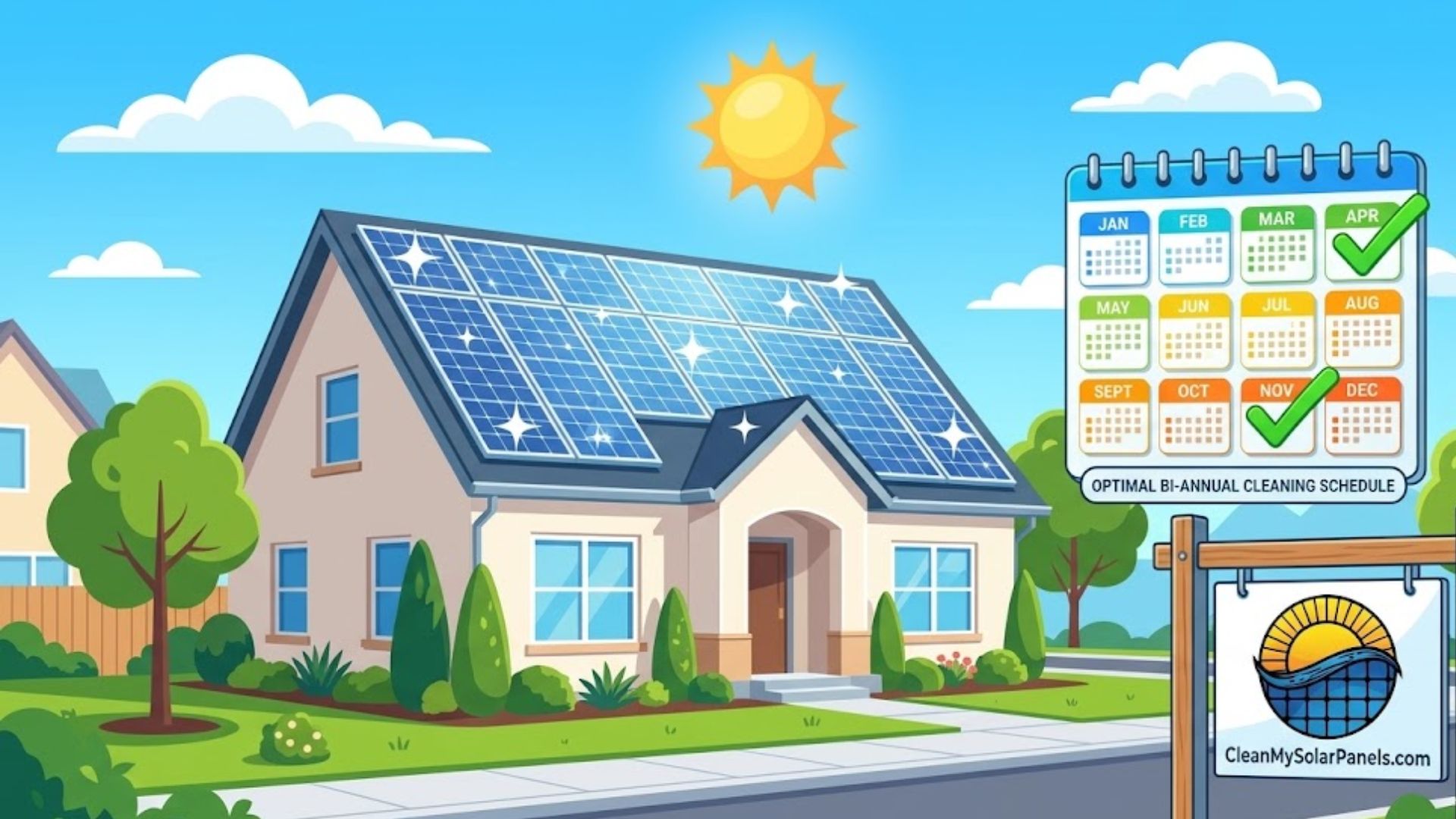
If you only plan to clean them once a year, the absolute best time to schedule a cleaning is late spring (April or May). Why spring? By May, the massive blooms of yellow and green pollen have usually subsided. If you clean your panels right after pollen season ends, you are washing away the stickiest, most stubborn grime of the year just before the long, highly productive days of summer arrive. This ensures your panels are crystal clear and operating at 100% maximum capacity when the sun is at its strongest, giving you the absolute best return on your investment.
If you opt for a bi-annual schedule, a secondary cleaning in late autumn (October or November) clears away fallen leaves, pine needles, and harvest-season dust before the weaker sunlight of winter sets in.
4 Environmental Factors That Change Your Schedule
The “once-a-year” rule is a great baseline, but solar panels are highly localized. What works for a home in the rainy Pacific Northwest will not work for a home in the dusty deserts of Arizona.
How often you should clean your solar panels heavily depends on your region. Here are the four biggest environmental factors that require you to clean your panels more frequently:
1. Dry, Dusty Climates (2 to 3 Times a Year)
If you live in a desert region (like Nevada or Arizona) or an area prone to high winds and prolonged droughts (like Southern California), dust is your biggest enemy. Without regular rainfall to provide a preliminary rinse, fine dust settles evenly across your panels and bakes into a thick, light-blocking film. Homes in these regions often require cleanings every three to four months during the dry season.
2. Heavy Tree Canopy (2 to 3 Times a Year)
Trees are beautiful, but they are a nightmare for solar panels. If your roof is shaded by large oaks, pines, or Douglas Firs, you are battling two massive threats: sticky tree sap and heavy bird activity. Sap acts like superglue, trapping leaves and dirt against the glass. Meanwhile, birds nesting in the trees will drop highly acidic guano on your array. To prevent the glass from being permanently etched, read our guide on how to clean tree sap off solar panels and increase your cleaning frequency.
3. Agricultural Zones (2 Times a Year)
If your home is located near active farming communities, the air quality changes dramatically during the spring planting season and the autumn harvest. Massive tractors kick up heavy soil, pesticide dust, and plant particulate that coats your roof in a thick brown haze. You will need a thorough cleaning immediately after the local harvest wraps up.
4. Coastal Living (2 to 4 Times a Year)
Living near the ocean is a dream, but it is incredibly harsh on exposed technology. Coastal homes are constantly bombarded by sea salt spray. Salt is highly corrosive and will slowly eat away at the aluminum framing and exposed wiring of your array. Additionally, coastal areas have massive populations of seagulls, whose droppings are highly acidic. Frequent, specialized cleaning is essential to prevent permanent hardware corrosion.
The “Tilt Angle” Factor: Does Roof Pitch Matter?
While climate dictates what falls on your roof, the angle of your panels dictates how long it stays there. The pitch of your roof plays a massive role in your ideal cleaning frequency, as studies consistently show that steeper tilt angles naturally shed dust and debris much faster.
- Flat Roofs & Carports (0° to 10° Pitch): If your panels are mounted perfectly flat, they are highly prone to “pooling.” When it rains or dew settles, the dirty water has nowhere to run off. It sits in the center of the glass and evaporates, leaving behind thick, muddy rings of dirt. Flat-mounted panels almost always require cleaning 3 to 4 times a year to prevent this severe, localized shading.
- Standard Pitched Roofs (15° to 30° Pitch): This is the sweet spot. A standard angle allows heavy rains to easily wash away light, loose debris (like dry leaves and large dust particles) down into the gutters. You can stick to the standard 1 to 2 times a year schedule.
- Extremely Steep Roofs (35°+ Pitch): Panels on incredibly steep roofs naturally shed debris much faster. However, because steep roofs are incredibly dangerous to navigate, you should strictly rely on a professional using specialized extension poles from the ground rather than ever attempting this maintenance yourself.
Quick Reference: Cleaning Frequency by Environment
| Your Local Environment / Setup | Recommended Cleaning Frequency | Primary Solar Threats |
| Standard Pitched Roof (Suburbia) | 1 to 2 times a year | General dust, seasonal pollen, smog |
| Flat Roofs & Carports | 3 to 4 times a year | Pooling water, thick muddy residue |
| High Desert / Arid | 2 to 3 times a year | Heavy baked-on dust, volcanic ash |
| Wooded / Forested | 2 to 3 times a year | Sticky tree sap, pine needles, bird droppings |
| Coastal / Beachfront | 2 to 4 times a year | Corrosive sea salt spray, acidic seagull guano |
| Agricultural Zones | 2 times a year (Post-harvest) | Heavy soil dust, tractor exhaust, chaff |
How to Tell When It’s Time to Clean
You shouldn’t wait for your calendar to remind you to clean your panels. Your system will usually tell you when it is suffocating. You don’t need to climb a dangerous ladder to find out; you just need to know what to look for.
1. Check Your Monitoring App (The Data Method) Most modern solar systems come with a smartphone app (like Enphase, SolarEdge, or Tesla) that tracks your daily energy production. Get in the habit of checking this app once a month. If you notice a steady, unexplained drop in power output during exceptionally sunny days, dirt is highly likely to be the culprit.
2. The Ground Visual Test Step back and look at your roof from the yard or the street. Healthy, highly efficient solar panels should look dark, sleek, and highly reflective. If the glass looks dull, cloudy, or has visible brown streaks or white bird droppings, your panels are struggling to absorb light.
If you are noticing a drop in power but are hesitant to act, we highly recommend reading our guide explaining exactly how bad it is if you don’t clean your solar panels.
When to Break the Schedule: Emergency Cleanings
Sometimes, environmental events require you to completely ignore your bi-annual schedule and book a professional immediately. Do not wait for spring if you experience any of the following:
- Nearby Wildfires: If you live in a state prone to wildfires, you must schedule a professional cleaning as soon as the air clears. Wildfire ash blocks an immense amount of sunlight and becomes highly acidic and corrosive when mixed with morning dew.
- Heavy Construction Next Door: If a new housing development or a major home renovation is happening next door, the air is filled with drywall dust, sawdust, and plaster. This industrial dust aggressively coats panels and needs to be removed quickly.
- A Sudden Pest Infestation: If you notice a flock of pigeons has suddenly taken up residence under your array, do not wait. The acidic droppings will destroy your glass in a matter of weeks. You will need a deep clean and the installation of protective bird mesh immediately.
Manufacturer Warranty Requirements: Read the Fine Print
If the threat of lost energy doesn’t convince you, your manufacturer’s warranty should. Top-tier solar brands like SunPower, Tesla, REC, and Qcells offer incredible 20-to-25-year performance warranties. However, these warranties come with strict “proper maintenance” clauses.
If a panel fails because it overheated due to a severe “hotspot”—a condition documented by the U.S. Department of Energy caused by leaving thick bird droppings or tree sap on the glass for months on end—the manufacturer can point to a lack of maintenance and legally deny your warranty claim.
Furthermore, all major manufacturers explicitly state that using abrasive brushes, pressure washers, or harsh chemicals instantly voids your warranty. Regular, documented cleanings by a certified professional using approved deionized (DI) water systems is the absolute best way to ensure your massive warranty remains bulletproof.
The Danger of Doing It Yourself
Once homeowners realize they need to clean their panels, many try to save a few dollars by doing the job themselves. They drag a garden hose onto the roof and grab a bucket of dish soap. This is a massive, incredibly expensive mistake.
- Hard Water Damage: Standard tap water contains dissolved minerals like calcium and magnesium. If you spray tap water onto hot solar panels, the water evaporates instantly, leaving chalky white mineral stains baked onto the glass. This creates the exact shading problem you are trying to fix!
- Scratched Glass: If you scrub panels with standard household sponges or abrasive garage brooms, you will permanently scratch the sensitive anti-reflective coating.
- Physical Safety: Climbing onto a slanted, potentially slippery roof while wrangling a wet hose is a recipe for disaster. Slips and ladder falls result in thousands of severe injuries every year.
The True ROI of Professional Cleaning
To clean panels safely, professionals use specialized Deionized (DI) Water Systems and Water-Fed Carbon Fiber Poles. The DI filter strips 100% of the minerals out of the water, allowing them to gently scrub the panels and leave them drying perfectly spotless and streak-free.
When you look at the cost to hire a local professional, it is vital to view it as an investment with a direct return.
Put real numbers on it. If your system normally saves you $2,000 a year, the National Renewable Energy Laboratory’s typical soiling loss of about 5% is costing you around $100 a year. At the dusty end of NREL’s range, 7%, it is $140. In a pollen-heavy region during peak season, where losses reach 15%, it is $300 while that lasts. Those are the honest figures — and they are smaller than the ones most cleaning companies quote. If a local professional charges you $150 to $200 to properly clean the panels, you are instantly recovering your lost power and pocketing a net gain of $200!
By ignoring the grime on your roof, you are quite literally throwing away the free energy you already paid to generate. To dive deeper into how “soiling losses” impact your wallet, check out our data-driven analysis on the true cost of a dirty solar panel.
Frequently Asked Questions (FAQs)
What happens if I never clean my solar panels? If you never clean your panels, the layer of dust, sap, and smog will permanently bake onto the glass. You will give up a few percent of your production — NREL measures 2% to 7% depending on climate — but the energy is the least of it. The real exposure is irreversible hot-spot damage where sap or droppings shade individual cells, and a manufacturer warranty that assumes reasonable maintenance.
Should I clean my panels after it snows? You should never use a snow shovel or ice scraper on your panels, as this will shatter the glass. You can use a soft-foam roof rake to gently pull heavy snow off so the panels can begin generating power again, but a true “washing” should wait until the spring thaw.
Do I need to turn my solar system off before cleaning? Most professionals highly recommend shutting off the system via the AC disconnect switch before cleaning. This ensures total electrical safety and prevents the panels from experiencing rapid temperature changes when cool water hits the hot glass.
Why You Should Rely on CleanMySolarPanels.com
At the end of the day, climbing onto a roof to wrestle with heavy, specialized cleaning equipment is incredibly dangerous and time-consuming. You bought solar panels to make your life easier and save money, not to add a hazardous chore to your to-do list.
That is exactly why CleanMySolarPanels.com exists. We are your ultimate, unbiased matchmaker in the solar industry. We make it incredibly easy to find qualified, insured, and highly-rated solar cleaning professionals right in your specific neighborhood.
These local experts already own the expensive deionized water filtration systems and the ultra-soft carbon-fiber brushes required to safely clean premium panels without scratching them or voiding your warranty.
Secure Your Energy Independence
Your solar panels represent a massive, exciting investment in your home’s future. You paid for them to reduce your energy bills and give you independence from the utility grid.
Now that you know how often you should clean your solar panels based on your local environment, don’t let a highly preventable layer of dirt stand between you and maximum efficiency. Regular, professional cleanings protect your manufacturer warranty, prevent dangerous electrical hotspots, and ensure your system is performing at its absolute peak year-round.
Don’t let dirt eat your hard-earned profits. Take the risk and the hassle out of solar maintenance. Find a trusted, highly-rated solar cleaning pro in your area and secure the best price today.