Is It Safe to Walk on Solar Panels to Clean Them? The Ultimate Safety Guide
By Adam, Founder, CleanMySolarPanels · May 8, 2026
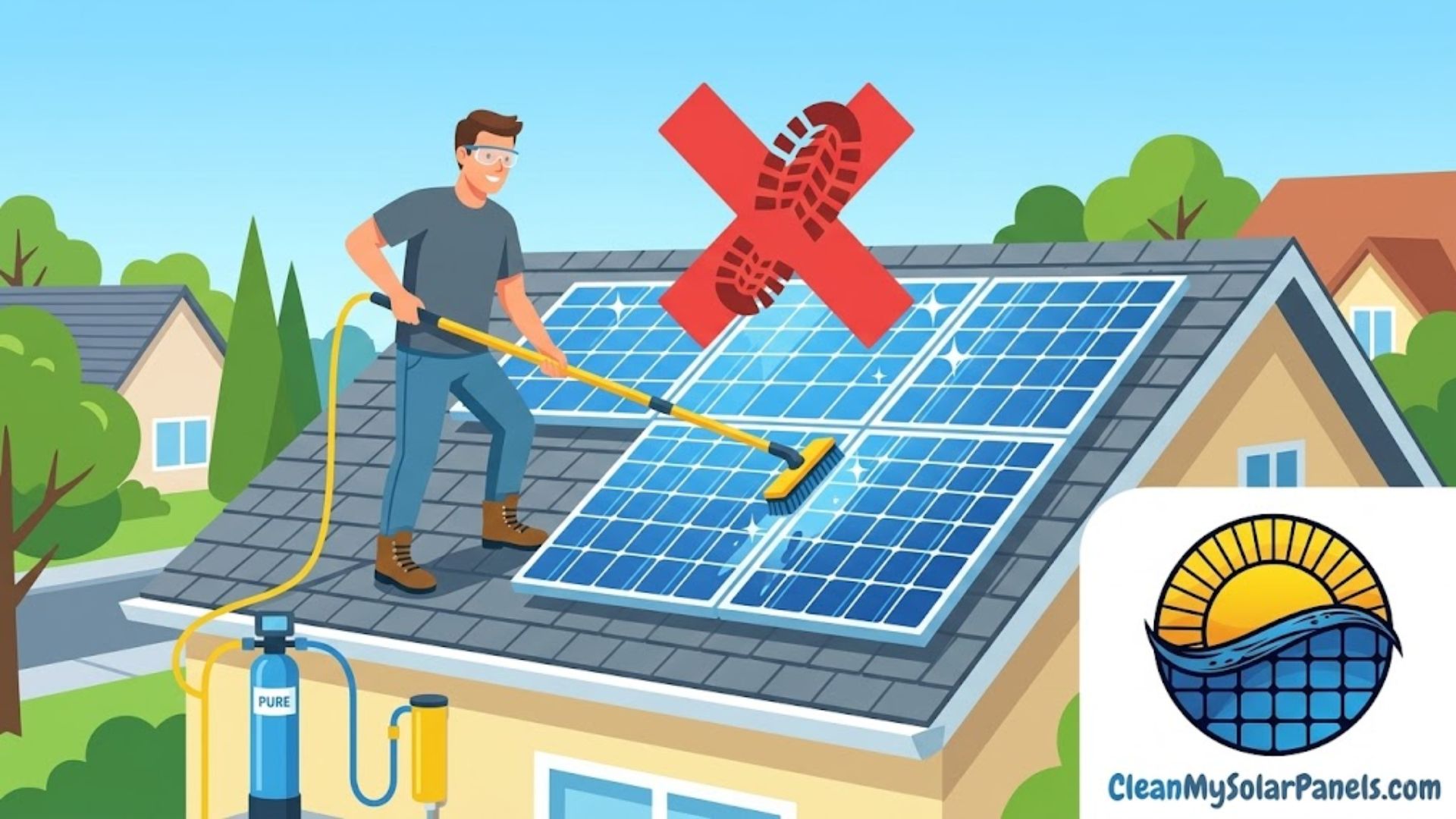
No — you should never walk, step, kneel, or stand on a solar panel. The spec sheet misleads here: a rating of 5,400 Pascals (over 110 pounds per square foot) applies to evenly spread loads like snow. A boot heel concentrates your weight onto a few square inches, flexing the glass and snapping the brittle silicon cells underneath — invisible micro-cracks that quietly drain output and void your 25-year warranty.
There's your neck to think about too: wet solar glass is close to frictionless, which is why OSHA enforces strict fall-protection rules for elevated work.
Below: why the weight rating doesn't cover footsteps, how micro-cracks and hotspots destroy panels, what to check if you've already stepped on one, and how to clean the array with your boots off the glass.
The Weight Limit Myth: Can Solar Panels Hold a Person’s Weight?
To understand why walking on panels is so destructive, we first have to address the most common point of confusion among DIYers: the solar panel weight limit.
If you read the spec sheet that came with your solar panels, you might notice that they are rated to withstand incredible amounts of environmental pressure. Most Tier-1 solar panels are tested to withstand up to 5,400 Pascals (Pa) of downward pressure on the front of the glass. In plain English, that means the panel is engineered to support over 110 pounds per square foot.
Looking at those impressive numbers, a 180-pound homeowner might logically ask, “Can solar panels hold a person’s weight?”
The answer relies entirely on the physics of how that weight is applied. The difference lies between a uniform static load and a dynamic point load.
When a panel is rated for 5,400 Pa, it is rated for heavy snow accumulation. Snow distributes its weight perfectly and evenly across the entire surface area of the glass and the aluminum frame. Every square inch of the panel is carrying an equal, manageable fraction of the total weight.
However, when you step on a panel, you are not distributing your weight evenly. You are applying 180 pounds of dynamic, shifting pressure onto a tiny three-to-four-inch area directly under the heel of your boot. This concentrated “point load” creates a massive, localized stress fracture point that the panel’s internal structure was absolutely never designed to handle.
The Invisible Threat: Micro-Cracks
You might be thinking, “But I stepped on one last year to clean the gutters, and the glass didn’t break!”
This is the most insidious part of walking on solar panels damage. The top layer of a solar panel is made of highly durable, tempered glass. It is entirely possible to step on a panel and not shatter the top glass layer. You will look down, see that the glass is intact, wipe away your footprint, and assume no damage was done.
You are completely wrong. The true, catastrophic damage happens underneath the glass. As extensively documented by the National Renewable Energy Laboratory (NREL), mechanical stress is a leading cause of premature module degradation.
A solar panel is manufactured like a sandwich. Below that protective tempered glass lies the actual photovoltaic cells—the pieces of hardware that absorb sunlight and turn it into electricity. These silicon cells are incredibly brittle. They are roughly the thickness of a piece of cardstock or a potato chip.
When you step on the tempered glass, the glass flexes inward under your concentrated weight. Because the glass flexes, the brittle silicon cells underneath are forced to bend. Silicon does not bend; it snaps.
Stepping on solar panels instantly causes the silicon wafers to snap, creating microscopic fractures known as micro-cracks solar panels cannot ever recover from. These cracks are completely invisible to the naked eye. You won’t know they are there until you check your solar monitoring app a month later and realize your energy production has mysteriously plummeted.
The “Snail Trail” Warning Sign
While micro-cracks start out invisible, they don’t always stay that way. Over several months, moisture and humidity can seep into the microscopic fractures you created with your boot. This causes a chemical reaction with the silver paste used in the panel’s grid lines.
The result is a visible discoloration known in the solar industry as a “snail trail.” These look like dark, jagged, lightning-bolt-shaped lines creeping across the silver grid of the panel. If you see a snail trail that matches the size and shape of a human footprint, the panel is permanently damaged.
The “Hotspot” Domino Effect
Micro-cracks don’t just lower your efficiency; they create a severe electrical fire hazard. When a silicon cell cracks, the electrical current struggles to jump across the microscopic gap. This electrical resistance generates massive amounts of heat.
Over time, this heat creates a “hotspot” inside the panel—very similar to the severe hotspots that develop when you fail to stop pests and birds from ruining your system with opaque, acidic droppings. Hotspots can burn right through the protective polymer backsheet of the panel, permanently scorch the wiring, and completely short-circuit the entire module. A single misplaced footstep can trigger a domino effect that destroys a $400 piece of equipment and puts your roof at risk of an electrical fire.
The Financial Blow: Walking on Solar Panels Warranty
Let’s assume the worst happens. You stepped on a panel, you caused a micro-crack, and six months later, the panel completely fails due to a severe hotspot. You call your installer and ask them to replace it under your 25-year manufacturer warranty.
Will the manufacturer cover it? Absolutely not.
Top-tier solar manufacturers (such as SunPower, Tesla, REC, and Qcells) are very aware of the micro-crack phenomenon. When a failed panel is returned to the manufacturer, they don’t just look at it with the naked eye. They put the panel through an Electroluminescence (EL) Imaging scan. This is essentially an X-ray for solar panels.
An EL scan will instantly reveal the web of micro-cracks spreading outward from the exact shape of a human footprint or a knee.
Every single major solar manufacturer explicitly states in their installation and maintenance manuals that walking on solar panels is a hard “No,” and that doing so constitutes improper maintenance, point-load stress, and abuse. When the EL scan reveals footprint damage, your walking on solar panels warranty claim will be denied immediately. You will be entirely responsible for the out-of-pocket costs to buy a new panel, pay for shipping, and hire a specialized crew to install it.
What If You Already Stepped on a Panel?
If you are reading this guide after you already used your solar array as a stepping stone, do not panic, but do take immediate action to monitor the health of your system.
- Check Your Monitoring App: Open your Enphase, SolarEdge, or Tesla app and look at the panel-level production data. Compare the output of the panel you stepped on to the panels immediately next to it. If it is producing 10% to 20% less power on a sunny day, the micro-cracks have already impacted the electrical flow.
- Conduct a Visual Inspection: Look for the “snail trails” mentioned above. Also, look closely at the glass itself—if the tempered glass has a spiderweb-like shatter pattern, the panel is compromised and must be replaced before water seeps into the electrical housing.
- Call a Professional for a Thermal Scan: Many high-end solar maintenance professionals use thermal imaging drones or handheld thermal cameras. A thermal camera will instantly highlight a “hotspot” glowing bright red or white. If a hotspot is detected, the panel is a fire risk. Ultimately, paying the standard solar panel cleaning cost to have an expert safely maintain the array going forward is infinitely cheaper than replacing an entire string of ruined panels.
The Slippery Slope: The Extreme Physical Danger
Beyond the financial destruction of your equipment, we have to talk about your personal safety.
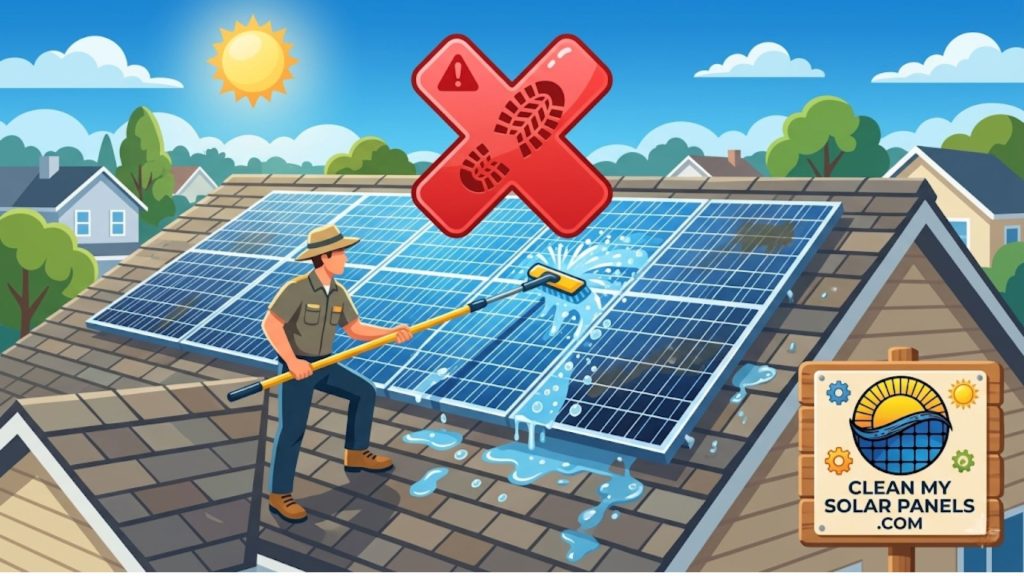
If you are asking, “Can you stand on solar panels to clean them?” you are severely underestimating the physical realities of wet solar glass. Solar panels are coated with an ultra-smooth anti-reflective layer. When this glass is dry, it is slick. When this glass is wet—and especially if it is coated in soapy water or a specialized cleaning solution—it becomes a literal frictionless surface.
Stepping on a wet solar panel is the exact equivalent of stepping onto a block of wet ice that is tilted at a 30-degree angle, two stories in the air.
A standard asphalt shingle roof is dangerous enough to navigate when wet. If you step onto a wet solar panel to regain your balance, your feet will fly out from under you instantly. Slips and falls from roofs result in thousands of severe, life-altering injuries every single year. This is why federal safety organizations like OSHA (Occupational Safety and Health Administration) place such extreme emphasis on strict fall-protection protocols for elevated work. No amount of saved maintenance money is worth risking a devastating fall.
How to Do It Right: Cleaning Solar Panels Safely
If you cannot step on the array, how are you supposed to reach the top row? Cleaning solar panels safely requires the right technique, the right positioning, and, more importantly, the right equipment.
If you are a dedicated DIYer determined to clean the array yourself, you must follow these golden rules:
1. Keep Your Feet on the Roof Shingles
You must map out your cleaning route so that your feet never leave the standard roofing material. You should always walk in the designated pathways around the array, never over it. Caution: If you have a delicate clay tile roof, walking on the tiles can crack them just as easily as walking on a panel. In this case, stay off the roof entirely.
2. Invest in a Water-Fed Extension Pole
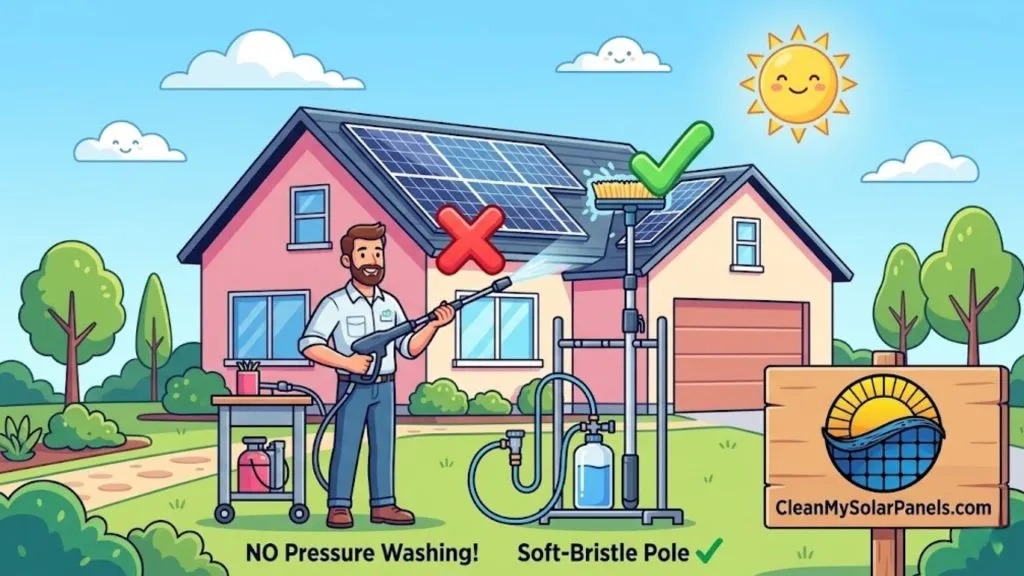
You cannot clean a large array with a short-handled brush. You must purchase a lightweight, carbon-fiber or aluminum water-fed extension pole tipped with one of the best soft brushes for solar panel cleaning available. A quality 20-foot to 30-foot pole allows you to stand safely at the bottom edge of the array (or even safely on the ground) and reach the highest, furthest panels without ever needing to lean your body weight over the glass.
3. Use Deionized (DI) Water
As we cover extensively in our DIY guides, you cannot use standard tap water from a garden hose. Tap water leaves hard, chalky mineral stains baked onto the glass. You must use a Deionized water filtration system to ensure the panels dry spotless and streak-free without the need for a squeegee.
4. Ditch the Power Tools
And remember, while you might be tempted to blast the dirt from afar instead of scrubbing, can you pressure wash solar panels? Absolutely not. High pressure will instantly blow out the weather seals and destroy your panels.
Safe Cleaning Methods Comparison Table
To help you decide the best course of action, here is a breakdown of the risks associated with different cleaning methods:
| Cleaning Method | Personal Safety Risk | Risk to Panel / Roof | Warranty Status | Cost / Effort |
| Walking on Panels | EXTREME (Slipping, Falls) | EXTREME (Micro-cracks, Hotspots) | Instantly Voided | Free, but financially ruinous long-term |
| Standing on Roof + Short Brush | High (Slips on wet shingles) | Medium (Accidental leaning on panels) | Intact | Low cost, high physical effort |
| Ground-Based Extension Pole | Low (Feet stay on the ground) | Low (Must avoid hitting panels too hard) | Intact | High upfront cost for carbon-fiber poles |
| Hiring a Local Professional | Zero (Pros are insured/trained) | Zero (Pros use DI water & soft brushes) | 100% Protected | Affordable flat-fee; zero physical effort |
Frequently Asked Questions
Can you walk on solar panels if you put a piece of plywood over them?
No. While plywood might distribute your weight slightly better than a boot, you are still applying dynamic pressure and rough friction directly against the sensitive anti-reflective coating of the glass. The risk of micro-cracks and severe scratching remains incredibly high.
Can solar panels hold a person’s weight if they are installed completely flat?
Even if the panels are mounted flat on a commercial roof or a carport, the physics of the fragile silicon cells do not change. The tempered glass might hold you, but the cells underneath will still flex and snap. Never walk on a panel, regardless of the tilt angle.
Should I turn my system off first before cleaning?
Yes. To guarantee electrical safety and avoid the hidden dangers of thermal shock, you should thoroughly understand how and why you need to turn off solar panels to clean them before applying any water.
Can I kneel on a solar panel to reach the one above it?
Absolutely not. Kneeling actually concentrates your body weight into an even smaller point-load than standing does. Kneeling on a panel applies intense, highly localized pressure that guarantees the silicon cells beneath your knee will shatter.
Can I use a drone or robot to clean my panels?
While solar cleaning robots do exist, they are currently incredibly expensive and primarily used for massive, multi-megawatt commercial solar farms. For residential homeowners, hiring a human professional with a water-fed pole remains the safest and most cost-effective option.
Protect Your Warranty and Your Neck
Your solar panels represent a massive, exciting investment in your home’s future. They are highly complex miniature power plants designed to save you money for decades. They are not stepping stones, they are not scaffolding, and they are certainly not walkways.
- Do not test the weight limit of your expensive glass.
- Do not risk snapping the fragile silicon cells and creating dangerous electrical hotspots.
- Do not risk voiding your 25-year manufacturer warranty for a shortcut.
Keep your feet on the roof and your hands on a long-reach pole—or hire a pro.
If managing 30-foot carbon fiber poles and navigating steep, slippery roof angles sounds like a dangerous hassle, it is time to bring in the experts. At CleanMySolarPanels.com, we make it incredibly easy to find qualified, insured, and highly-rated solar cleaning professionals right in your specific neighborhood. They have the reach, the tools, and the training to get your system sparkling clean while keeping their boots safely off your glass.