Deionized Water for Cleaning Solar Panels: Why Pros Use It
By Adam Walters, Founder, CleanMySolarPanels · November 21, 2026
Deionized water is the best water for cleaning solar panels because it has had its dissolved minerals removed, so it dries on the glass without leaving spots. Panel maker REC names it as the ideal cleaning water, and about four in ten of the cleaning companies profiled on CleanMySolarPanels say they use purified or deionized water. Tap water is usually allowed, but it can leave a mineral film.
What is deionized water?
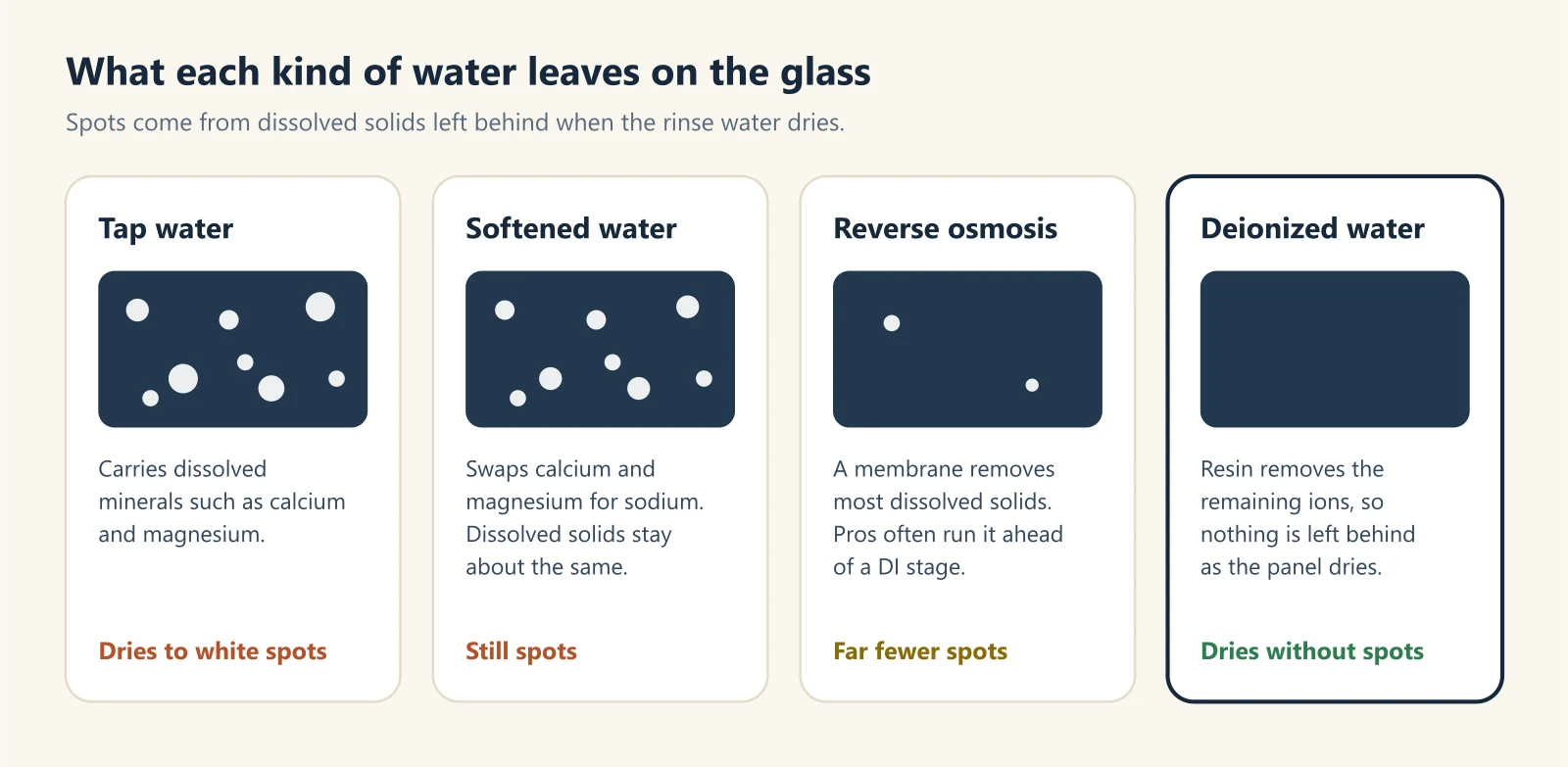
Deionized water, often shortened to DI water, is ordinary water that has been passed through a bed of resin beads that capture its dissolved minerals. Tool maker Unger describes deionization as "the process of removing ions (impurities) from water". What comes out is water with almost nothing dissolved in it.
That matters because of how a water spot forms. When a drop of tap water dries on glass, the water evaporates and whatever was dissolved in it stays behind. On a window that is a cosmetic problem. On a solar panel the residue sits between the sun and the cells, and it gives the next round of dust something to stick to.
The amount of dissolved material in water is measured as total dissolved solids, or TDS, in parts per million (ppm). A small handheld meter reads it in a few seconds.
Why does tap water leave spots on solar panels?
Tap water leaves spots on solar panels because most of it is hard to some degree. The US Geological Survey describes hardness as "the amount of dissolved calcium and magnesium in water", and the USGS classes water above 120 milligrams per liter as hard and above 180 as very hard. It also reports that hard water is prevalent in the east-central and western United States, which covers much of the country's rooftop solar.
Heat makes it worse. A panel in full sun dries rinse water in seconds, before it can run off, so the minerals bake onto the glass. That is the white haze people notice a day or two after hosing their panels down.
A water softener does not fix this. A softener swaps calcium and magnesium for sodium, so the water feels softer but still carries dissolved solids and still spots.
What water do solar panel makers ask for?
Solar panel makers ask for clean, mild water, and they treat cleaning method as a warranty matter. Two examples from the makers' own documents, checked in November 2026:
- REC. REC's cleaning guide says: "Ideally, de-ionized water should be used to clean the panel." If none is available, REC allows rainwater, tap water or diluted alcohol. The same guide says pressure washers, steam cleaners and high-pressure hoses "will invalidate the warranty".
- Trina Solar. The Trina Solar Vertex user manual requires water with a pH of 6 to 8 and hardness of no more than 600 milligrams per liter, and recommends soft water. It adds that damage "caused by failure to clean or improper cleaning procedures will void Trina Solar warranty".
Both makers also warn about temperature. REC says to use water "at ambient temperature to avoid thermal shock", and Trina Solar allows the water to be no more than 10°C (18°F) warmer than the panel and no more than 5°C (9°F) colder. Cold hose water on a panel that has sat in afternoon sun is the usual way glass gets cracked, which is one reason cleaners work early in the morning.
Your own panels may differ. Look up the installation or maintenance manual for your panel model before you clean, because that document is what a warranty claim is judged against.
How do professional cleaners use deionized water?
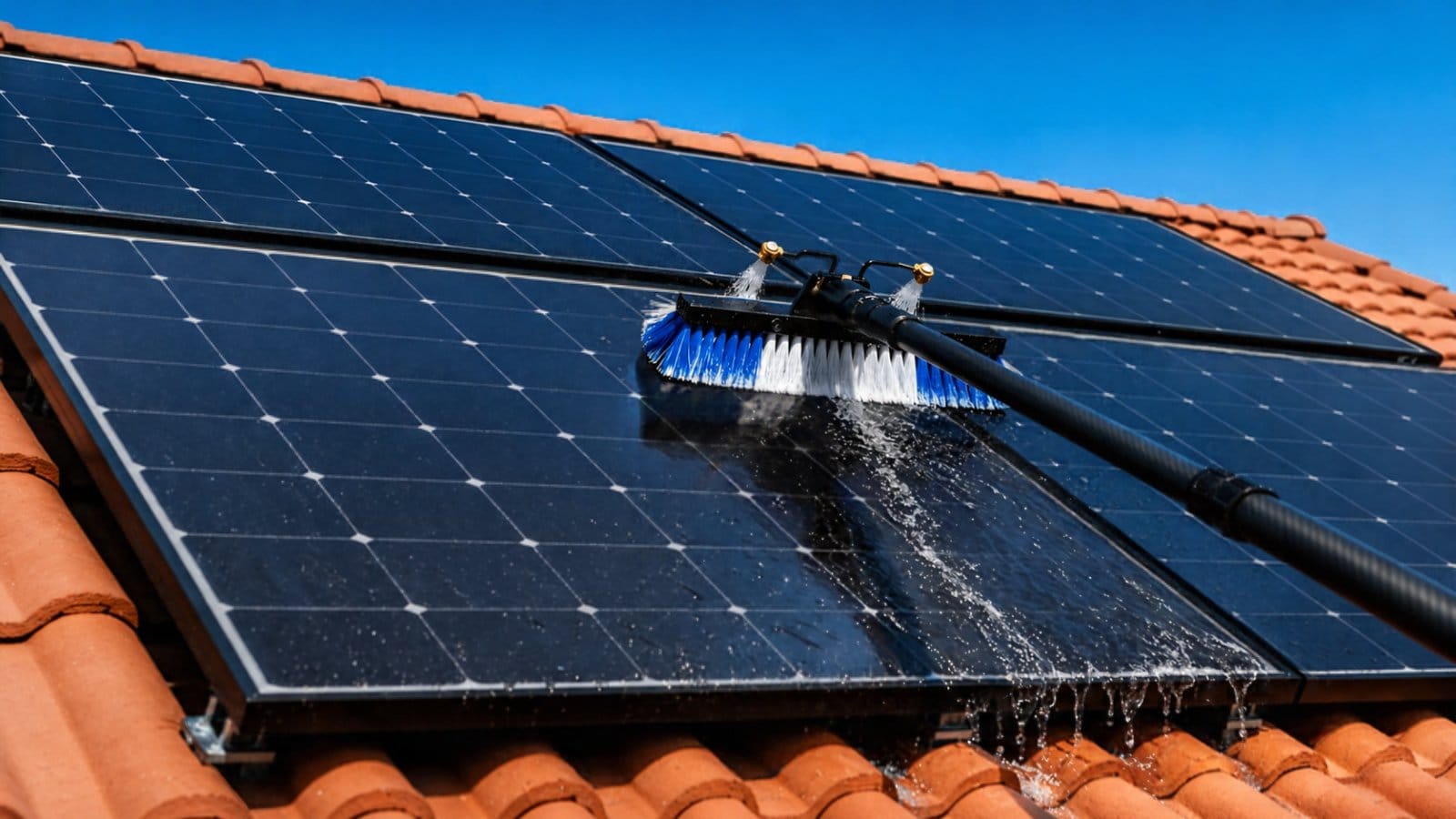
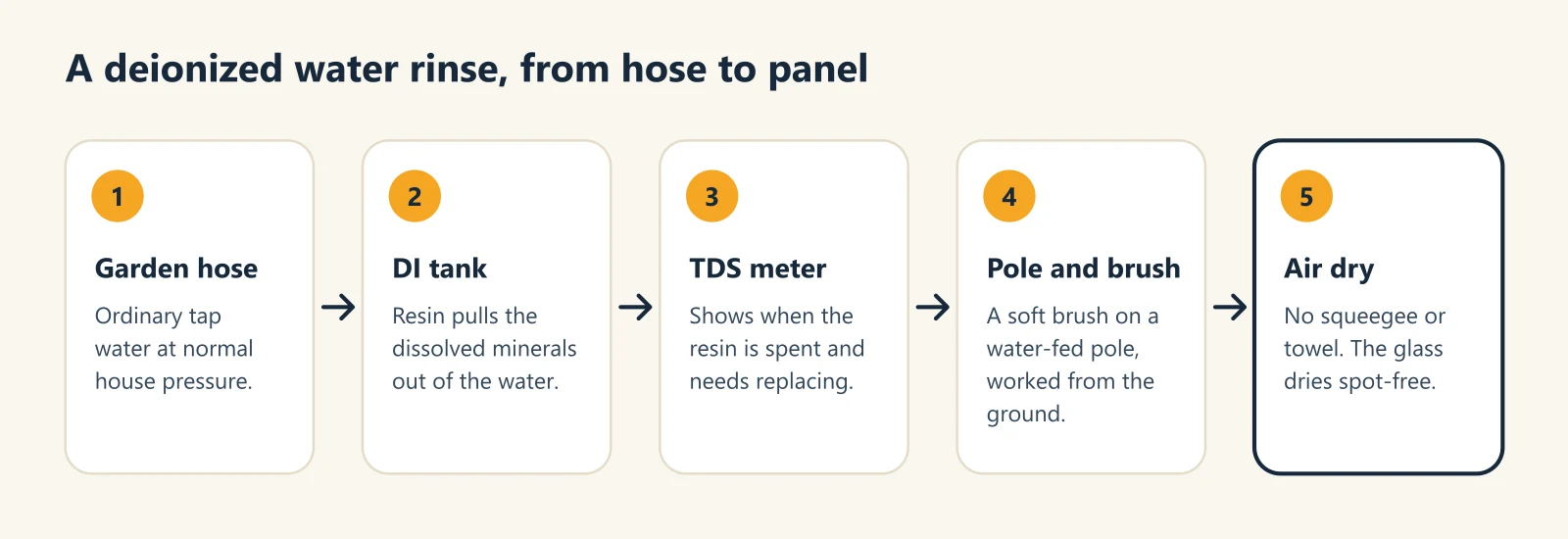
Of the 502 company profiles on CleanMySolarPanels that are written from the companies' own websites, 206 mention deionized, purified or pure water (counted in November 2026). Those solar panel cleaners run tap water through a DI tank, or through a reverse osmosis unit followed by a DI stage, and feed it up a pole to a soft brush. The brush loosens the dirt and the pure water carries it off the panel. Nothing is toweled or squeegeed. The glass is left wet and dries clean.
Three things make this the standard method:
- No residue. With nothing dissolved in the water, there is nothing to leave behind, so no soap is needed for ordinary dust. Our guide to the best solar panel cleaning soap covers the cases where water alone is not enough.
- No one on the roof. A water-fed pole reaches most residential arrays from the ground or a low ladder. Roof work is where the serious injuries happen.
- No pressure. The water arrives at garden-hose pressure, which keeps the job inside what makers such as REC allow.
Cleaners watch a TDS meter as they work. Unger's manual for its HydroPower DI system says water is fully demineralized at 0 ppm and that "the resin should be changed when the TDS meter reads 10 ppm" to keep the result spot-free. The same manual notes that harder water uses the resin up faster, which is why crews in hard-water areas often put reverse osmosis in front of the DI tank.
Do you need deionized water to clean your own panels?
You need deionized water for your own panels only if your tap water is hard enough to spot. Some homes can skip it.
Start by measuring. A handheld TDS meter reads your tap water in seconds. As a rough guide:
| Your tap water | What to expect | Sensible approach |
|---|---|---|
| Low TDS, soft water | Little or no spotting | A soft brush and tap water, in the cool of the morning |
| Moderate TDS | Light film that builds over several washes | Tap water to wash, a deionized final rinse |
| High TDS, hard water | Visible white spots after one rinse | Deionized water for the whole job, or hire a cleaner |
For a final rinse, an inline filter that screws onto a garden hose is the cheapest route, though the small ones treat only a few dozen gallons. A wall-mounted or rolling DI system holds enough resin for several cleanings of a home array. The resin is a running cost: the harder your water, the sooner it needs replacing.
If the array is on a second story, or the roof is steep, the water question is secondary. Our step-by-step guide to cleaning solar panels like a professional covers what can be done safely from the ground.
When hiring a cleaner makes more sense
Hiring a solar panel cleaner makes more sense when your water is hard, your roof is high, or you would use a DI system once a year. A professional setup that combines reverse osmosis and deionization costs far more than a home unit, and a cleaner spreads that cost across hundreds of jobs.
When you compare quotes, ask each company what water it uses and whether it checks TDS on site. A cleaner who rinses with untreated tap water in a hard-water area is leaving minerals on your glass. You can compare local solar panel cleaning companies by state and city, and each profile describes the method the company says it uses.
Frequently asked questions
Is deionized water the same as distilled water?
Deionized water and distilled water are both very pure, but they are made differently. Distilled water is boiled and condensed. Deionized water is passed through resin that removes dissolved mineral ions. Either will dry on a solar panel without spots. Deionized water is what cleaners use because a DI tank produces it on site from a garden hose.
Can I clean solar panels with tap water?
You can clean solar panels with tap water if your panel maker allows it and your water is soft. REC, for example, permits tap water when deionized water is not available. In hard-water areas tap water tends to leave a white mineral film as it dries, so a deionized final rinse is worth adding.
Does softened water work for cleaning solar panels?
Softened water is not a substitute for deionized water on solar panels. A water softener exchanges calcium and magnesium for sodium, so the water still contains dissolved solids and still leaves spots when it dries. Softened water is gentler than hard water, and Trina Solar recommends soft water, but only deionized or distilled water dries clean.
What TDS reading is safe for a spot-free rinse on solar panels?
A TDS reading close to zero gives a spot-free rinse on solar panels. Unger, which makes professional DI systems, defines pure water as 0 ppm and advises changing the resin when the meter reads 10 ppm. If your rinse water reads well above that, expect some spotting as the panels dry.
Will deionized water damage solar panels?
Deionized water will not damage solar panels. REC describes de-ionized water as the ideal water for cleaning its panels. The risks in cleaning come from other things: high pressure, abrasive tools, harsh chemicals, and cold water on hot glass. Always check the cleaning section of your own panel maker's manual first.