3 Best Soft Brushes For Solar Panel Cleaning: A 2026 Buyer’s Guide
By Adam, Founder, CleanMySolarPanels · March 9, 2026
The best brush for solar panel cleaning is a soft flagged-nylon brush on a telescopic water-fed pole — about $200–$350 for a quality setup, or $30–$80 for a manual hose-fed brush. Flagged bristles glide over the anti-reflective coating without scratching it; a stiff broom or deck brush will, and REC and Canadian Solar both put it in writing that improper cleaning voids the warranty.
Count the whole kit before you buy, though: pole, deionized water filter, and roof safety gear total $550–$900+, while hiring a pro typically runs $110–$320 per cleaning.
Below: the three brush styles worth buying in 2026, the bristle spec that matters, and why your water matters as much as your brush.
Disclosure: some links in this article go to Amazon. If you buy through them we may earn a small commission at no extra cost to you. We do not sell cleaning equipment and no manufacturer pays for placement here.
The Science: Why You Can’t Just Use Any Broom
Before we dive into the specific brushes, it is critical to understand why you are shopping for one.
Solar panels are not made of standard window glass. They are coated with a highly sensitive, microscopic anti-reflective layer. This coating is engineered to capture sunlight and prevent it from bouncing off the surface, drawing maximum energy into the photovoltaic cells underneath.
If you use a standard household broom, a rough sponge, or a stiff deck brush, you will instantly create microscopic scratches across this anti-reflective coating.
“Thinking you can use a regular garage broom to sweep off your solar panels is like using sandpaper to wash your car’s windshield. It might remove the surface dust, but it leaves permanent, microscopic scratches that permanently ruin the glass.”
Once the glass is scratched, two terrible things happen:
- Efficiency Plummets: The scratches scatter the incoming sunlight, permanently reducing your system’s power output.
- Warranties Voided: The manufacturers put this in writing. REC’s cleaning guide states that “the use of pressure or steam cleaners and high pressure hoses, knives, blades and metallic sponges is not permitted on REC panels and will invalidate the warranty.” Canadian Solar is equally direct: “Damages induced by inappropriate cleaning procedures will void Canadian Solar Inc. warranty.”
That REC sentence also rules out the shortcut people reach for when scrubbing feels too slow — read why a pressure washer makes panel damage worse, not cleaning faster before you aim a hose at your array.
This is why finding a specialized, ultra-soft bristle brush for cleaning solar panels is so important.
The Top 3 Solar Panel Cleaning Brushes for 2026
If you are building your DIY cleaning toolkit, here are the three best styles of brushes to consider this year, ranging from simple telescopic options to high-tech electric spinners.
1. The Telescopic Water-Fed Pole System (The Gold Standard)
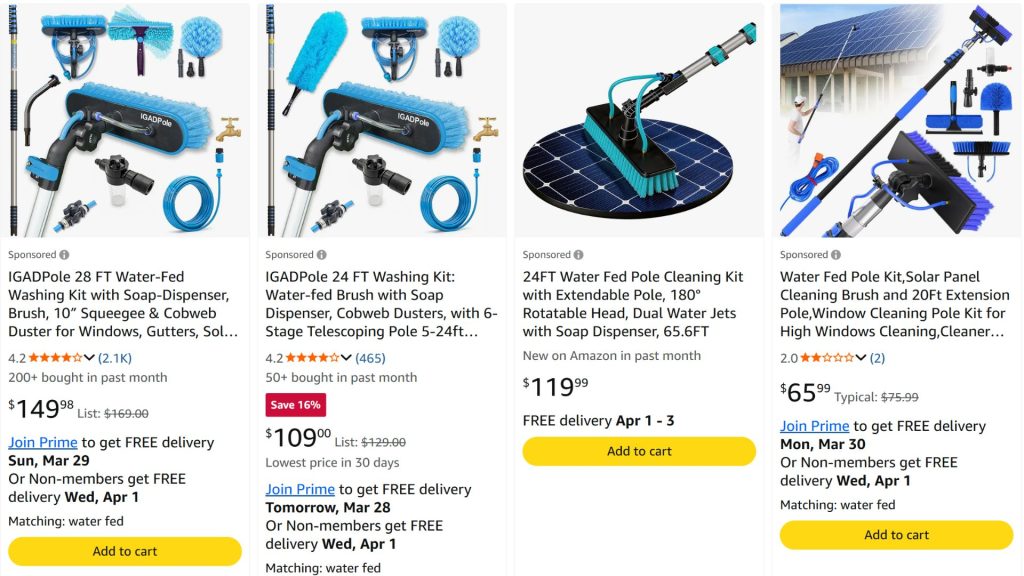
If you want to clean solar panels the way a professional crew does, you need to look at water-fed poles. This is the exact style of equipment used by local experts.
A water-fed solar panel cleaning brush features a hollow, extendable pole (usually made of lightweight aluminum or carbon fiber). A water hose connects directly to the base of the pole, pumping water up through the center and out through specialized jets nestled inside the brush head.
🛒 View Top-Rated Water-Fed Poles on Amazon
Pros:
- Continuous Rinsing: The water washes away the dirt as you scrub, preventing abrasive dirt particles from being dragged across the glass.
- Reach: A good extension brush for cleaning solar panels can reach 20 to 30 feet, allowing you to clean ground-mount systems or first-story roofs safely from the ground.
- Ultra-Soft Bristles: High-quality models use flagged (split-end) nylon bristles that glide over the anti-reflective coating without scratching.
Cons:
- Weight: When a 30-foot pole is filled with water, it becomes incredibly heavy and difficult to maneuver.
- The Tap Water Problem: Unless you hook this pole up to a costly deionized (DI) water filter, you will be spraying hard tap water onto your panels, which leaves damaging mineral stains behind.
2. The Spinning Electric Solar Panel Brush (The High-Tech Option)
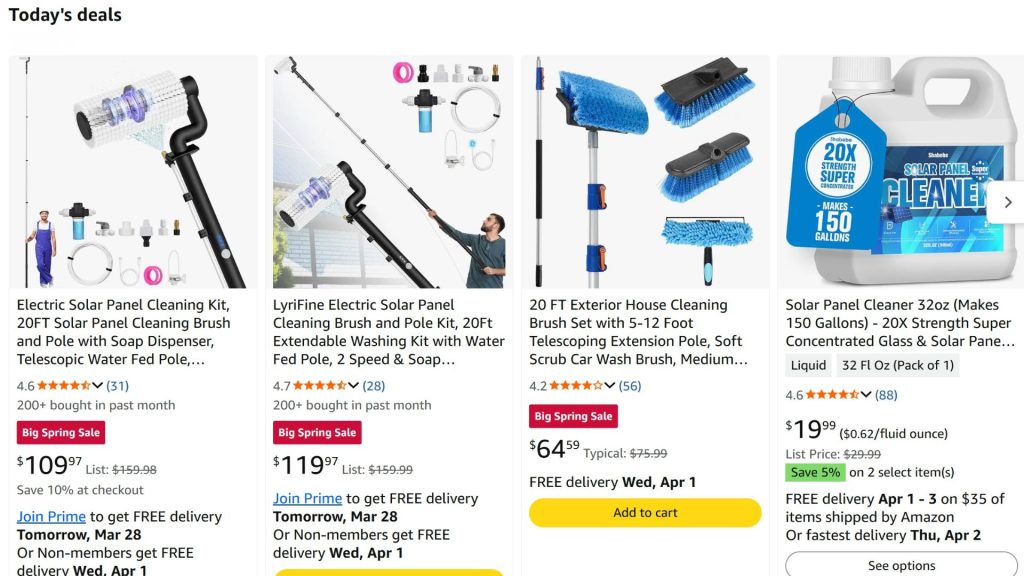
For homeowners with massive rooftop arrays or ground-mounted systems who want to cut their physical labor in half, the electric solar panel cleaning brush is gaining popularity in 2026.
These brushes feature a motorized, dual-spinning head at the end of a telescopic pole. The rotation of the ultra-soft bristles does the scrubbing for you, easily lifting baked-on bird droppings and sticky tree sap without requiring you to apply heavy downward pressure.
🛒 View Electric Spinning Solar Brushes on Amazon
Pros:
- Zero Elbow Grease: The electric motor does the heavy lifting, significantly reducing fatigue.
- Faster Cleaning: The rapid spinning action clears grime much faster than a manual solar panel cleaning broom.
Cons:
- Solar Panel Cleaning Brush Price: These are incredibly expensive, often costing anywhere from $400 to over $1,000 for a quality consumer model.
- Weight and Maintenance: They are heavy, require battery charging, and have moving mechanical parts that can break over time.
3. The Manual Flow-Through Wash Brush (The Budget Option)
If your array is ground-mounted, on a low single-storey roof, or small enough that you are only cleaning a handful of modules, the third option is the one most homeowners actually end up buying: a soft flow-through wash brush that threads onto a garden hose. Water runs down the inside of the handle and out through the bristle bed, so you are rinsing and agitating at the same time instead of scrubbing dry grit across the glass.
The specification matters more than the brand. Look for flagged (split-end) nylon or polyester filaments, a moulded head with no exposed metal ferrule, and a hose thread rather than a friction fit. Avoid anything sold as a “deck brush” or “scrub brush” — those bristles are stiff by design.
Pros:
- Cheapest by a wide margin: commonly sold in the $30 to $80 range, against $400 or more for a motorised head.
- Nothing to charge or service: no battery, no motor, no moving parts to fail.
- Continuous rinse: the flow through the head carries loosened grit away instead of dragging it across the coating.
Cons:
- Tap water spots: without a deionising filter you are rinsing with dissolved minerals, so the panels dry with a mineral haze in hard-water areas.
- Limited reach: most come with a short handle or a light pole, so anything above a single storey still means a ladder — which is the part of this job that actually hurts people.
- All the effort is yours: baked-on droppings and sap need dwell time and repeated passes rather than pressure.
The Elephant in the Room: The Water You Use
You can buy the most expensive, best solar panel cleaning brush and pole on the market, but if you hook it up to your standard garden hose, you are making a massive mistake.
Standard tap water contains dissolved minerals like calcium and magnesium. When you spray tap water onto solar panels sitting in the hot sun, the water evaporates instantly. The minerals do not evaporate; they bake onto the glass as a hard, chalky white residue. This hard water scale blocks sunlight just as badly as the original dirt did!
This is why you cannot just use dishwashing liquid and tap water. Professional cleaners use specialized, thousand-dollar Deionized (DI) water filtration tanks that strip the dissolved minerals out of the water, bringing it down to near-zero total dissolved solids. Water that pure dries without leaving spots, which is why professionals rinse with it and never towel-dry. If you are washing with tap water instead, what you put in it matters more, not less — see the pH-neutral solar cleaning solutions worth buying.
The Hidden Economics: The True Cost of DIY
Before you click “Add to Cart” on a new brush, it is crucial to look at the total financial picture. To clean your panels safely and without voiding your warranty, a brush is only piece of the puzzle. Here is a realistic look at what a proper DIY setup costs versus simply hiring a local professional:
| Expense | DIY Cost | Hiring a Local Pro |
| High-Quality Water-Fed Pole/Brush | $200 – $350 | Included |
| Inline Deionized (DI) Water Filter System | $250 – $400 | Included |
| OSHA-Approved Roof Safety Harness Kit | $100 – $150 | Included |
| Your Personal Labor & Time | 3 to 5 Hours | 0 Hours |
| Total Upfront Cost | $550 to $900+ | $150 to $300 (Flat Fee) |
As you can see, buying the proper equipment costs nearly three times as much as hiring a pro to do it for you. It would take years of cleanings to break even on your DIY equipment—and that doesn’t account for the massive physical risks.
Is DIY Right For You? A Quick Checklist
Still not sure if you should buy a brush or book a pro? If you answer “Yes” to any of the following questions, do not attempt to DIY:
- Is your roof two stories or higher? (The risk of fatal falls increases exponentially).
- Do you have a steeply pitched roof or delicate clay tiles? (Tiles crack easily under foot traffic).
- Are your panels heavily soiled with baked-on sap or bird droppings? (Requires intensive scrubbing and high-grade DI water).
- Does your solar warranty require proof of professional maintenance?
How CleanMySolarPanels.com Makes It Easy
As the industry’s leading directory, CleanMySolarPanels.com believes your weekends are better spent relaxing, not wrestling with a heavy water-fed solar panel cleaning brush on a slanted roof.
We act as your ultimate matchmaker. Instead of buying expensive tools you will only use once a year, our platform makes it incredibly easy to find a qualified, insured, and highly-rated professional right in your specific neighborhood. These local experts already own the premium carbon-fiber poles, the electric spinning brushes, and the heavy-duty DI water filtration systems required to do the job perfectly.
When you use our directory, you can quickly compare quotes from multiple vetted businesses. Because local companies know they are competing for your business on our platform, you secure a highly competitive, fair price for the job.
Protect Your Investment
Your solar panels represent a massive investment in your home’s future. While it is commendable to want to maintain them yourself, using the wrong “cleaning brush solar panel” setup can permanently destroy your anti-reflective coating and void your warranty.
If you are determined to DIY, ensure you invest in a genuine soft-bristle brush and pure deionized water. But if you want to eliminate the risk and the steep equipment costs entirely, leave the heavy gear to the experts.
Don’t risk your warranty, your wallet, or your safety.
Put the brush down and let a trusted, highly-rated solar cleaning pro handle the hard work.