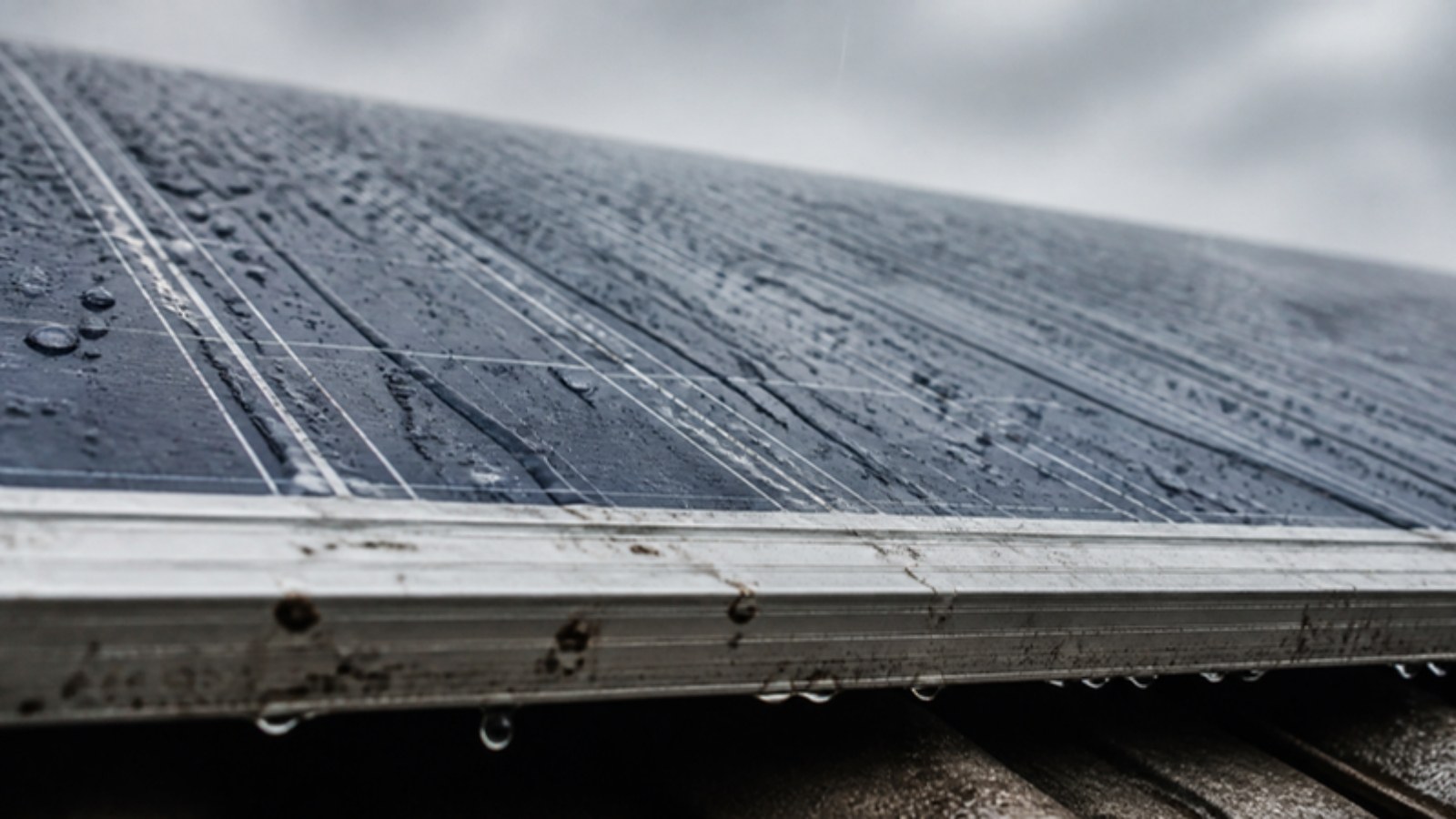
Does Rain Clean Solar Panels? What a Storm Washes Off, and What It Leaves
By Adam, Founder, CleanMySolarPanels · October 29, 2026
Rain rinses loose dust off solar panels. It does not clean them. A good downpour on a well-tilted array can lift a light layer of dry dust, and in a wet climate that is enough to keep losses small between professional cleanings. What rain leaves behind is the problem: pollen film, bird droppings, sap, salt, ash, the mineral spots that form as drops dry, and the strip of mud along the bottom edge of every panel where the water stops.
That is why NREL measures soiling losses of around 5% even in climates that get regular rain, 7% in dusty ones, and 10% to 15% during pollen season. If rain did the job, those numbers would be close to zero.
This guide covers what rain actually does on the glass, the six kinds of dirt it cannot shift, why your city's rain pattern matters more than its rain total, the one case where rain makes panels dirtier, and how to tell whether yours need a proper wash.
What a rainstorm does on a solar panel
Picture a panel on a pitched roof during a heavy shower. Water lands across the glass, gathers into sheets, runs down the tilt and drips off the lower frame. Three things happen on the way.
Loose particles move. Dry dust that is sitting on the surface, not bonded to it, gets carried down and off. On a panel tilted 20 degrees or more, a hard rain will visibly clear fresh dust. This is the part rain does well.
Bonded dirt stays. Anything that has been wetted and dried before, or that is sticky or oily, has already attached to the glass. Rain wets it again and slides over it. Pollen, sap, droppings, ash and the film that road and industrial haze leaves are all in this group.
Dirty water collects at the bottom edge. The frame around a panel stands a few millimetres proud of the glass. Water carrying dirt down the panel slows against that lip, pools, and dries, leaving a dark strip two to five centimetres wide along the lower edge of every panel. On a shallow-tilt or flat array the pooling happens across the whole surface and dries into rings. That strip shades the bottom row of cells, and because cells in a string share current, it drags down the output of the whole panel.
So a rainstorm leaves a panel cleaner in the middle, as dirty as before at the edges, and with every bonded layer still in place.
Six kinds of dirt rain does not remove
1. Pollen
Tree pollen is the single biggest soiling source in the eastern half of the country, and it is the one rain handles worst. Pollen grains are oily and slightly sticky, they arrive in dry weather, and the first light rain or heavy dew after they land glues them to the glass as a yellow-green film. Later storms wet the film and let it dry again. In Atlanta the pine and oak season runs February to May; in Boston, Chicago and New York it is April to June; in Houston and Miami March to May. All of those cities get plenty of spring rain, and all of them still show a pollen layer in June. That is why local pros in the pollen belt recommend a cleaning right after the season ends rather than waiting for the storms to do it.
2. Bird droppings
Droppings are the worst thing that lands on a panel. They are opaque, so the cells beneath them produce nothing, and they are acidic, so left to bake in the sun they can etch the anti-reflective coating. Rain softens the surface of a dropping and leaves the rest. Under a patch of droppings the shaded cells heat up while the rest of the string keeps pushing current through them, which is how hot spots start. Pigeons nesting under an array make it worse every week. If birds are a regular presence, proofing the array is cheaper than the damage.
3. Tree sap and honeydew
Sap from pines and maples, and the honeydew that aphids drop from oaks and elms in early summer, are sugars and resins. Water does not dissolve them; it beads on them. A roof under trees builds a tacky film through the growing season that collects every other kind of dirt on top of it. Our guide to removing tree sap from panels explains why it needs a brush and purified water, not a hose.
4. Salt
Near the coast, sea spray dries on the glass as a white, hazy crust of salt crystals. Rain redissolves some of it, spreads it thinner, and leaves it again as the panel dries, so the haze never quite goes. Salt also works into frames and connectors. Honolulu, Key West, Miami Beach, Virginia Beach and the Bay Area shoreline all need a fresh-water wash at least twice a year, and homes right on the water need more, regardless of how much it rains.
5. Wildfire ash and smoke film
Ash is fine, oily and slightly alkaline, and smoke leaves a film even where no ash falls. The first dew or drizzle after a smoky spell bonds it to the glass, and from then on rain slides over it. Across the West, from Sacramento and Boise to Portland and Seattle, late-summer smoke is now a routine reason for an extra cleaning. Our wildfire ash guide covers the method and the timing.
6. Mineral spots and the mud strip
Rain itself is nearly pure water, but it carries whatever was in the air and on the glass. As each drop dries it leaves a tiny ring of that material, and across a panel those rings add up to a dull film. Sprinkler overspray is far worse: tap water carries dissolved calcium and magnesium that dry into hard white spots. And every storm, however clean, ends with the strip of mud along the bottom edge described above. The strip is the reason a panel can look clean from the yard and still be down several percent.
Rain pattern matters more than rain total
The useful question is not how much rain your city gets, but when it falls relative to when the dirt arrives.
Where the dirt and the rain come at different times, rain helps least. In the desert Southwest it barely rains from May to October, which is exactly when dust is heaviest. Phoenix builds dust from June to September; Las Vegas from May to September; Fresno from June to October. Nothing rinses the glass for months, so local pros recommend two to four cleanings a year. The monsoon makes it worse: the gust front ahead of each storm dumps dust, the rain turns it to mud, and the mud dries in an afternoon.
Where it rains often but lightly, rain glues more than it rinses. Drizzle and fog in the Pacific Northwest and the Bay Area wet the pollen and ash on the glass without ever carrying it off. The Douglas fir pollen that coats Portland roofs in April and May dries into a tan crust under exactly this kind of weather, and in the shade of a big tree the constant damp lets moss and lichen take hold along the panel frame.
Where it rains hard and often in summer, rain helps most. The thunderstorms that roll through Dallas, Oklahoma City, Omaha and the Midwest in June, July and August are the best natural rinse a panel gets. They are heavy enough to move loose dust and frequent enough to keep it from bonding. Local pros in those cities still recommend one or two cleanings a year, for the pollen in spring and the harvest dust in autumn, both of which arrive when the storms do not.
Where the rain comes down through dust, rain makes panels dirtier. Florida, the Gulf coast and central Texas get Saharan dust plumes from June into August. The first storm after a plume brings the dust down with it, and the panels dry with a speckled tan film that was not there before the rain. Locals call it dirty rain. The same happens anywhere after a dust storm or a smoky week.
How much a clean panel really gains
The honest numbers are smaller than most cleaning companies quote and larger than most homeowners expect, which is the short answer to whether solar panels really need cleaning. NREL's soiling measurements put annual losses at about 2% in the wettest climates, 5% as a national average, 7% where it is dusty, and 10% to 15% in pollen-heavy regions during the season. Our own Grime Index, which ranks the cities we cover by dust, pollen, rain and bird pressure, puts the three dustiest at 15% a year and the cleanest at about 5.5%.
On a system saving $2,000 a year, that is $40 in Seattle, $100 in an average suburb, $140 in a dusty one and $300 in Fresno or Phoenix. Against a professional cleaning at $110 to $320, the energy alone pays for the visit in the dusty and pollen-heavy cities. Everywhere else the case rests on what dirt does besides shade: hot spots under droppings, etching from acidic residue, and the maintenance clause in a 25-year warranty. Our data-driven comparison of cleaning against neglect works through the figures.
The single most useful measurement is your own. Note production on a clear day the week before a cleaning and on a clear day the week after. The difference is what rain was failing to recover.
How to tell whether rain has done enough
Look at the bottom edge, not the middle. From the ground, the centre of a panel can look clean after a storm. The dark strip along the lower frame is the giveaway that bonded dirt is still there.
Check the monitoring app after a dry week. Compare a clear day now with a clear day in the same month last year, or with the week after your last cleaning. A steady gap on sunny days is soiling.
Watch for a colour. A yellow cast in spring is pollen. White spots are droppings or mineral deposits. A grey, even dullness is smoke, haze or salt. Rain removes none of them. Our guide to the signs your panels need cleaning has the full eye test.
Count the dry days. If your city's dust season is under way and it has not rained properly in three weeks, assume the panels are carrying a layer. The city pages on this site show the months for each city, and local pros' recommended frequency.
Can you just hose them down?
A garden hose is not rain, and it is usually worse. Tap water carries dissolved minerals that dry into spots and a film, so a quick hose-down on a sunny afternoon can leave a panel dirtier than it found it. If you want to help the rain along on a single-storey roof or a ground mount, do it properly: purified water from a DI filter, a soft brush on a pole, early or late in the day so the glass is cool. Our guide to cleaning panels from the ground covers the method and the gear, and the reasons pressure washers, dish soap and vinegar do more harm than rain ever will. On a two-storey or steep roof, hire it out.
What this means for your schedule
Rain decides how far apart your cleanings can be, not whether you need them.
- Wet summer climates (the Midwest, the Northeast, the South): once or twice a year, timed after pollen season and after leaf drop or harvest. Rain covers the summer.
- Winter-rain climates (California, the Pacific Northwest): once or twice a year, after pollen in late spring and after the dry season or fire season in autumn. Rain covers the winter and little else. Where it snows instead, see clearing snow safely.
- Desert and Central Valley: two to four times a year. Rain covers nothing between May and October.
- Coastal homes: at least twice a year with fresh water, whatever the rainfall, for the salt.
- Flat or low-tilt arrays: three or four times a year anywhere, because rain pools instead of running off.
Our guide to how often to clean solar panels sets this out city by city, with the months local pros plan around.
Frequently asked questions
Does rain clean solar panels?
Partly. Rain rinses loose dry dust off a tilted panel, but it leaves pollen film, bird droppings, sap, salt, ash and mineral spots, and it dries into a strip of mud along the bottom edge of every panel. That is why measured soiling losses stay around 5% even in rainy climates.
Do solar panels need cleaning if it rains a lot?
Yes, less often. In wet-summer climates most local pros recommend one or two cleanings a year, after pollen season and after leaf drop. Rain keeps the gap between cleanings long; it does not close it.
Can rain make solar panels dirtier?
Yes, in two cases. When rain falls through airborne dust, as after a Saharan plume in Florida or a dust storm in Arizona, it brings the dust down and dries as a speckled film. And light drizzle or fog on pollen or ash glues it to the glass instead of washing it off.
Why is the bottom edge of my solar panel dirty after rain?
The frame stands a few millimetres above the glass. Water carrying dirt down the panel slows against it, pools and dries, leaving a dark strip that shades the bottom row of cells. On a flat or low-tilt array the same pooling happens across the whole surface.
Is hosing down solar panels as good as rain?
Usually worse. Tap water carries minerals that dry into spots and film. If you clean panels yourself, use purified water from a DI filter and a soft brush, early or late in the day, and only on a roof you can reach safely.
How much output does a dirty panel lose?
About 5% a year in an average climate by NREL's measurements, 7% in dusty ones and 10% to 15% in pollen season, which is $100 to $300 a year on a system saving $2,000. In the desert cities the loss reaches 15% a year.
Does snow clean solar panels?
No. Snow slides off a pitched array within a day or two of sun and takes some loose dirt with it, but the melt leaves a line of grit along the lower edge. Never scrape or shovel a panel; wash it on a dry day above freezing.
When is the best time to clean solar panels in a rainy climate?
Right after the local pollen season ends, usually late spring, when the long bright days are about to start. In the Pacific Northwest and California, add a second visit after the dry season or fire season in autumn.