How Do I Clean Solar Panels on a Two-Story House Safely?
By Adam, Founder, CleanMySolarPanels · May 22, 2026
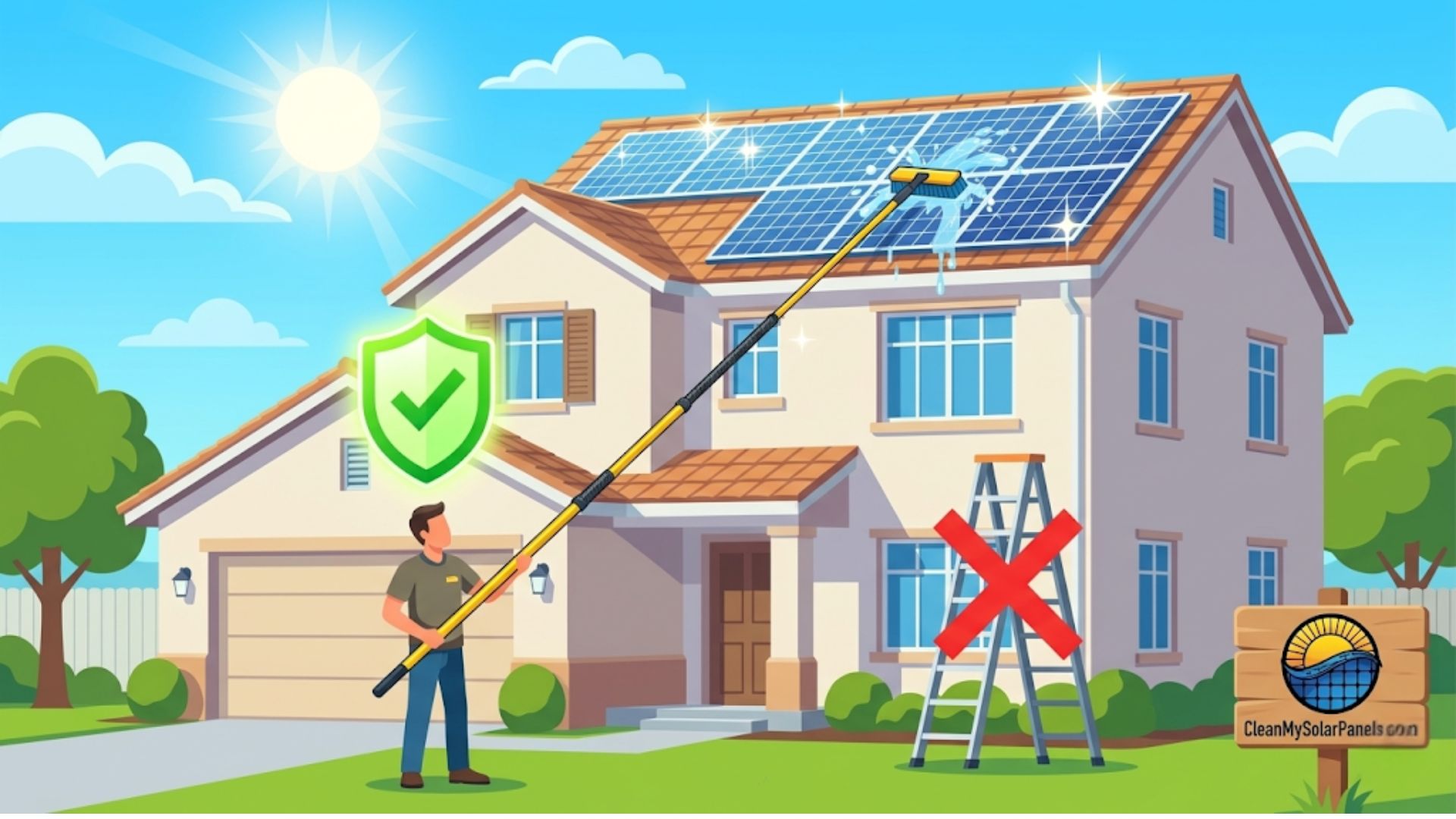
The only safe DIY way to clean solar panels on a two-story house is from the ground, using a telescopic water-fed pole — never from a ladder or the roof. A proper ground kit (carbon-fiber pole, soft solar brush, DI water filter) runs $500–$900, while hiring an insured pro typically costs $150–$300 — which is why most two-story owners skip the gear and book the pro.
The height is the whole problem. Two-story panels sit 20 to 30 feet up, wet solar glass is as slick as black ice, and the CDC lists falls from ladders and roofs as the leading cause of unintentional injury and death in home maintenance.
Below: why extension ladders fail at this height, the DIY shortcuts that wreck panels, the ground-based equipment that actually works, and the math on DIY versus hiring out.
The Gravity of the Situation: Ladder and Roof Risks
It is incredibly easy to underestimate the danger of a two-story roof until you are actually up there. Solar panel cleaning safety dictates that you must respect the physical realities of the environment you are entering.
According to the Centers for Disease Control and Prevention (CDC), falls from ladders and roofs are the leading cause of unintentional injury and mortality in home maintenance. When you attempt to clean a solar array, you are combining three of the most dangerous elements in home improvement: extreme height, slanted surfaces, and flowing water.
If you climb onto a two-story roof with a bucket of soapy water and a garden hose, you are creating a frictionless surface. Solar glass is coated in a smooth anti-reflective layer. When wet, it is like walking on black ice. Furthermore, once soapy water drips onto your asphalt shingles or clay tiles, your entire roof becomes a water slide.
Crucial Rule: We have stated this in our comprehensive safety guides, but it bears repeating—never, under any circumstances, should you use the panels as a walkway to reach the top of the array. If you want to know the exact physics of why the glass breaks, read our full breakdown: Is it safe to walk on solar panels?
Why Standard Ladders Fail for High Reach Solar Panel Cleaning
Many homeowners think they can bypass the danger of walking on the roof by simply working from the top of an extension ladder. If you are researching how to clean solar panels on a high roof, you must understand the severe limitations of standard household ladders. A 24-foot or 32-foot extension ladder is heavy, unwieldy, and completely unsuited for this specific job.
1. The Angle of Attack
A standard extension ladder leans against the edge of your gutters. From this position, you are staring at the bottom edge of the solar panels. To reach the top row of the array, you have to push a wet, heavy brush up a 30-degree incline. You will have zero leverage, and the dirty water will run directly down the pole into your face and arms.
2. The Danger of Overreaching
Because you cannot walk on the panels, you will be tempted to lean your body weight far to the left or right to reach the outer edges of the array from your ladder. This shifts your center of gravity outside the stable rails of the ladder, leading to an immediate, catastrophic ladder tip-over from 20 feet up.
“Creative” (and Dangerous) DIY Shortcuts
Because a two-story roof is so intimidating, homeowners often try to find “creative” shortcuts to clean the glass without having to climb up there. Unfortunately, these shortcuts usually result in permanently destroyed panels.
- The 2nd-Story Window Leaf Blower: Some homeowners try to lean out of a second-story bedroom window with a backpack blower, hoping to blast the dust away. Not only is this a severe fall hazard, but air pressure cannot remove sticky pollen or bird droppings. Worse, you risk blowing debris under the panels. (Read more: Can I use a leaf blower to clean solar panels?).
- The Pressure Washer Temptation: Realizing a brush won’t reach, many homeowners standing on a ladder will try to cheat by using a pressure washer to blast the dirt away from a distance. Do not do this. The intense kickback can easily throw you off a ladder. Worse, high-pressure water will instantly destroy the waterproof weather seals on your panels and void your warranty. (Read more: Can you pressure wash solar panels?).
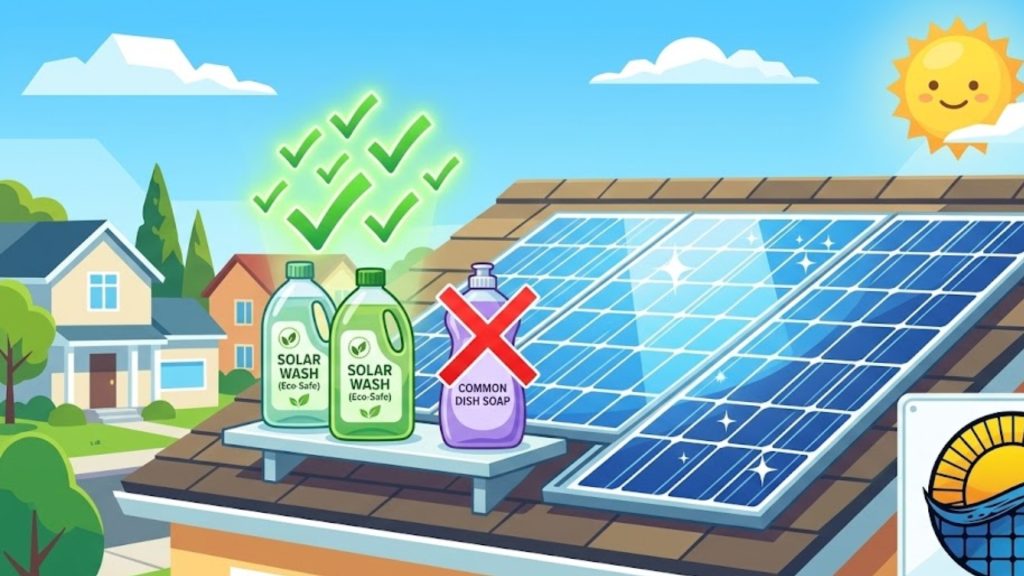
- The Wrong Soap: In an attempt to get the job done quickly, DIYers often use automotive soap in a hose-end foam cannon. This is a massive mistake. Automotive soap contains waxes that leave a sticky film on solar glass, actively attracting more dirt. Always use a dedicated solar wash or pure water. (Read more: Can I use car wash soap on solar panels?).
Electrical Safety at Heights
There is another massive safety component to cleaning high roofs that DIYers often overlook: electricity. Your solar panels are active miniature power plants.
When you are maneuvering a 30-foot wet pole near your roofline, you are introducing water to high-voltage equipment. If a local squirrel has chewed the protective casing of a solar wire, that water can instantly become an electrical conductor. Before you ever attempt to clean your array, you must understand exactly why you need to turn off your solar panels to clean them to guarantee your system is depowered and safe to touch.
The Safe Solution: Cleaning Solar Panels from the Ground
If walking on the roof is a death trap, working from a ladder is wildly impractical, and shortcuts destroy your warranty, what is the correct method?
The only manufacturer-approved, 100% safe method for DIY homeowners is cleaning solar panels from the ground.
To do this, you must abandon the garden hose and invest in professional-grade solar panel cleaning equipment for tall houses. The cornerstone of this equipment is the telescopic water-fed pole.
How Water-Fed Poles Work
A water-fed pole is a hollow, extendable tube that connects directly to a pure water source. The water flows up through the center of the pole and shoots out of specialized jets nestled inside an ultra-soft bristle brush head.
This allows you to stand safely with both feet firmly planted on your front lawn, extend the pole 20 to 30 feet into the air, and gently agitate the dirt on your two-story roof while a continuous stream of pure water rinses the grime away.
Essential Equipment for Two Story House Solar Panel Maintenance
If you are committed to doing the job yourself, building a high-reach cleaning kit requires a significant upfront investment. Here is exactly what you need to safely and effectively clean a high roof from the ground:
1. A Carbon-Fiber Telescopic Pole
You cannot use a cheap aluminum or fiberglass extension pole for a two-story house. When you extend a pole 30 feet into the air and fill it with water, aluminum will bow, bend, and become uncontrollably heavy. You must invest in a high-quality carbon-fiber pole. Carbon fiber is incredibly rigid and lightweight, allowing you to control the brush head precisely from 30 feet below.
2. A Specialized Solar Brush Head
Solar glass scratches incredibly easily. If you use a stiff deck brush or a standard window squeegee at the end of your 30-foot pole, you will permanently damage the anti-reflective coating on the glass. You must use a scratch-free, flagged-bristle brush. (Review our top recommendations in our guide to the best soft brushes for solar panel cleaning).
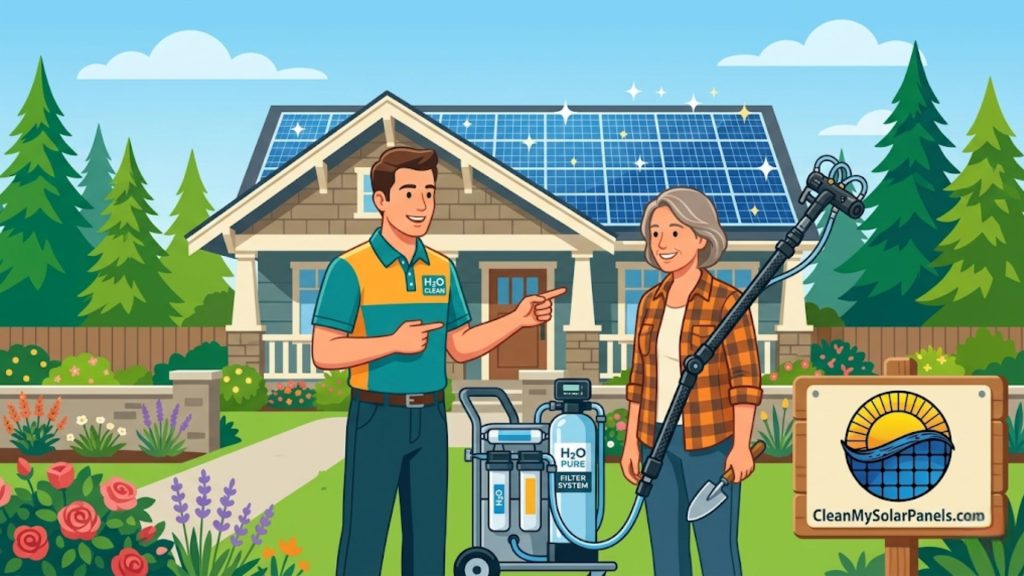
3. An Inline Deionized (DI) Water Filter
This is the most critical piece of equipment. You cannot pump standard tap water from your garden hose up a 30-foot pole. Tap water is full of heavy minerals (like calcium). When you spray tap water onto hot solar panels, the water evaporates instantly, leaving a chalky white mineral scale baked onto the glass. This permanent scale blocks sunlight and ruins your efficiency.
You must purchase a Deionized (DI) water filtration tank to connect to your hose. This strips 100% of the minerals out of the water, allowing the panels to dry completely spotless and streak-free without you ever having to climb up there with a squeegee.
The Hidden Challenges of Cleaning from the Ground
While a carbon-fiber water-fed pole keeps you safely off the roof, it is not a magic wand. Two story house solar panel maintenance performed from the ground still presents several difficult physical hurdles:
- The Blind Spot: When you are standing 25 feet below the panels, you are looking up at a sharp angle. It is incredibly difficult to see the top edge of the panels or to verify if you have successfully scrubbed off a stubborn, baked-on bird dropping.
- Extreme Muscle Fatigue: Even with a lightweight carbon-fiber pole, holding your arms above your head and maneuvering a wet brush 30 feet in the air for an hour requires immense upper body strength and shoulder endurance.
- Power Line Hazards: When manipulating a 30-foot pole in your yard, you must be hyper-aware of your surroundings. If the wet pole accidentally makes contact with the overhead power lines connecting to your house, the results are instantly fatal.
The 2-Story Pest Problem
As a side note, having your solar panels on a second-story roof doesn’t just make them harder to clean; it makes them a premium target for local wildlife.
Pigeons, starlings, and roof rats love high solar panels because they are completely isolated from ground predators like neighborhood cats. Because you cannot easily see under the panels from the ground, pests can build massive, highly combustible nests under your array completely unnoticed. If you start to notice an influx of birds on your high roof, read our guide on how to stop pests from ruining your system before they chew through your high-voltage wiring.
Frequently Asked Questions (FAQs)
How do I know if my 2nd-story panels need cleaning if I can’t get up there to check?
You don’t need a ladder to check your panel health. Instead, rely on the “Eye Test” from your sidewalk (look for a dull, brown, matte finish instead of glossy glass), or check your solar inverter app for unexplained drops in energy production on sunny days. Review all 5 signs your solar panels need cleaning to know exactly when it’s time for a wash.
Is it safe to clean them from an aerial lift or cherry picker?
If you have access to a commercial aerial lift, it is much safer than an extension ladder. However, renting a boom lift for a single afternoon usually costs well over $300, which is significantly more expensive than just hiring a local professional to do the job for you.
Will hiring a professional for a two-story house cost more?
Usually, yes. Professionals base their pricing on risk and time. Because a two-story home requires specialized high-reach carbon fiber poles or specific OSHA-compliant roof safety harnesses, you can expect a slight premium over a single-story job.
High-Reach Cleaning Methods Comparison
To help you make the best decision for your home, here is a quick breakdown of the risks and costs associated with different two-story cleaning methods:
| Cleaning Method | Physical Safety Risk | Warranty Risk | Equipment Cost / Fee | Effort Level |
| Extension Ladder + Brush | EXTREME (Fall Hazard) | High (Scratches/Pressure) | Low ($50 – $100) | Exhausting |
| DIY Water-Fed Pole (Ground) | Low (Power Line Hazard) | Medium (Hard Water Spots) | High ($500 – $900) | High |
| Hiring a Local Professional | Zero (To Homeowner) | Zero (100% Protected) | Affordable ($150 – $300) | Zero |
The ROI of Hiring a Professional
Let’s look at the financial reality of building a safe DIY high-reach cleaning kit. A quality 30-foot carbon-fiber pole, a specialized soft-bristle brush, and a consumer-grade DI water filtration tank will easily cost you between $500 and $900.
Conversely, hiring a verified, fully insured local professional typically costs a flat fee of $150 to $300 (depending on your exact roof pitch and location). For a deeper dive into these numbers, review our comprehensive solar panel cleaning cost guide.
Professional solar cleaners already own the massive, truck-mounted DI water systems and the $1,000+ commercial carbon-fiber poles required to do the job effortlessly. They are trained in OSHA-compliant roof safety, meaning if they do need to access the roof to remove stubborn tree sap or install critter guards, they use professional safety harnesses and roof anchors.
When you factor in the high upfront cost of proper equipment, the exhausting physical labor, and the lingering danger of overhead power lines, hiring a local expert is almost always the most cost-effective and stress-free solution for a two-story home.
Keep Your Feet on the Ground
Your rooftop solar array is a complex, highly engineered miniature power plant designed to save you thousands of dollars over the next two decades. Treat it with the respect it deserves, and treat your own physical safety with even more respect.
- Do not climb onto a wet, slanted two-story roof.
- Do not try to scrub panels from the unstable top rung of an extension ladder.
- Do not use a pressure washer to cheat the distance.
If you are determined to clean the panels yourself, you must invest in a high-quality DI water filter and a carbon-fiber telescopic pole to do the job safely from the grass.
However, if buying specialized water filtration tanks and wrestling with 30-foot poles sounds like a dangerous, exhausting hassle, it is time to bring in the experts.
Safety first—hire a professional with the right equipment for high-reach cleaning.
At CleanMySolarPanels.com, we make it incredibly easy to find qualified, insured, and highly-rated solar cleaning professionals right in your specific neighborhood. Let the pros handle the heights, the chemistry, and the heavy lifting so you can enjoy maximum energy production year-round.