How Do I Manage Algae Growth on Solar Panels in the PNW?
By Adam, Founder, CleanMySolarPanels · May 29, 2026
Managing algae on PNW solar panels comes down to three things: trim back overhanging trees, book a professional cleaning twice a year (late spring and late autumn), and stay off the roof yourself. Wet algae is as slick as black ice, and OSHA lists slips and ladder falls among the most common causes of serious home-maintenance injuries. Bleach and pressure washers are off the table too — both destroy the panel's anti-reflective coating or seals and void the warranty.
The good news: a professional cleaning is an affordable flat fee — typically $110–$320 — and pros use deionized water and soft brushes that clear the slime without touching your warranty.
Below: how to tell algae from moss and lichen, why Western Oregon breeds all three, what the growth costs you in output and roof damage, and how the pros remove it safely.
Algae vs Moss Solar Panels: What is Growing on Your Roof?
Before you can formulate a plan to clean your solar array, you need to identify exactly what is growing on it. While they are often lumped together by frustrated homeowners as just “green stuff,” algae, moss, and lichen are biologically distinct organisms that require completely different removal strategies.
Understanding the ongoing battle of algae vs moss solar panels is the first, most crucial step in proper Oregon solar maintenance.
Green Algae (The “Slime”)
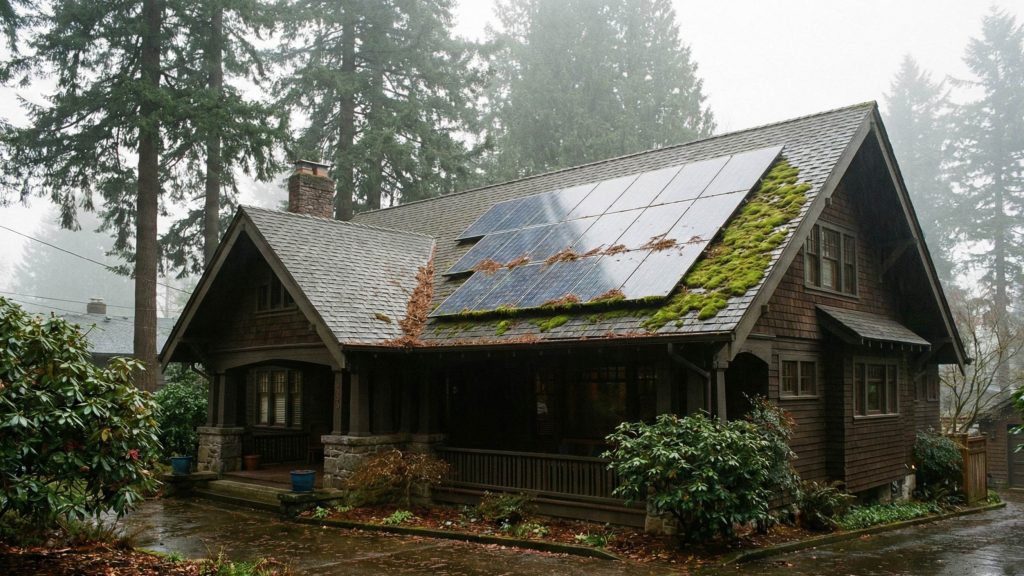
Algae is a simple, non-vascular plant that thrives in constant moisture. On a solar panel, algae typically presents itself as a thin, slick, green or brownish-black film across the flat surface of the glass. It does not have roots, stems, or leaves. It spreads rapidly across your roof via airborne spores, completely covering the anti-reflective coating of your panels in a hazy, light-blocking slime. While it lacks deep roots, its incredibly slippery, gelatinous nature makes it one of the most dangerous, life-threatening hazards for anyone attempting to walk on a roof.
Moss (The “Sponges”)
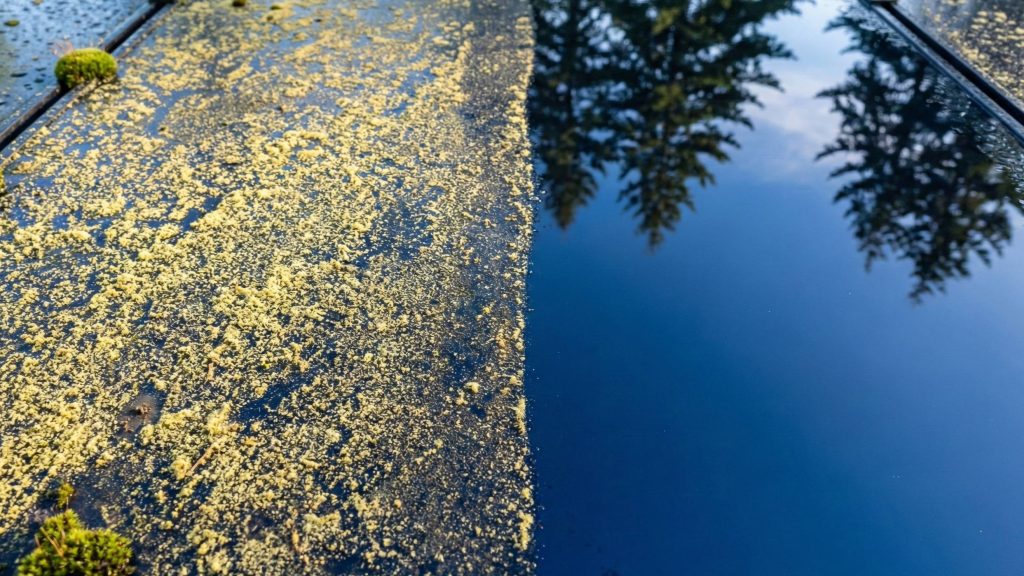
Unlike algae, moss is a dense, clumping plant that absorbs and holds massive amounts of water. Moss rarely grows directly on the smooth, hot center of the solar glass because it cannot easily grip the anti-reflective coating. Instead, it thrives in the shaded gaps between your solar panels, along the lower aluminum frames, and directly on your asphalt shingles beneath the array. Moss acts like a literal sponge, holding dampness against your roof and panel framing, which can eventually degrade your weather seals and lead to devastating water ingress and roof rot.
Lichen (The “Crust”)
Lichen is a unique, symbiotic combination of algae and fungus. It appears as crusty, pale green, yellow, or gray patches that firmly attach themselves to the glass and aluminum frames. Lichen is incredibly destructive. It actually produces mild organic acids that can permanently etch into the anti-reflective coating of your solar panels if not safely neutralized and removed by a professional.
Quick Reference: Biological Growth Comparison
| Type of Growth | Where it Grows | Visual Appearance | Primary Threat to System |
| Algae | Flat on the glass | Green/brown, highly slippery slime | Severe light blockage & extreme slip hazard |
| Moss | Aluminum frames & roof shingles | Thick, clumping, sponge-like green mats | Holds moisture against seals; causes roof rot |
| Lichen | Glass and frames | Crusty, hard, scaly patches | Produces acids that permanently etch the glass |
If you want a deeper dive into the specific biological threats facing the Portland metro area, we highly recommend reading our comprehensive Portland solar maintenance guide.
Why Western Oregon is the Perfect Breeding Ground
Why do homeowners in Nevada or Arizona only worry about dry dust, while homeowners in Western Oregon battle a biological invasion every winter? The answer lies in the unique microclimates found west of the Cascade Mountains. As noted by experts at the Oregon State University Extension Service, the damp, mild winters of the Willamette Valley provide the perfect incubation chamber for spores to colonize hard surfaces.
1. Persistent Dampness and Humidity
From October through late May, Western Oregon exists in a state of near-constant moisture. Even when it isn’t actively pouring rain, the heavy morning marine layer and thick valley fog keep rooftops consistently damp. Algae requires a constant, thin layer of water to photosynthesize and reproduce. The infamous “drizzle” of the Pacific Northwest provides the exact catalyst required for explosive algae growth.
2. Dense Tree Shading
If your home is surrounded by towering Douglas Firs, maples, or native cedars, your roof spends a significant portion of the day in the shade. Algae and moss despise direct, scorching UV light, which dries them out and halts their reproduction. The shaded, cool environments provided by typical Oregon landscaping create a safe haven for green slime to thrive completely uninterrupted.
3. Organic Debris Accumulation
Trees don’t just provide shade; they drop massive amounts of organic material. Pine needles, leaves, twigs, and sticky sap accumulate in the small, hard-to-reach gaps around your solar panels. As this organic matter begins to decompose in the rain, it creates a nutrient-rich “tea” that flows slowly down your roof, feeding the algae and drastically accelerating its spread across the glass.
How Green Slime Destroys Your System’s Efficiency
You might be wondering if a thin, transparent layer of green algae is really worth worrying about. The financial reality is that biological growth is significantly more destructive to your solar energy production than standard summer dust.
Because algae is a living organism that relies on photosynthesis to survive, it actively absorbs sunlight. When a layer of green slime coats your solar panels, it acts as a permanent, opaque filter. The algae absorbs the sun’s valuable UV rays before they can ever reach the delicate photovoltaic cells beneath the glass.
This localized shading creates a severe bottleneck in your system. Because most residential solar systems utilize string inverters (where panels are wired together in a series), if the bottom half of your array is heavily shaded by a thick film of algae, the power output of the entire system will drop to match the dirtiest panel.
This creates severe electrical resistance, which generates heat. Over time, this heat can create an electrical “hotspot” that permanently scorches the internal wiring of the panel and can even warp the backsheet. For a detailed, data-backed analysis on exactly how much money these efficiency drops are costing you, check out our deep-dive into the true cost of a dirty solar panel.
The Structural Threat: How Algae and Moss Damage Your Roof
It isn’t just your solar energy production that suffers. When biological growth is allowed to thrive under and around your solar panels, your actual roof structure is at severe risk.
The narrow, shaded gap between the bottom of your solar panels and your asphalt shingles stays damp long after the rest of the roof has dried. When moss takes root here, it acts as a permanent, wet sponge. Over time, this trapped moisture lifts the edges of your shingles, rots the underlying roof decking, and compromises the waterproof flashing around your solar mounts. Attempting to repair roof rot beneath a massive solar array requires entirely removing and reinstalling the panels—a process that easily costs thousands of dollars.
The Risks of Cleaning Green Slime Off Solar Panels Yourself
When an Oregon homeowner notices their energy production dropping and sees green slime taking over the glass, their first instinct is often to grab a ladder, a bucket of soapy water, and a stiff brush on a Saturday afternoon.
As a dedicated DIYer, you are likely capable of handling most standard home maintenance tasks. However, cleaning green slime off solar panels is an entirely different, incredibly dangerous beast. Before you attempt to clean your roof, you must understand the severe physical and financial risks involved.
1. The Ultimate Slip Hazard (Walking on Ice)
The single most dangerous aspect of algae is its physical texture. When green algae gets wet—which it inevitably will when you start cleaning—it becomes extraordinarily slick. It is frequently described by roofing professionals as being “as slippery as black ice.”
If you climb onto a slanted, two-story roof with a heavy garden hose, the moment your wet shoes step onto an algae-covered shingle, you will lose all traction. According to the Occupational Safety and Health Administration (OSHA), slips and ladder falls are the leading cause of severe, life-altering home maintenance injuries. Furthermore, if you slip and step on a solar panel to catch your balance, you will instantly create invisible micro-cracks that permanently destroy the panel. (Read more about this specific danger in our guide: Is it safe to walk on solar panels?).
2. The Chemical Danger to Your Panels
Desperate to kill the algae and moss quickly, many homeowners reach for harsh household chemicals like bleach, heavy-duty degreasers, or standard zinc-based roof-moss killers. Never apply these chemicals to your solar panels.
Solar panels are coated with a microscopic, highly sensitive anti-reflective layer. Harsh chemicals, particularly bleach and ammonia, will instantly chemically strip this coating. Once the coating is destroyed, your panels will become highly reflective, bouncing sunlight away and permanently crippling your energy production. Furthermore, using unauthorized, abrasive chemicals will instantly void your 25-year manufacturer warranty.
3. The Pressure Washer Disaster
If chemicals are out, what about using a power washer to blast the slime away? Absolutely not. Blasting your solar panels with high-pressure water will force moisture straight through the protective silicone weather seals framing the glass. This will cause catastrophic water ingress, permanently short-circuiting the internal electronics of the panel. You can read our full breakdown of this hazard here: Can you pressure wash solar panels?.
Safe Oregon Solar Maintenance: How the Pros Handle Algae
If DIY methods are too dangerous or destructive, how do you safely restore your system’s efficiency? You must rely on the specialized techniques used by local professionals. Proper Oregon solar maintenance requires industrial-grade tools that the average homeowner simply does not own.
If you want to know exactly how verified experts handle heavy biological growth, here is the strict protocol they follow:
- Deionized (DI) Water Systems: Professionals never use standard tap water from a garden hose, which contains minerals that leave baked-on hard water spots. They use specialized, truck-mounted filtration tanks that strip 100% of the minerals from the water.
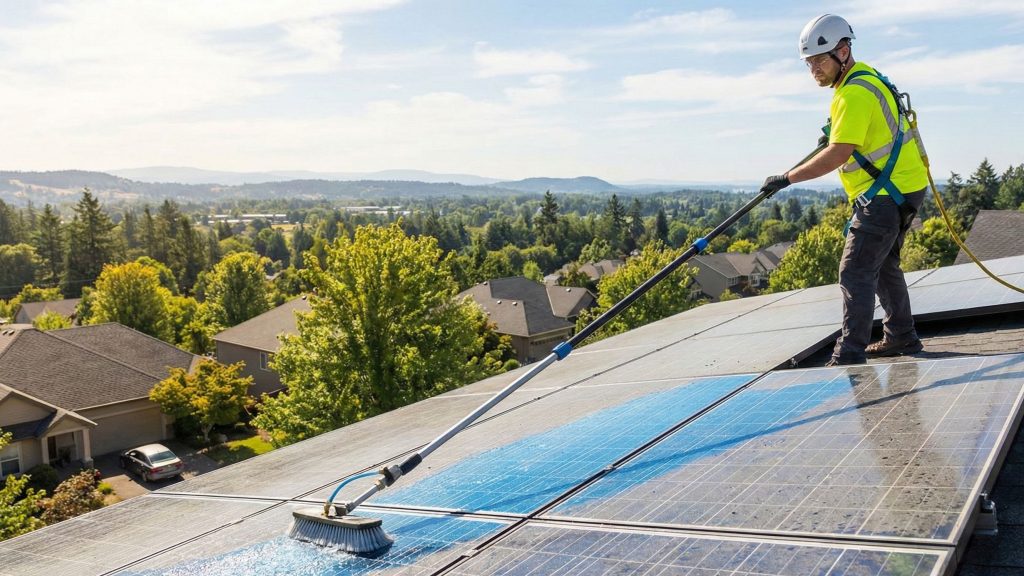
- Water-Fed Carbon Fiber Poles: To avoid the massive safety risk of walking on an algae-slicked roof, professionals use ultra-lightweight, extendable carbon fiber poles. This allows them to safely clean the panels from the ground, a sturdy ladder, or a secure OSHA-approved roof anchor point.
- Specialized Soft-Bristle Agitation: Instead of harsh chemicals or stiff garage brooms, experts rely on specialized, flagged-bristle soft brushes designed specifically for solar glass. The soft bristles gently agitate the green slime, while the constant flow of pure DI water lifts the biological matter and floats it safely off the roof.
- Warranty-Safe, Eco-Friendly Treatments: Because PNW homeowners care about their environment, the best professionals offer eco-friendly solar cleaning options. If biological growth is severe, pros can apply specialized, manufacturer-approved, biodegradable treatments that neutralize algae spores without harming your landscaping or local groundwater.
High-Reach Algae Removal: DIY vs. Professional
To clearly see the financial and physical risks associated with handling algae in the Pacific Northwest, look at this quick comparison table:
| Method | Physical Safety Risk | Equipment Cost / Fee | Warranty Risk | Environmental Impact |
| DIY (Hose, Ladder, Bleach) | EXTREME (Slips on wet algae) | Low ($50 – $100) | Instantly Voided (Chemicals) | High (Toxic bleach in yard runoff) |
| DIY (Water-Fed Pole System) | Moderate (Power line hazards) | High ($500 – $900) | Moderate (Hard water stains) | Low |
| Hiring a Local Professional | Zero (To Homeowner) | Affordable Flat Fee ($150 – $300) | Zero (100% Protected) | Zero (DI water & eco-friendly) |
Preventative Measures for PNW Homeowners
While you cannot control the Oregon rain, you can take proactive steps to make your roof a much less hospitable environment for algae, moss, and lichen.
1. Trim Your Trees: The single most effective way to slow down algae growth is to introduce more direct sunlight and airflow to your roof. Trim back large overhanging branches. By reducing the cool shade and limiting the amount of organic debris (leaves, sap, and pine needles) falling onto your array, you effectively cut off the algae’s food source.
2. Establish a Bi-Annual Cleaning Schedule: In the damp Pacific Northwest, a single annual cleaning is rarely enough to keep biological growth at bay. For optimal performance, schedule a professional cleaning in late spring (to clear away sticky pollen, sap, and spring algae blooms) and a secondary cleaning in late autumn (to clear away fallen leaves and agricultural dust before the damp winter sets in).
Frequently Asked Questions (FAQs)
Can I use a leaf blower to get the moss off my panels?
No. While a leaf blower is great for dry autumn leaves, it cannot remove sticky, damp algae or heavy moss that has anchored itself to the framing. If you use air pressure, you also risk blowing wet, organic debris deep under the panels where it will rot. Read more in our guide: Can I use a leaf blower to clean solar panels?.
Do I need to turn my solar panels off if they are covered in algae?
You don’t need to turn them off just because they are dirty, but you must turn them off before you or a professional introduces water to clean them. Mixing water with high-voltage electronics is highly dangerous. Learn the exact shutdown protocols in our guide: Do you need to turn off solar panels to clean them?.
Will installing critter guards prevent moss?
Critter guards are essential for keeping birds and squirrels out, but they will not stop airborne algae spores from settling on the glass. However, they do keep out massive piles of nesting debris, which prevents the moisture traps that moss loves to grow in.
Protect Your Energy Independence
Your solar panels represent a massive financial investment in your home. You installed them to reduce your carbon footprint, lower your utility bills, and gain long-term independence from the local power grid.
Do not let a highly preventable layer of Pacific Northwest green slime steal your efficiency, and absolutely do not risk your life trying to scrub a slippery, two-story roof with a garden hose.Treat your solar array like the high-yield investment it is. Protect your manufacturer warranty, ensure maximum energy production, and keep your feet safely on the ground.
If you want a deeper dive into the mechanical and financial risks of doing nothing (or doing it wrong), read our guide on how bad it is if you don’t clean your solar panels.
Ready to evict the algae and restore your power? Take the risk and the hassle out of your Oregon home maintenance. Find a trusted, highly-rated solar cleaning professional in your area and secure the best price today.