When is it Too Hot to Clean Solar Panels in Oregon? The Summer Safety Guide
By Adam, Founder, CleanMySolarPanels · May 25, 2026
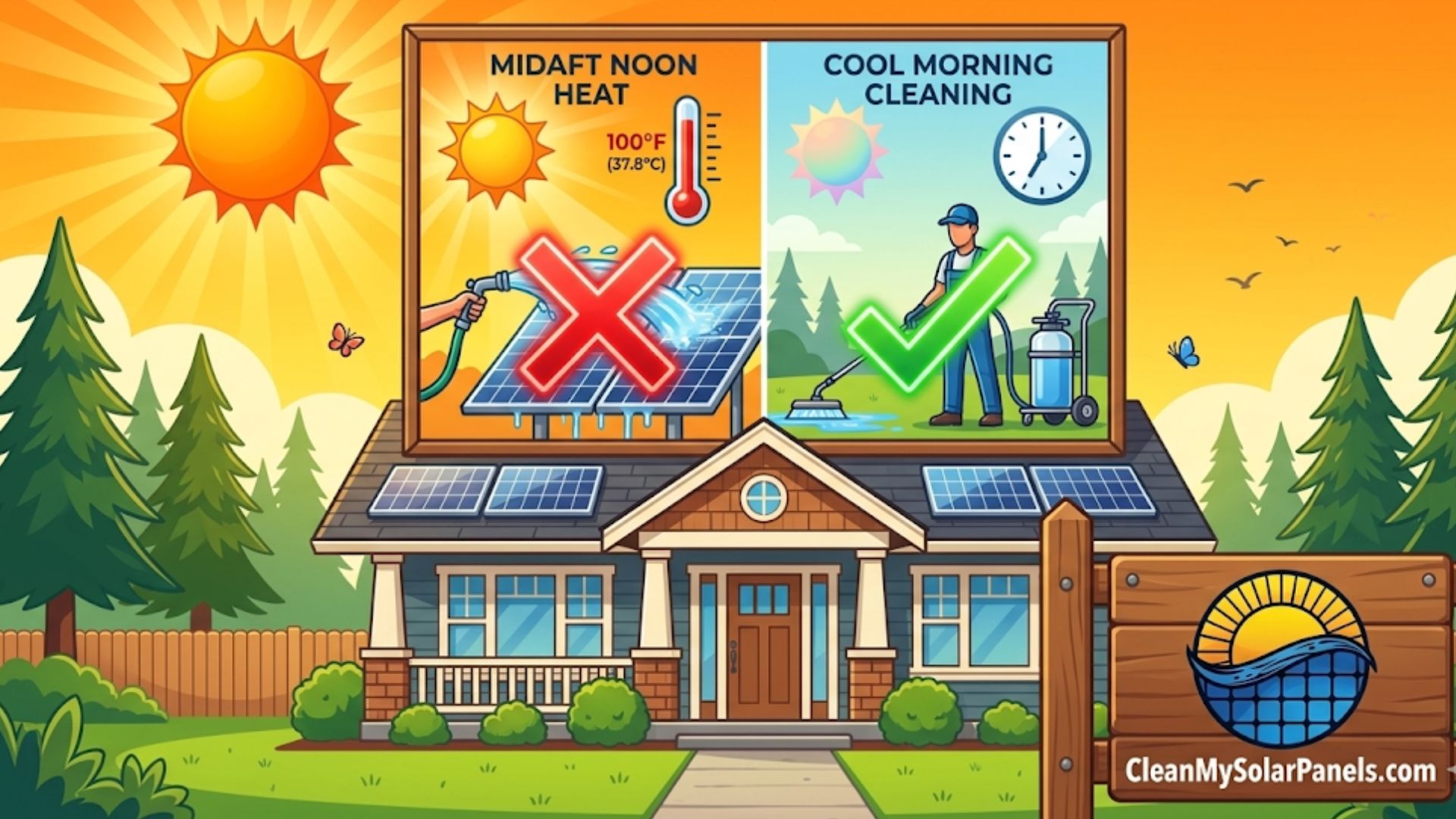
Skip cleaning any time panel glass is too hot to touch — on a 95°F Oregon afternoon it reaches between 150°F and 170°F, and the safe window is early morning, 6:00 AM – 8:00 AM, when the glass is cool. Spray 50°F hose water on superheated glass and you risk thermal shock: shattered panels, invisible micro-cracks, and a voided warranty.
The dirt is still worth dealing with. A summer's worth of dust can put you down about 5% to 7% — NREL's range for U.S. systems — and a professional cleaning runs $150 to $250, versus $400 to $600 to replace a single panel cracked by a midday DIY attempt.
Here's the physics of superheated glass, the thermal shock risk, and the safe summer cleaning schedule.
The New Normal: Oregon’s Blistering Summers
To understand the danger, we first have to acknowledge the reality of the modern Oregon summer.
Whether you live in the Willamette Valley, the Portland Metro area, or the High Desert of Central Oregon, summer temperatures routinely push past 95°F. When the ambient air temperature hits 95°F, it is incredibly uncomfortable for you—but it creates a terrifying physical environment on your roof.
Your solar panels are specifically engineered to be dark (usually deep blue or black) and coated with a microscopic anti-reflective layer. Their entire biological purpose is to absorb as much solar radiation as physically possible and prevent it from reflecting away.
Because they are so incredibly efficient at absorbing solar energy, they also absorb massive amounts of heat.
The Science of Superheated Solar Glass
During a 95°F afternoon in Oregon, the dark asphalt shingles on your roof can easily reach 140°F. Your solar panels, hovering just a few inches above those baking shingles, are absorbing direct, relentless UV radiation.
On a hot summer afternoon, the tempered glass on the surface of your solar panel can reach scorching temperatures between 150°F and 170°F (65°C to 76°C).
This is hot enough to instantly cause second-degree burns if you were to place your bare hand on the glass. The aluminum frames holding the panels together become untouchable. The internal wiring, the microinverters beneath the array, and the delicate silicon photovoltaic cells are completely heat-soaked.
This extreme heat is the exact reason why introducing water during the middle of the day is a recipe for absolute disaster.
The Hidden Danger: Thermal Shock Risk
This is the most critical concept every solar owner must understand. If you take away only one piece of information from this guide, let it be the definition of thermal shock risk.
In physics, thermal shock occurs when a material experiences a rapid, extreme change in temperature, causing different parts of the material to expand or contract at different rates.
Imagine taking a piping-hot glass baking dish straight out of a 400-degree oven and immediately plunging it into a sink full of ice water. You know exactly what happens: the glass violently shatters into a thousand pieces. The sudden drop in temperature causes the surface of the glass to contract inward faster than the interior of the glass, creating massive internal stress that rips the molecular structure apart.
This exact same phenomenon applies to your solar array.
If you climb onto your roof at 2:00 PM on a 95-degree Oregon summer day and spray your 160°F solar panels with 50°F groundwater from your garden hose, the temperature of the glass will instantly drop by over 100 degrees.
The Catastrophic Results of Thermal Shock
When you induce thermal shock on a solar panel, the damage is instantaneous, irreversible, and entirely your fault.
1. Shattered Tempered Glass
In the worst-case scenario, the violent contraction of the glass will cause the panel to instantly shatter. Because it is tempered glass, it will spiderweb into thousands of tiny shards. A shattered panel is completely ruined, produces zero electricity, and becomes an immediate fire hazard that must be professionally decommissioned.
2. Invisible Micro-Cracks
Even if the top layer of tempered glass survives the sudden blast of cold water, the fragile silicon solar cells beneath the glass likely will not. The sudden flexing of the glass will cause the brittle silicon wafers to snap. These microscopic fractures—known as micro-cracks—are invisible to the naked eye. You will think the cleaning was a success, only to realize a month later that your panel’s energy output has permanently plummeted.
3. Instantly Voided Warranties
If you shatter a panel or cause massive micro-cracks through thermal shock, do not expect the manufacturer to bail you out. Top-tier solar manufacturers (like SunPower, Tesla, REC, and Qcells) have seen this exact scenario thousands of times.
If you submit a warranty claim, the manufacturer will put the panel through an Electroluminescence (EL) Imaging scan (an X-ray for solar panels). The scan will instantly reveal the stress-fracture patterns unique to thermal shock. Because their owner’s manuals explicitly forbid cleaning panels during peak heat hours, your Oregon heatwave solar cleaning attempt will be classified as “improper maintenance and abuse.” Your 25-year warranty will be denied, and you will be paying over $400 to replace the single panel out of pocket.
The “Hard Water Bake” (Permanent Mineral Staining)
Let’s assume you manage to avoid shattering the glass. Cleaning superheated panels in the middle of a summer day introduces a secondary, highly destructive threat: rapid evaporation and hard water scaling.
While water in the Portland area (sourced from the Bull Run watershed) is relatively soft, if you live in rural Oregon, the Willamette Valley, or Central Oregon, you are likely using municipal tap water or a private agricultural well. This water is notoriously “hard,” meaning it is packed with dissolved minerals like calcium, iron, and magnesium.
If you spray hard tap water onto a 160°F solar panel, the water boils and evaporates in a matter of seconds. However, the dissolved minerals do not evaporate.
Because the water flashes off so quickly, you don’t even have time to scrub the panel. The calcium and magnesium bake instantly onto the hot anti-reflective coating of the glass, leaving behind thick, chalky white spots.
These hard water stains create a permanent, opaque physical barrier that blocks sunlight. By trying to wash away a summer’s worth of dust with a garden hose in the heat, you will accidentally create a permanent “soiling loss” that completely blinds your solar cells. Once these minerals are baked into the microscopic pores of the hot glass, they are incredibly difficult—and sometimes impossible—to remove without scratching the panel.
For a complete breakdown of why standard garden hoses ruin solar investments, read our deep-dive analysis on the true cost of a dirty solar panel.
Personal Safety: The Heat Exhaustion Factor
We have discussed the danger to your hardware, but we must also address the severe physical danger to you.
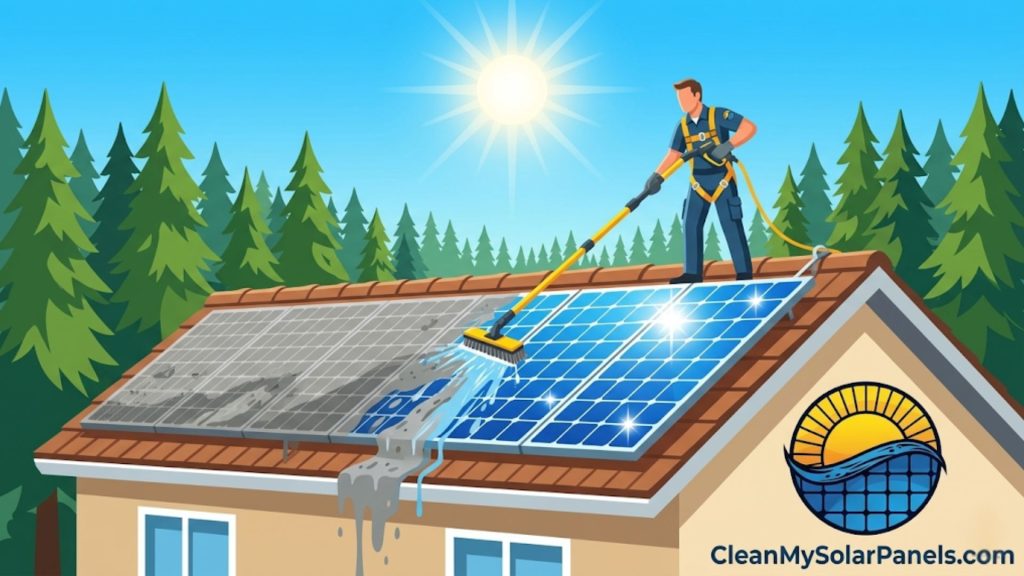
When conducting any summer solar maintenance, your personal safety must come first. According to the Occupational Safety and Health Administration (OSHA), working on elevated, unshaded surfaces during high-heat events is a leading cause of severe heat exhaustion and heatstroke.
Consider the physical reality of a DIY cleaning attempt at 2:00 PM in July:
- You are standing on a dark, slanted roof radiating 140°F heat upward.
- You are in direct, unshaded sunlight.
- You are engaging in strenuous physical labor (wrestling a heavy hose, scrubbing with a long pole).
- You are dealing with slippery, soapy water on a slanted surface.
Heat exhaustion can sneak up on you in minutes. Dizziness, nausea, and muscle cramps are the first symptoms. If you become dizzy while standing near the unguarded edge of a two-story roof, the risk of a fatal fall becomes terrifyingly high. No amount of saved energy production is worth risking your life.
💡 Crucial Safety Warning: Even in optimal weather conditions, you should never use a solar panel as a walkway to reach other parts of your roof. To understand the hidden physics of point-load damage, read our full safety breakdown: Is it safe to walk on solar panels?
The Proper Schedule for Summer Solar Maintenance
If you cannot clean your panels during the heat of the day, when is the correct time to perform summer maintenance?
To protect your panels from thermal shock and ensure the water doesn’t evaporate before you can scrub the dirt away, you must clean the panels when the glass is cool to the touch.
Summer Cleaning Schedule Risk Assessment
Here is a quick visual breakdown of the best (and most dangerous) times to tackle roof maintenance during the Oregon summer:
| Time of Day | Glass Temperature / State | Thermal Shock Risk | The Verdict |
| Early Morning (6 AM – 8 AM) | Cool to the touch / Pre-soaked by dew | Zero / Very Low | IDEAL (Safest Time) |
| Midday / Afternoon (12 PM – 5 PM) | Superheated (150°F+) | EXTREME (Shatter Risk) | DANGEROUS (Avoid) |
| Late Evening (8 PM – 9 PM) | Warm / Radiating stored heat | Moderate | Risky |
| Overcast / Cloudy Days | Cool / Blocked UV radiation | Low | Safe Alternative |
The Golden Window: Early Morning (6:00 AM – 8:00 AM)
The absolute best time to clean solar panels during an Oregon summer is the early morning, just as the sun is coming up.
- Cool Glass: The panels have had the entire night to radiate their heat away. The glass is cool and perfectly safe to introduce to cold water.
- The Dew Advantage: The natural Pacific Northwest morning dew has been sitting on the panels for hours. This dew acts as a natural pre-soak, loosening the baked-on summer dust, tree pollen, and bird droppings, making them infinitely easier to scrub away.
- Safe Temperatures: The ambient air temperature is comfortable, drastically reducing your risk of heat exhaustion.
Why Late Evening is Risky
Many homeowners assume that if they can’t clean in the morning, they can just wait until the sun goes down around 8:30 PM.
While this is safer than midday, it is still highly risky. Solar panels are excellent thermal masses. Even after the sun dips below the horizon, the dark glass and the dark roof shingles continue to radiate intense heat for hours. If it was 100°F that afternoon, the glass might still be 120°F at 8:30 PM. Introducing cold water at this stage still carries a moderate risk of thermal shock and rapid evaporation. If you must clean in the evening, wait until dusk has fully passed and the glass is cool to the touch.
Overcast and Cloudy Days
If an unexpected cloudy or overcast day rolls through during the summer, this provides an excellent, safe window for cleaning. Heavy cloud cover prevents the panels from absorbing direct UV radiation, keeping the glass relatively cool and safe to wash at any time of day.
How Professional Cleaners Handle the Heat
If you want to know how to clean solar panels like a pro, you have to look at how local Oregon experts schedule their days and the technology they use.
1. Strategic Scheduling
Professional solar cleaners understand the dangers of thermal shock better than anyone. During the peak of an Oregon summer, a reputable professional will schedule your cleaning very early in the morning. If they have multiple jobs booked, they will often halt operations by 11:00 AM and refuse to touch a roof during the midday heat.
2. Deionized (DI) Water Systems
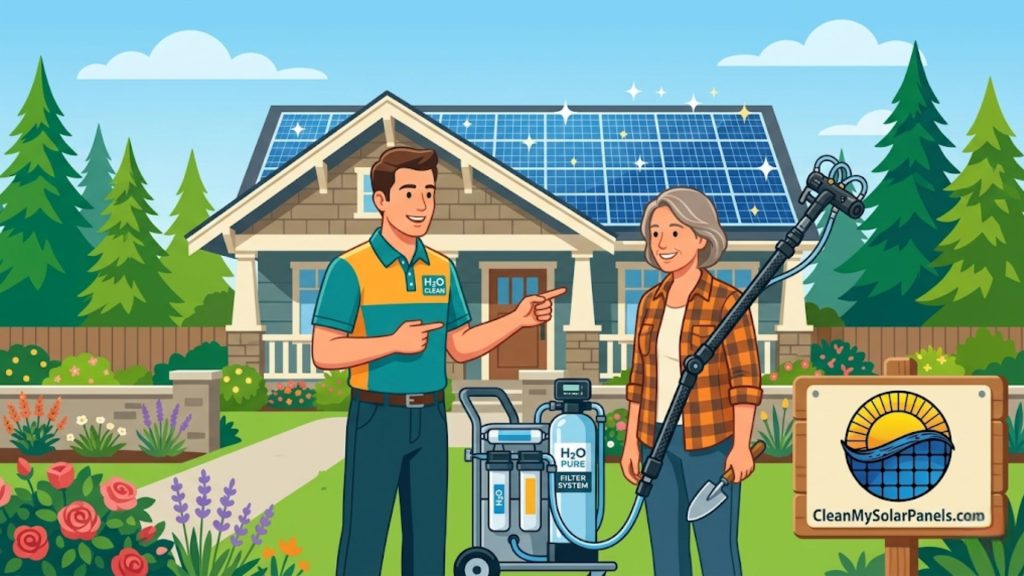
Professionals never use standard municipal tap water. They arrive with heavy-duty, truck-mounted Deionized (DI) water filtration systems. This technology strips 100% of the dissolved minerals (like calcium) out of the water. Even if a small amount of water evaporates quickly, there are absolutely no minerals left behind to stain the glass. The panels dry completely spotless and streak-free.
3. Electrical Safety
Pros know that mixing water and high-voltage electronics is dangerous. Before a drop of water touches your roof, a professional will know exactly why you need to turn off solar panels to clean them and will safely isolate the AC/DC disconnects to ensure zero risk of electrical shock.
4. No Pressure Washers Allowed
Regardless of the temperature, professional solar cleaners never use high-pressure water. They use ultra-soft, water-fed carbon fiber poles that gently agitate the dirt. We cover the severe dangers of high-pressure streams in our guide: Can you pressure wash solar panels?
The ROI of Safe, Professional Maintenance
When you look at the cost of hiring a local professional to clean your solar panels, it is vital to view it as a high-yield investment rather than a nagging chore.
Let’s look at the financial reality of the situation.
If your panels are carrying a summer’s worth of dust, expect to be down about 5% to 7% — NREL’s range for U.S. systems, with the top of it reserved for dusty and traffic-heavy sites. On a system saving you $2,000 a year that is $100 to $140, and it lands in the months when your production is highest and your air conditioning is working hardest.
If you attempt a DIY cleaning during a heatwave and accidentally shatter a single panel via thermal shock, you are instantly out $400 to $600 for the replacement panel, plus the specialized labor to install it.
Conversely, hiring a verified, fully insured local professional typically costs a flat fee of $150 to $250.
The professional service instantly restores your lost energy production, entirely eliminates the risk of thermal shock, protects your 25-year manufacturer warranty, and keeps your feet safely on the ground. The service literally pays for itself in recovered energy and mitigated risk.
Frequently Asked Questions (FAQs)
Can I just spray the panels with warm water to prevent thermal shock?
While this makes sense in theory, it is practically impossible for a homeowner to execute. Your hot water heater cannot supply enough volume to wash an entire roof, and mixing warm water outside is highly inefficient. Furthermore, warm tap water still contains the dissolved minerals that will bake onto the glass and ruin your efficiency.
Should I cover my panels with a tarp to cool them down before cleaning?
No. Throwing a heavy tarp over superheated panels traps the heat underneath and creates severe localized hotspots. Additionally, walking on a slanted roof to wrestle a massive tarp over an array is incredibly dangerous and invites a high fall risk.
Will turning the system off help the panels cool down?
Turning the system off at the breaker box stops the flow of electricity to your home (which is required for safety), but it does not stop the dark glass from absorbing the sun’s physical heat. Even when powered down, a solar panel baking in 95-degree sunlight is still a severe thermal shock risk.
Can I use car wash soap to get the summer dust off quickly?
Absolutely not. Automotive soaps contain waxes and synthetic polymers designed to leave a shiny, protective film on car paint. If you put that on your solar panels, you will leave an opaque film that blocks sunlight and attracts sticky pollen. Read our full warning here: Can I use car wash soap on solar panels?
Don’t Sweat the Summer Maintenance
Your rooftop solar array was designed to drastically lower your utility bills and provide reliable power during the hottest, most demanding months of the Oregon summer. It is a high-yield, multi-thousand-dollar asset.
Leaving that on the glass through August is financially reckless. But trying to solve the problem by spraying freezing cold water onto superheated glass is a catastrophic mistake.
Don’t let the heatwave destroy your investment.
Eliminate the risk of thermal shock, prevent permanent hard water stains, and maximize your summer energy ROI today. Use our nationwide directory to find heavily vetted, insured, and highly experienced experts perfectly suited for your specific Oregon neighborhood.