How Much Does Solar Panel Cleaning Cost? A Complete 2026 Guide
By Adam, Founder, CleanMySolarPanels · March 30, 2026 · Updated October 29, 2026
Professional solar panel cleaning costs $110–$320 for most homes. That is the band across every city we track, from the real listing data behind this directory. In Phoenix most homeowners pay $120–$280; in San Francisco it is $160–$340; in Tucson, $110–$240. Panel count, roof height and pitch, access, and how dirty the glass is decide where your own quote lands inside that range.
Is it worth paying? Usually, yes, and you can measure it. Dust, pollen, bird droppings, salt and smoke act like a shade cloth. NREL documents soiling losses of 5–25% in dusty regions, and a cleaning returns that output the same afternoon.
This guide covers what pros charge and why, what a quote should include, what it costs in each city we cover, when doing nothing costs more than the cleaning, what the do-it-yourself route really adds up to, and how to get a fair price without guessing.
The short answer: average solar panel cleaning prices
Residential cleaning is priced one of two ways.
1. Per-panel pricing, about $6 to $16 per panel. Many local pros count your panels and multiply. Worked back from typical visit totals, that is roughly $6 to $16 a panel, so a standard 20-panel home lands between $110 and $320 for the visit. Most companies use a sliding scale: the more panels you have, the lower the price per panel.
2. Flat-rate pricing, $110 to $320 for the visit. Other companies quote one price for the whole job up to a panel cap, for example "$200 for up to 25 panels". On a standard single-storey home a flat rate usually falls between $110 and $260. Taller or harder-access roofs push toward the top of the band and sometimes past it.
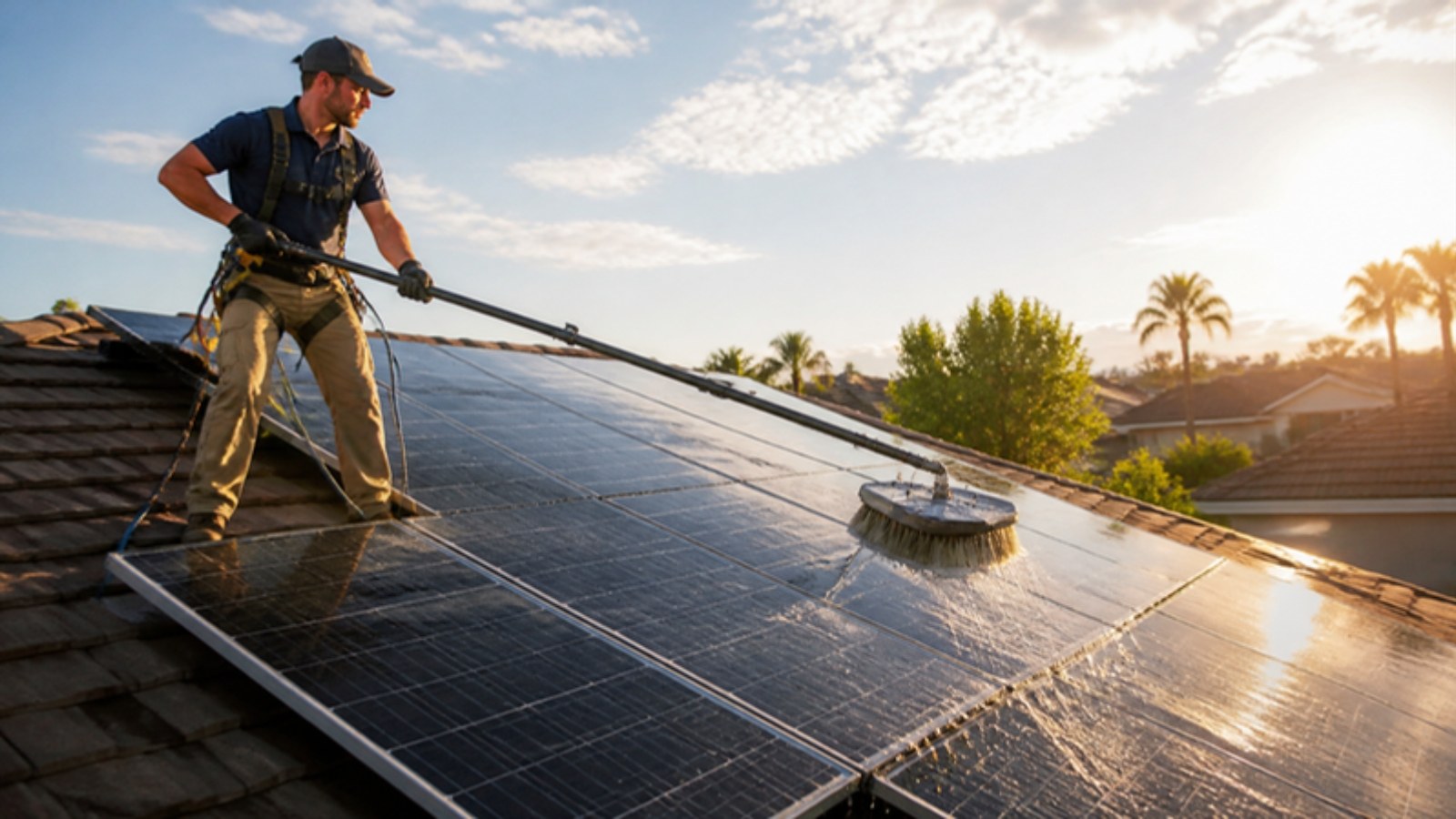
Either way, the price buys the same work: a deionised-water rinse, a soft-brush wash of every panel, a second rinse so nothing dries on the glass, and a look at the frames and wiring while the crew is up there. The rest of this guide explains the gap between $110 and $320.
Quick reference pricing table
| Pricing structure and home type | Typical cost | Best for |
| Per-panel, small system (10–15 panels) | $110 – $200 | Townhomes, smaller energy needs |
| Per-panel, large system (20–30+ panels) | $200 – $320+ | Large homes, high energy needs |
| Flat rate, standard single-storey | $110 – $260 | Average suburban homes |
| Flat rate, multi-storey or steep pitch | $250 – $400+ | Complex roofs, two-storey homes |
Pro tip: not sure how many panels you have? Check the original installation contract or the array layout in your monitoring app (Enphase, SolarEdge, Tesla) before you request quotes. An exact count gets you an exact price.
What it costs in each city we cover
Prices move with the local market, the local dirt and the local roof stock. The table below is built from the same data as our city pages, so it updates as pros list and claim their profiles. Click a city to see the pros serving it, the dust season, and how often local companies recommend cleaning.
| City | Typical cost | Cleanings per year | Grime Index | Pros listed |
|---|---|---|---|---|
| Birmingham, Alabama | $150–$300 | 1–2× / year | #30 | 4 |
| Anchorage, Alaska | $150–$350 | 1–2× / year | #81 | 3 |
| Phoenix, Arizona | $120–$280 | 2–4× / year | #3 | 23 |
| Tucson, Arizona | $110–$240 | 2–4× / year | #5 | 7 |
| Little Rock, Arkansas | $150–$300 | 1–2× / year | #41 | 6 |
| Fresno, California | $120–$260 | 3–4× / year | #1 | 8 |
| Los Angeles, California | $150–$320 | 2–3× / year | #4 | 22 |
| Orange County, California | $150–$320 | 2× / year | — | 12 |
| Riverside, California | $140–$300 | 2–4× / year | — | 22 |
| Sacramento, California | $130–$300 | 2× / year | — | 21 |
| San Diego, California | $140–$300 | 2× / year | #9 | 22 |
| San Francisco, California | $160–$340 | 1–2× / year | — | 12 |
| Denver, Colorado | $150–$300 | 1–2× / year | #17 | 8 |
| Hartford, Connecticut | $150–$300 | 1–2× / year | #75 | 4 |
| Wilmington, Delaware | $150–$300 | 1–2× / year | #69 | 6 |
| Boca Raton, Florida | $150–$300 | 1–2× / year | #51 | 4 |
| Coral Gables, Florida | $150–$300 | 1–2× / year | #64 | 5 |
| Coral Terrace, Florida | $150–$300 | 1–2× / year | #55 | 5 |
| Davie, Florida | $150–$320 | 2–3× / year | #28 | 5 |
| DeBary, Florida | $150–$300 | 1–2× / year | #53 | 1 |
| DeLand, Florida | $150–$300 | 1–2× / year | #59 | 1 |
| Deltona, Florida | $150–$300 | 1–2× / year | #60 | 2 |
| Gainesville, Florida | $150–$320 | 2–3× / year | #25 | 7 |
| Jacksonville, Florida | $150–$300 | 2–3× / year | #35 | 9 |
| Key West, Florida | $150–$350 | 2× / year | #44 | 1 |
| Miami, Florida | $140–$300 | 2× / year | #27 | 5 |
| Miami Beach, Florida | $150–$300 | 2× / year | #48 | 5 |
| Orlando, Florida | $150–$300 | 1–2× / year | #38 | 8 |
| Oviedo, Florida | $120–$275 | 1–2× / year | #47 | 1 |
| Port Orange, Florida | $150–$300 | 1–2× / year | #74 | 5 |
| St. Petersburg, Florida | $140–$300 | 2× / year | #20 | 9 |
| Tampa, Florida | $130–$280 | 2× / year | #22 | 7 |
| West Little River, Florida | $150–$300 | 1–2× / year | #54 | 5 |
| Atlanta, Georgia | $150–$300 | 1–2× / year | #31 | 6 |
| Honolulu, Hawaii | $150–$350 | 2× / year | #26 | 13 |
| Boise, Idaho | $150–$300 | 2–3× / year | #11 | 6 |
| Chicago, Illinois | $150–$300 | 1–2× / year | #19 | 8 |
| Indianapolis, Indiana | $150–$300 | 1–2× / year | #61 | 4 |
| Des Moines, Iowa | $150–$300 | 1–2× / year | #33 | 1 |
| Wichita, Kansas | $150–$300 | 2× / year | #13 | 4 |
| Louisville, Kentucky | $150–$300 | 1–2× / year | #23 | 4 |
| New Orleans, Louisiana | $150–$300 | 1–2× / year | #45 | 7 |
| Portland, Maine | $150–$300 | 1–2× / year | #84 | 3 |
| Baltimore, Maryland | $150–$300 | 1–2× / year | #49 | 8 |
| Boston, Massachusetts | $150–$300 | 1–2× / year | #70 | 2 |
| Detroit, Michigan | $150–$300 | 1–2× / year | #24 | 6 |
| Minneapolis, Minnesota | $150–$300 | 1–2× / year | #65 | 8 |
| Jackson, Mississippi | $150–$300 | 1–2× / year | #46 | 1 |
| Kansas City, Missouri | $150–$300 | 2× / year | #34 | 6 |
| Billings, Montana | $150–$300 | 2× / year | #14 | 2 |
| Omaha, Nebraska | $150–$300 | 2× / year | #29 | 5 |
| Las Vegas, Nevada | $120–$270 | 3–4× / year | #2 | 8 |
| Manchester, New Hampshire | $150–$300 | 1–2× / year | #80 | 3 |
| Newark, New Jersey | $150–$300 | 1–2× / year | #10 | 4 |
| Albuquerque, New Mexico | $150–$300 | 2–3× / year | #6 | 14 |
| New York, New York | $150–$350 | 1–2× / year | #39 | 6 |
| Charlotte, North Carolina | $150–$300 | 1–2× / year | #63 | 15 |
| Fargo, North Dakota | $150–$300 | 1–2× / year | #56 | 5 |
| Columbus, Ohio | $150–$300 | 1–2× / year | #67 | 6 |
| Dover, Ohio | $150–$300 | 1–2× / year | #73 | 2 |
| Oklahoma City, Oklahoma | $150–$300 | 2× / year | #12 | 5 |
| Astoria, Oregon | $150–$300 | 1–2× / year | #85 | 1 |
| Beaverton, Oregon | $150–$300 | 1–2× / year | #62 | 10 |
| Bend, Oregon | $150–$300 | 1–2× / year | #16 | 5 |
| Eugene, Oregon | $150–$300 | 1–2× / year | #32 | 5 |
| Gresham, Oregon | $200–$320 | 1–2× / year | #52 | 9 |
| Hillsboro, Oregon | $175–$300 | 1–2× / year | #42 | 6 |
| Hood River, Oregon | $150–$300 | 1–2× / year | #57 | 4 |
| Jacksonville, Oregon | $150–$300 | 2× / year | #21 | 5 |
| Lake Oswego, Oregon | $150–$300 | 1–2× / year | #72 | 8 |
| Oregon City, Oregon | $150–$300 | 1–2× / year | #79 | 4 |
| Portland, Oregon | $150–$300 | 1–2× / year | #76 | 11 |
| Salem, Oregon | $150–$300 | 1–2× / year | #37 | 8 |
| Tigard, Oregon | $150–$300 | 1–2× / year | #58 | 7 |
| West Linn, Oregon | $150–$300 | 1–2× / year | #78 | 6 |
| Philadelphia, Pennsylvania | $150–$300 | 1–2× / year | #40 | 4 |
| Providence, Rhode Island | $150–$300 | 1–2× / year | #82 | 3 |
| Charleston, South Carolina | $150–$300 | 1–2× / year | #50 | 7 |
| Sioux Falls, South Dakota | $125–$275 | 1–2× / year | #36 | 5 |
| Nashville, Tennessee | $150–$300 | 1–2× / year | #43 | 7 |
| Austin, Texas | $130–$280 | 2× / year | #15 | 12 |
| Dallas, Texas | $120–$280 | 1–2× / year | — | 11 |
| Houston, Texas | $120–$280 | 2× / year | — | 12 |
| San Antonio, Texas | $120–$260 | 2× / year | #8 | 7 |
| Salt Lake City, Utah | $150–$300 | 2–3× / year | #7 | 6 |
| Burlington, Vermont | $150–$300 | 1–2× / year | #83 | 4 |
| Virginia Beach, Virginia | $150–$300 | 1–2× / year | #66 | 4 |
| Seattle, Washington | $150–$325 | 1–2× / year | #77 | 6 |
| Charleston, West Virginia | $150–$300 | 1–2× / year | #71 | 1 |
| Milwaukee, Wisconsin | $150–$300 | 1–2× / year | #68 | 4 |
| Cheyenne, Wyoming | $150–$300 | 2× / year | #18 | 1 |
A few patterns stand out in that table.
The desert Southwest is cheapest per visit and needs the most visits. Tucson's $110–$240 and Phoenix's $120–$280 are the lowest bands we track, because the roofs are low, the lots are open and the crews are busy year round. The catch is frequency: pros in both cities recommend two to four cleanings a year, so the annual spend is similar to a coastal city that cleans once.
Coastal California costs more per visit. San Francisco at $160–$340, Los Angeles and Orange County at $150–$320 sit at the top of the range, driven by labour cost and steeper, tighter roofs. San Diego at $140–$300 and Riverside at $140–$300 are a step down.
Texas and Florida cluster in the middle. Dallas and Houston both run $120–$280, San Antonio $120–$260 and Austin $130–$280. In Florida, Tampa is $130–$280, Miami $140–$300, and the Keys and the oak-canopy towns such as Gainesville run $150–$320 or more because salt and pollen make the job slower.
Islands and the far north cost the most. Honolulu and Anchorage both run $150–$350. Equipment, water and labour all cost more to bring to the roof, and in Honolulu the salt crust takes longer to lift.
The Pacific Northwest pays for moss, not dust. Gresham at $200–$320 and Hillsboro at $175–$300 have the highest floor in the table, because a cleaning there often means clearing moss and lichen from the panel edges as well as washing the glass.
If your city is not in the table yet, the national band of $110–$320 is the right planning number, and the city page for your area will show pricing as soon as pros there list it.
Decoding the quote: six things that move the price
A quote is not a guess. When a cleaner prices your job they are weighing six things about your property. Knowing them tells you whether a quote is fair and what you can do to bring it down.
1. Panel count and system size
The most obvious driver. A 40-panel array takes more time, more purified water and more brush strokes than a 10-panel townhouse system. Volume discounts are normal: the per-panel rate on a big system is usually lower than on a small one, which is why a 36-panel home might pay $280 while a 12-panel home pays $140 from the same company.
2. Roof height and pitch
A single-storey roof with a gentle pitch can be washed from the ground or a short ladder with a water-fed pole, and it is the cheapest job a cleaner does. A two-storey home with a steep pitch needs harnesses, roof anchors or a longer pole, and more time per panel. Three storeys, or a roof with multiple small faces, pushes the quote toward the top of the range. Our guide to cleaning panels on a two-storey house explains why pros price height the way they do.
Pro tip: say up front if you have a two-storey home, a clay or slate tile roof (crews cannot walk on it), or a steep pitch. Accurate details prevent an upcharge on the day.
3. Access and tilt
How close can the truck park? Is there a hose tap on the right side of the house? Can a pole reach the array from the ground, or does someone need to go up? Ground-mount and carport arrays are the easiest and often the cheapest per panel. Flat-roof arrays on commercial buildings can be cheap per panel too, because the crew walks the roof and never climbs. The expensive combination is a high roof, a shallow tilt that holds water and dirt at the bottom edge, and no ground access.
4. How dirty the glass is, and with what
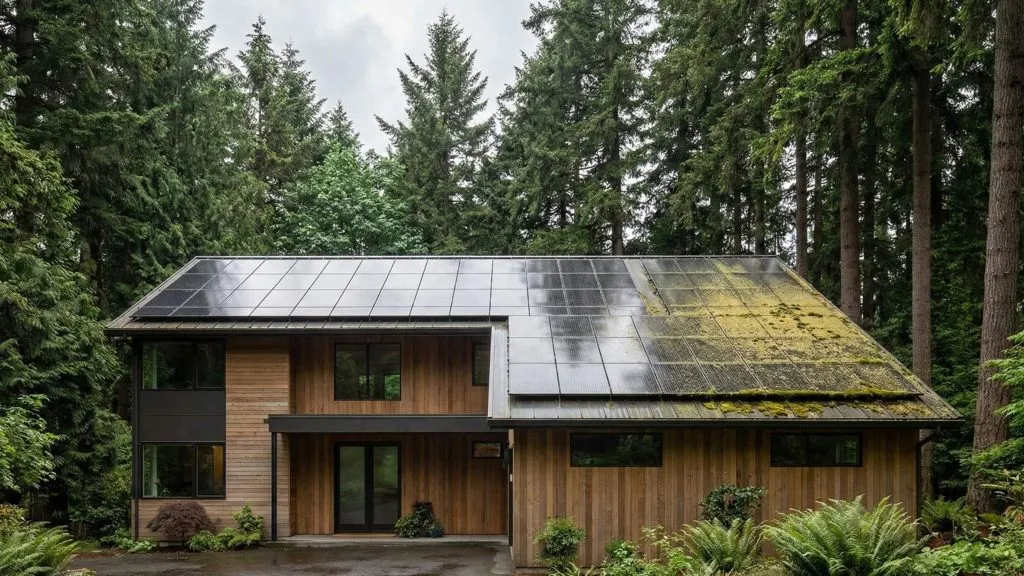
A light summer dust rinses off fast. Five years of neglect does not. Sticky soils take real scrubbing: tree sap under pines, baked-on bird droppings near parks and water, salt crust on the coast, wildfire ash after a smoky month, and the greasy film that forms near highways and refineries. In the Pacific Northwest, moss and lichen along the frame edge are a separate job. Expect a first-time or long-overdue cleaning to be quoted higher than a maintenance visit, and ask whether the price drops once you are on a schedule.
5. Add-ons
The base price covers the wash. Bird and pigeon proofing (wire mesh clipped around the array so nothing nests under it) is quoted per linear foot and often done in the same visit. Gutter clearing, window washing, a thermal or visual inspection, and panel-edge moss removal are extras, and some crews bundle them at a discount if you book the lot at once. Our guide to birds and solar panels explains why proofing is worth pricing with the first cleaning in pigeon country.
6. Where you live and how far the crew drives
Like any home service, cleaning tracks the local cost of labour. A crew in San Francisco pays more for everything than a crew in Tucson, and the table above reflects it. Distance matters too: a home an hour outside the metro may carry a trip charge, and a few pros set a minimum for rural jobs. Asking "is there a travel charge for my address?" is the quickest way to avoid a surprise.
Per-panel, flat rate, or a maintenance plan?
Which structure saves you money depends on the system and how often you clean.
Per-panel suits small and unusual systems. If you have 10 panels on a garage, a per-panel price is almost always cheaper than a flat rate designed for a 25-panel home. It also suits split arrays, where some panels are easy and some are not, because a good pro will price the hard face separately.
Flat rate suits the average suburban home. With 18 to 28 panels on one or two roof faces, a flat rate is usually the lowest total and the easiest to compare between companies. Check the panel cap in the quote and what happens above it.
A maintenance plan suits anyone who needs two or more cleanings a year. Plans are priced per visit at a discount to the one-off price, with the visits fixed in advance: typically two a year in most of the country and three or four in the desert Southwest and the Central Valley. Most pros on this site that offer plans list them on their profile. A plan removes the guesswork about timing, and it keeps the first-visit "neglect" surcharge from ever coming back.
Commercial arrays are priced per panel, at scale. A 400-panel warehouse roof or a carport array is quoted per panel at a rate well below residential, scheduled around the site's hours, and usually comes with a production report before and after. Our guide to commercial cleaning and its return covers how facilities managers justify the spend.
What a professional cleaning should include
A fair quote in the $110–$320 band buys all of the following. If a quote is unusually cheap, this is the list to check it against.
- Purified water. Deionised or reverse-osmosis water, so no minerals dry on the glass. Ask what the crew's TDS reading is; anything close to zero is right.
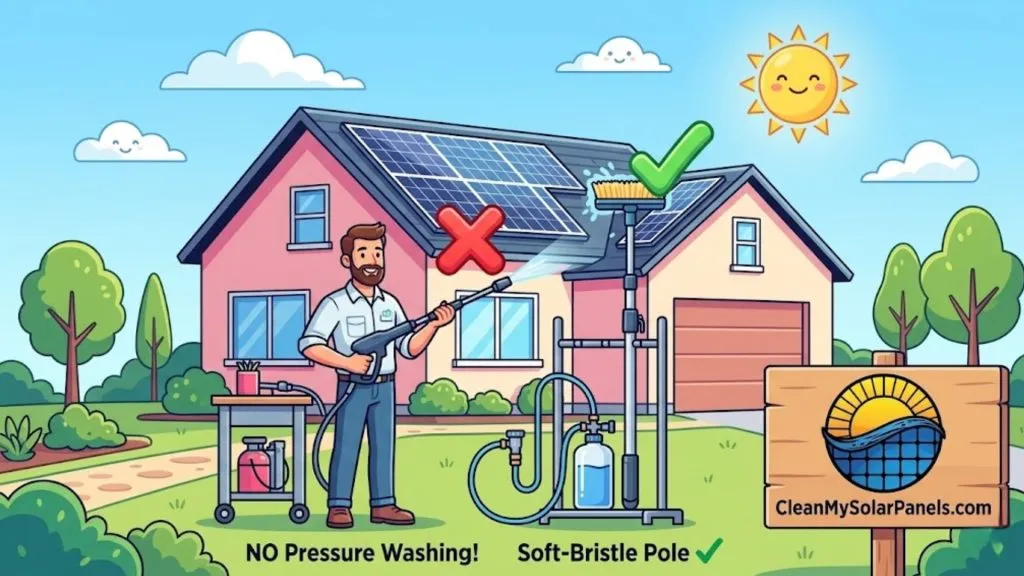
- A soft brush on a water-fed pole. Nylon or hog-hair bristles made for glass. No pads, no squeegees with metal edges, no pressure washer.
- Every panel, every face. Including the ones you cannot see from the yard.
- A second rinse. The wash lifts the dirt; the rinse carries it off. Skipping it leaves a film.
- A look at the hardware. Loose wiring, cracked glass, lifted frames, nests underneath. Pros do not fix these on a cleaning visit, but they should tell you.
- Before-and-after photos, and ideally a production reading from your monitoring app the day of the visit.
- Proof of liability insurance, sent before anyone climbs. On this site, pros state whether they carry it on their profile.
Our pros' guide to cleaning solar panels like a professional walks through the whole method if you want to see what you are paying for.
Red flags in a quote
A few things should make you pause before you book.
- Pressure washing. It cracks glass, forces water past the frame seals and voids the manufacturer's warranty. Here is why pros never do it.
- Soap, detergent or "special solution". Tap water plus dish soap leaves a film that attracts dust. Purified water needs nothing added. Our guide on dishwashing liquid and panels covers what the residue does.
- Walking on the panels. Micro-cracks in the cells do not show up until the output drops. Walking on panels is a warranty problem and a safety one.
- No insurance certificate. A reputable company sends it without being asked twice.
- A price that needs you to decide today. Cleaning is not an emergency. A pro who wants a decision on the phone is selling, not quoting.
- A quote far below everyone else's. Sometimes it is a new company earning reviews. Often it is a crew with a garden hose and a mop.
The hidden cost of doing nothing
Looking at a $200 quote and thinking "maybe next year" is reasonable. It is also usually wrong, and you can check it with your own numbers.
The power you lose to dirt is called soiling loss. Depending on where you live, NREL puts it between about 2% in wet climates and 7% where it is dusty or traffic-heavy, with roughly 5% as a national average. Pollen-heavy regions are the exception, reaching about 10% across a year and 15% at the peak of the season. Our own Grime Index, which ranks the cities we cover by dust, pollen, rain and bird pressure, puts the loss at 15% a year for the three dustiest metros (Fresno, Las Vegas and Phoenix) and about 5.5% for the cleanest.
Run the sum for your own home. If your panels save you $2,000 a year, a 5% soiling loss costs you $100 a year, a 7% loss $140, and a 15% loss in a desert city $300. In most of the country that is less than one cleaning, which is why the honest case for cleaning does not rest only on lost kilowatt-hours. It rests on three other things:
- Hot spots. A patch of bird droppings shades a few cells. The rest of the string keeps pushing current through them, they heat up, and over a season that can damage the cell permanently. A cleaning is cheaper than a panel.
- Warranty conditions. Most panel warranties require reasonable maintenance. Years of visible neglect gives a manufacturer a reason to argue.
- The compounding. Dirt that sits for two years bonds to the glass. The first cleaning after a long gap costs more and recovers less than a cleaning on schedule.
The data-driven comparison of cleaning against neglect works through all of this with figures. The short version: in a dusty or pollen-heavy city, cleaning pays for itself in energy alone; everywhere else it pays for itself in the panel you do not have to replace.
Money-saving tip: note your monitoring app's daily production for the week before a cleaning and compare it to the week after. On a sunny week you will see the difference on the graph, and you will know what the next cleaning is worth to you.
Is doing it yourself cheaper?
Sometimes. It depends on the roof and on what you buy.
On a single-storey roof or a ground mount, a careful DIY cleaning is realistic. Our guide to cleaning panels from the ground covers the method. The kit from our gear pages looks like this:
- A soft-brush kit with a telescopic pole, about $99, or a 26 ft water-fed kit at about $137.
- Purified water. A pre-filled DI resin tank on a garden hose is about $153, or a 24 ft pole with an inline filter and TDS meter at about $271 does both jobs.
- A handheld TDS meter, about $15, so you know when the resin is spent.
That is roughly $250 to $300 for a setup that will do a low roof two or three times a year, so it pays for itself against a $150 professional visit inside the second year, as long as the panels are reachable from the ground and you are comfortable on a ladder for the top row. Our guide to whether cleaning is worth it runs the same maths city by city.
On a two-storey or steep roof, DIY is rarely cheaper and never safer. Professional water-fed poles that reach a second storey start around $749 for a 30 ft carbon-fibre pole, and a multi-stage DI system is over $1,100. That buys about five professional cleanings. Add the risk: ladder falls cause thousands of serious injuries every year, and a wet, pitched roof is where many of them happen.
Three mistakes that cost more than a cleaning. Tap water on hot glass dries into mineral spots that shade the cells you just cleaned. Household sponges and brushes scratch the anti-reflective coating and void the warranty. Vinegar, car-wash soap and other home remedies leave films or etch the glass. If you do it yourself, do it with purified water and a glass-safe brush, or not at all.
How often you will pay for it
Cleaning is not a monthly bill. For most homes, once or twice a year keeps the system at peak output. The city pages on this site show what local pros recommend, and the pattern is clear:
- Once or twice a year across the Northeast, the Midwest, the Pacific Northwest and most of the South, where rain does part of the job between visits.
- Twice a year along the Gulf and Florida coasts and in most of Texas and California, where pollen in spring and dust or salt in summer each earn a visit.
- Two to four times a year in the desert Southwest and the Central Valley, where there is no rain to help for six months at a stretch.
At the national band, that is $110 to $320 a year for most homeowners and $300 to $900 a year in the dustiest cities, which is exactly where the energy recovered is largest.
When to book. The best single cleaning of the year comes right after the local dirt season ends: late spring in the pollen belt, the end of the monsoon in Arizona, the end of harvest in farm country, the end of fire season in the West. Our guide to the signs your panels need cleaning helps you judge by eye in between.
How to get a fair quote in five minutes
- Count your panels from the contract or the monitoring app, and note the roof: one or two storeys, pitch, tile or shingle, and whether a hose tap is reachable.
- Say what is on the glass. Pollen, bird droppings, sap, salt, moss or just dust. It changes the price and it changes what the crew brings.
- Ask for a per-visit price and the plan price if you expect to clean twice a year or more.
- Ask three questions: what water do you use, what is your TDS reading, and can you send your insurance certificate.
- Compare two or three quotes. Request them once here and only the pros you pick can contact you. The spread between the highest and lowest quote on the same roof is usually the whole gap between $110 and $320, and now you know what the gap is made of.
Our calculator will estimate what dirt is costing you by city before you decide, and the dirtiest cities ranking shows where your metro sits.
How CleanMySolarPanels helps
We do not clean panels, carry ladders or set prices. We list the companies that do, show what they offer, and let you compare them in one place. Reviews on this site come only from homeowners who booked through a quote request, so none are bought or imported. Pros state their services, their insurance and, where they offer them, their maintenance plans. Because local companies know they are being compared, the quotes you get back are competitive, and the price you pay is the local market price, not a guess.
Frequently asked questions
How much does it cost to clean solar panels on a house?
Most homes pay $110 to $320 for a professional cleaning. The low end is a small single-storey system in a competitive market such as Tucson or Phoenix; the high end is a large or two-storey array in an expensive coastal market such as San Francisco or Honolulu.
How much does solar panel cleaning cost per panel?
About $6 to $16 per panel, with the rate falling as the panel count rises. A 20-panel home at $10 a panel is $200, which sits in the middle of the national band.
Is it worth paying to have solar panels cleaned?
In dusty, pollen-heavy or coastal cities, yes on energy alone: a 7% to 15% soiling loss on a system saving $2,000 a year is $140 to $300 a year, which covers the cleaning. Everywhere else the case is protecting the panels from hot spots and warranty disputes, which costs far more than a cleaning when it goes wrong.
How often should I pay for a cleaning?
Once or twice a year for most of the country, twice a year on the Gulf and in Texas and California, and two to four times a year in the desert Southwest and the Central Valley. The city pages on this site show what local pros recommend.
Does rain clean solar panels for free?
Only partly. Rain rinses loose dust but leaves pollen film, bird droppings and the mineral streaks that form as drops dry, and shallow-tilt panels hold dirty water at the bottom edge. In most climates rain stretches the gap between cleanings; it does not replace them.
Can I clean solar panels myself to save money?
On a single-storey roof or a ground mount, yes, with purified water and a glass-safe brush; the kit costs about $250 to $300 and pays for itself in the second year. On a two-storey or steep roof the professional equipment costs over $1,000 and the fall risk is real, so a pro is cheaper and safer.
What is included in a professional cleaning?
A purified-water rinse, a soft-brush wash of every panel, a second rinse, a visual check of frames and wiring, and usually before-and-after photos. Bird proofing, gutter clearing, inspections and moss removal are priced as add-ons.
Why is solar panel cleaning more expensive in some cities?
Labour cost, roof stock and the kind of dirt. San Francisco and Los Angeles pay more for labour and have steeper, tighter roofs; Honolulu and Anchorage pay more for everything that has to reach the roof; Oregon cities pay for moss removal. Phoenix and Tucson are cheap per visit because the roofs are low and the crews are busy, but they need more visits a year.
Do solar panel cleaners offer discounts for regular service?
Most do. Maintenance plans price each visit below the one-off rate in exchange for fixed visits, usually two a year, and they avoid the higher first-visit price a neglected array attracts. Pros that offer plans list them on their profiles here.
Will cleaning void my solar panel warranty?
A professional cleaning with purified water and soft brushes will not. Pressure washing, abrasive pads, harsh chemicals and walking on the glass can. Ask any company you hire how they clean before they start.