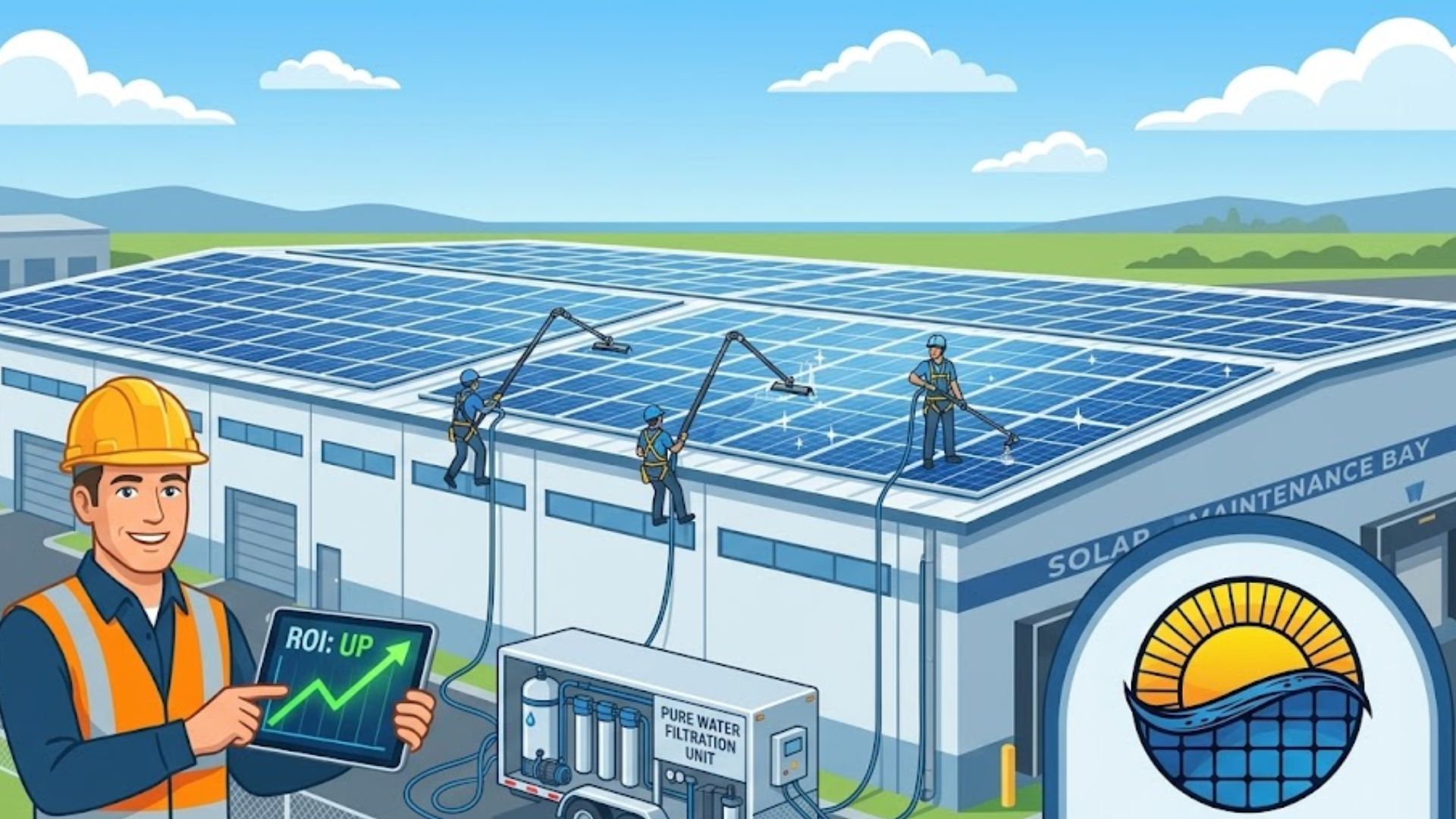
Commercial Solar Panel Cleaning: The ROI of Clean Energy
By Adam, Founder, CleanMySolarPanels · May 15, 2026
Commercial solar panel cleaning pays for itself: on a 100kW system, a $1,500 to $2,000 professional cleaning recovers roughly $3,375 in annual soiling losses — a net gain of $1,875 back into your operating budget. For 500kW and 1 MW+ arrays, the recovered revenue stretches into five figures.
The mechanism is simple. Grime on the glass blocks sunlight before it reaches the cells — NREL measures 2% to 7% of annual output lost on typical systems, and flat commercial roofs collecting HVAC exhaust, bird droppings, and industrial smog routinely run 10% to 15%. Your facility buys that lost power back from the grid at full commercial rates.
Below: the ROI math by system size, why in-house staff on the roof is a liability trap, and how often to budget for cleaning.
The CFO’s Perspective: Protecting Your Financial Projections
When your company first pitched the idea of a commercial solar array, the financial modeling was based on specific production guarantees. You calculated your break-even point and your projected ROI based on the system operating at peak efficiency (factoring in standard, unavoidable mechanical degradation of about 0.5% per year).
However, those initial financial models rarely account for preventable environmental degradation.
If your system was modeled to achieve a 5-year payback period, but it is losing 10% to 15% to a thick layer of industrial smog and bird droppings on a flat roof, your payback period stretches significantly. Every month your system underperforms, you are failing to hit the financial benchmarks promised to your board of directors. Protecting your initial financial projections requires proactive, scheduled maintenance to ensure the array produces the exact wattage it was designed to deliver.
The Financial Mechanics of “Soiling Losses”
Before you can approve a maintenance budget, you have to understand the mechanism of the loss. Solar panels generate electricity via photovoltaic cells protected by a sheet of tempered glass. This glass is treated with a microscopic, anti-reflective coating designed to trap sunlight.
When a layer of environmental grime coats this glass, it creates a physical, opaque barrier. The sunlight bounces off the dirt before it can ever reach the cells. This is known in the industry as “soiling loss.”
For a homeowner the numbers are modest: NREL measures 2% to 7% of annual output depending on climate, which on a typical residential system is $100 to $150 a year. An annoyance, rarely a crisis.
However, in the world of large scale solar cleaning, volume changes everything. Commercial utility rates, peak demand charges, and massive kilowatt-hour (kWh) generation goals mean that minor percentage drops compound into thousands of dollars of lost revenue.
The Math: A 100kW Commercial System
Let’s look at a realistic, conservative financial model for a mid-sized commercial facility (such as a medium warehouse, a large retail store, or a small manufacturing plant).
Assume your company operates a 100kW commercial solar system.
- A standard 100kW system generates roughly 150,000 kWh of electricity per year (depending heavily on your geographic location and local sunlight hours).
- Let’s assume your commercial utility rate is $0.15 per kWh.
- If your system operates at 100% capacity, it saves your business $22,500 per year in energy costs.
Commercial arrays are the exception to those residential numbers, and the reason is geometry. A flat or low-tilt warehouse roof does not shed anything — rain pools and dries in place instead of running off — and the same roof is often sitting in industrial particulate and a resident gull population. That combination is what puts a commercial site at the top of the measured range rather than the middle. Here is what a 15% loss looks like, which is a bad case rather than an average one:
- A 15% drop in production means you lose 22,500 kWh of energy.
- Because your facility still needs that power to operate, you are forced to buy that 22,500 kWh back from the local utility grid.
- The Hidden Cost: 22,500 kWh × $0.15 = **$3,375 in lost annual revenue.**
A 10% to 15% loss on a 100kW system is huge money. For enterprise-level facilities operating 500kW to 1MW (Megawatt) systems, the financial bleed easily stretches into the tens of thousands of dollars annually. If you want to dive deeper into the raw data regarding efficiency drops, you can review our foundational guide on why dirty panels are costing you money.
Calculating Your Maintenance ROI
If you are a facility manager presenting a budget to the CFO, you need to prove a positive Return on Investment. Commercial solar panel cleaning is one of the few operational expenses that literally pays for itself.
Using the 100kW system example above:
- Your Annual Loss from Dirt: $3,375
- Average Cost of Commercial Cleaning: $1,500 to $2,000 (billed flat-rate or per-kW).
- Your Net Financial Gain (ROI): By spending $1,500 on professional maintenance, you instantly recover your system’s peak capacity, generating a net positive cash flow of **$1,875** directly back into your operating budget.
Commercial ROI Breakdown Table
| System Size | Estimated Annual Value (at $0.15/kWh) | Cost of 15% Soiling Loss | Est. Cost of Professional Cleaning | Net ROI (Profit Saved) |
| 50 kW | $11,250 / year | -$1,687 / year | $750 – $1,000 | **+$687 to +$937** |
| 100 kW | $22,500 / year | -$3,375 / year | $1,500 – $2,000 | **+$1,375 to +$1,875** |
| 500 kW | $112,500 / year | -$16,875 / year | $5,000 – $8,000 | **+$8,875 to +$11,875** |
| 1 MW+ | $225,000 / year | -$33,750 / year | Custom Enterprise Bid | +$15,000+ |
Note: Pricing and yields vary by region, utility rates, and specific roof logistics. For an exact breakdown of average cleaning rates across the industry, consult our solar panel cleaning cost guide.
Unique Threats to Commercial Solar Arrays
The type of dirt accumulating on a commercial roof is vastly different from the dust on a standard suburban home. Commercial and industrial facilities create and attract heavy, complex pollutants that require highly specialized removal techniques.
1. HVAC and Industrial Exhaust
Commercial flat roofs are home to massive HVAC cooling towers, kitchen exhaust vents (for restaurants and food processing), and manufacturing exhaust pipes. These vents constantly expel greasy, oily particulate matter into the air, which settles directly onto the solar array. This industrial grease is incredibly sticky and completely immune to standard rainfall.
2. Massive Bird Infestations
Flat commercial roofs, especially those near water or urban centers, are prime real estate for massive flocks of seagulls and pigeons. Pigeons will frequently nest underneath the elevated racks of commercial ballasted solar systems. Bird droppings are highly acidic, completely opaque, and will permanently etch the solar glass if left unchecked. A severe bird infestation also poses a severe health and safety risk to any roof maintenance workers due to airborne pathogens. (Learn more about mitigating biological threats in our guide on how to stop pests from ruining your system).
3. Solar Farm Cleaning (Agricultural Dust)
If you manage a ground-mounted solar farm or a massive array for an agricultural processing facility, your biggest enemy is agricultural dust. Heavy farm machinery kicks up dense, heavy topsoil, fertilizer particulate, and chaff. This agricultural dust creates cement-like layers of mud on the glass that require industrial-scale, specialized water treatments to remove.
The Liability Trap: Why You Can’t Use In-House Staff
When facility managers recognize they are losing thousands of dollars to dirty panels, the most common knee-jerk reaction is to cut costs by assigning the job to their in-house maintenance or janitorial staff.
Do not do this. It is a catastrophic liability risk.
Attempting to clean a commercial solar array with an unspecialized crew introduces massive, potentially business-ending liabilities:
Risk 1: OSHA Violations and Workers’ Comp Liability
Working on a commercial roof—even a completely flat roof—is strictly regulated by the Occupational Safety and Health Administration (OSHA). Any employee working near the leading edge of a roof, near skylights, or navigating around high-voltage trip hazards must be equipped with proper fall protection, roof anchors, and specific safety training.
OSHA fines for fall protection violations are severe, often exceeding $15,000 per violation. Furthermore, if your janitor slips on the wet roof or trips over a conduit wire while dragging a heavy hose, your company is fully liable for a devastating workers’ compensation claim. The financial fallout of a single rooftop accident will instantly dwarf a decade’s worth of solar energy savings.
Risk 2: Roof Membrane Punctures
Most commercial buildings feature flat, TPO (Thermoplastic Polyolefin) or EPDM rubber membrane roofs. These roofs are highly susceptible to punctures. If an untrained maintenance worker drops a heavy tool, drags a sharp ladder, or walks carelessly over a seam, they can instantly puncture the waterproof membrane. A punctured TPO roof will cause massive water leaks into your commercial facility, potentially ruining inventory and requiring tens of thousands of dollars in emergency roofing repairs.
Risk 3: Irreversible Equipment Damage
Your in-house staff likely cleans windows with standard glass cleaner, heavy-duty degreasers, or pressure washers. If they apply these methods to a solar array, they will destroy it.
- High-pH degreasers permanently chemically burn the anti-reflective coating on solar glass.
- Using a pressure washer on a solar panel will instantly blow out the waterproof silicone weather seals, flooding the internal electronics and causing massive short circuits.
Risk 4: Voiding the Manufacturer Warranty
Commercial solar arrays come with massive, 25-year performance warranties. However, Tier-1 manufacturers explicitly state that using abrasive chemicals, improper brushes, or unauthorized maintenance personnel completely voids the warranty. If your in-house staff scratches the glass using a stiff garage broom, you will be paying out of pocket to replace hundreds of damaged panels.
What Commercial-Grade Professionals Actually Do
If you want to protect your assets and eliminate corporate liability, you must outsource this work to specialized, commercial-grade professionals. When you hire an expert in large scale solar cleaning, they bring specialized technology and strict compliance protocols to the table.
1. 100% Deionized (DI) Water Filtration
Commercial experts never use standard municipal tap water. Tap water is full of heavy minerals (calcium and magnesium) that bake onto hot solar glass, creating permanent, chalky hard-water stains.
Professionals arrive with heavy-duty, truck-mounted Deionized (DI) water filtration systems. This technology strips 100% of the minerals out of the water. They pump this pure water through ultra-soft, carbon-fiber, flagged-bristle solar brushes. The pure water acts as a magnet for industrial grime, rinsing the panels flawlessly and allowing them to air-dry completely spotless and streak-free.
2. Full Insurance and Compliance
A verified commercial solar cleaner carries massive general liability insurance and comprehensive workers’ compensation coverage. They assume 100% of the physical and financial risk of the rooftop operation. Furthermore, if you are a government facility, a public school, or a municipal entity, these specialized companies understand how to navigate state prevailing wage laws and rigorous compliance reporting.
3. Thermal Imaging and Preventative Inspections
The best commercial cleaners provide more than just a wash; they provide asset management. When a panel is severely soiled by bird droppings, the cells beneath the droppings overheat, creating dangerous electrical “hotspots” that can burn out the panel and create a fire hazard. Many commercial pros utilize handheld thermal cameras or drones to identify these hotspots before and after the wash, providing your facility management team with documented proof of system health.
Budgeting: How Often Should Commercial Systems Be Cleaned?
Determining your maintenance schedule depends entirely on your industry and your geographic location. As a general rule for corporate budgeting:
- Standard Commercial Retail/Office (Suburban): 1 to 2 times a year. A spring cleaning clears heavy pollen, and a fall cleaning removes summer dust.
- Industrial & Manufacturing (Urban): 2 to 4 times a year. Proximity to heavy vehicle traffic, HVAC exhaust, and industrial smog requires a quarterly or bi-annual approach to prevent sticky grime from baking onto the glass.
- Agricultural & Solar Farm Cleaning: 2 to 3 times a year. Scheduled heavily around post-planting (pollen) and post-harvest (heavy soil and tractor dust) seasons.
- Coastal Facilities: 3 to 4 times a year. Mandatory to prevent highly corrosive sea salt spray and acidic seagull droppings from eating away at the aluminum framing and exposed wiring.
Commercial Solar FAQ for Facility Managers
Will cleaning disrupt our daily business operations?
No. Professional commercial cleaners are accustomed to working around corporate schedules. Because the equipment is self-contained (often running from a truck-mounted tank in the parking lot) and the work is entirely isolated to the roof, your ground-level operations, retail space, or warehouse floor will experience zero disruptions.
Do we need to provide a water source on the roof?
Generally, no. Most commercial-grade professionals arrive with massive water tanks pre-filled with purified Deionized water. If you have an exceptionally large array (1 MW+), they may need to hook up their filtration system to a commercial spigot on the ground level, but they bring the hoses and pumps required to get it to the roof.
Can we just use a drone or automated robot to clean them?
While solar cleaning robots do exist, they are primarily used for massive, multi-megawatt ground-mounted utility solar farms in desert regions. For commercial rooftops with complex layouts, HVAC obstacles, and varying roof pitches, hiring a human professional with a water-fed pole remains the safest, most thorough, and most cost-effective option.
How do we account for this in our annual budget?
Solar cleaning should be categorized under standard facilities maintenance or OpEx (Operational Expenditures). Because the service actively restores lost energy production, many CFOs view it as a self-funding line item.
Protect Your P&L and Mitigate Risk
Your commercial solar array was designed to drastically lower your operating costs and improve your company’s sustainability profile. It is a high-yield, multi-million-dollar asset.
On a flat industrial roof, where those losses are realistic rather than theoretical, letting them run is financially reckless. Trying to solve the problem by sending untrained, uninsured in-house staff onto the roof is an unacceptable liability risk.
By treating commercial solar panel cleaning as an essential, high-ROI operational expense, you guarantee maximum power generation, ensure strict safety compliance, and perfectly preserve your long-term manufacturer warranties.
Don’t let industrial grime drain your company’s profits.
Eliminate the liability and maximize your energy ROI today. Use our nationwide directory to find heavily vetted, insured, and highly experienced experts perfectly suited for your specific commercial facility.
Find Commercial-Grade Pros | Compare Commercial Quotes for Free