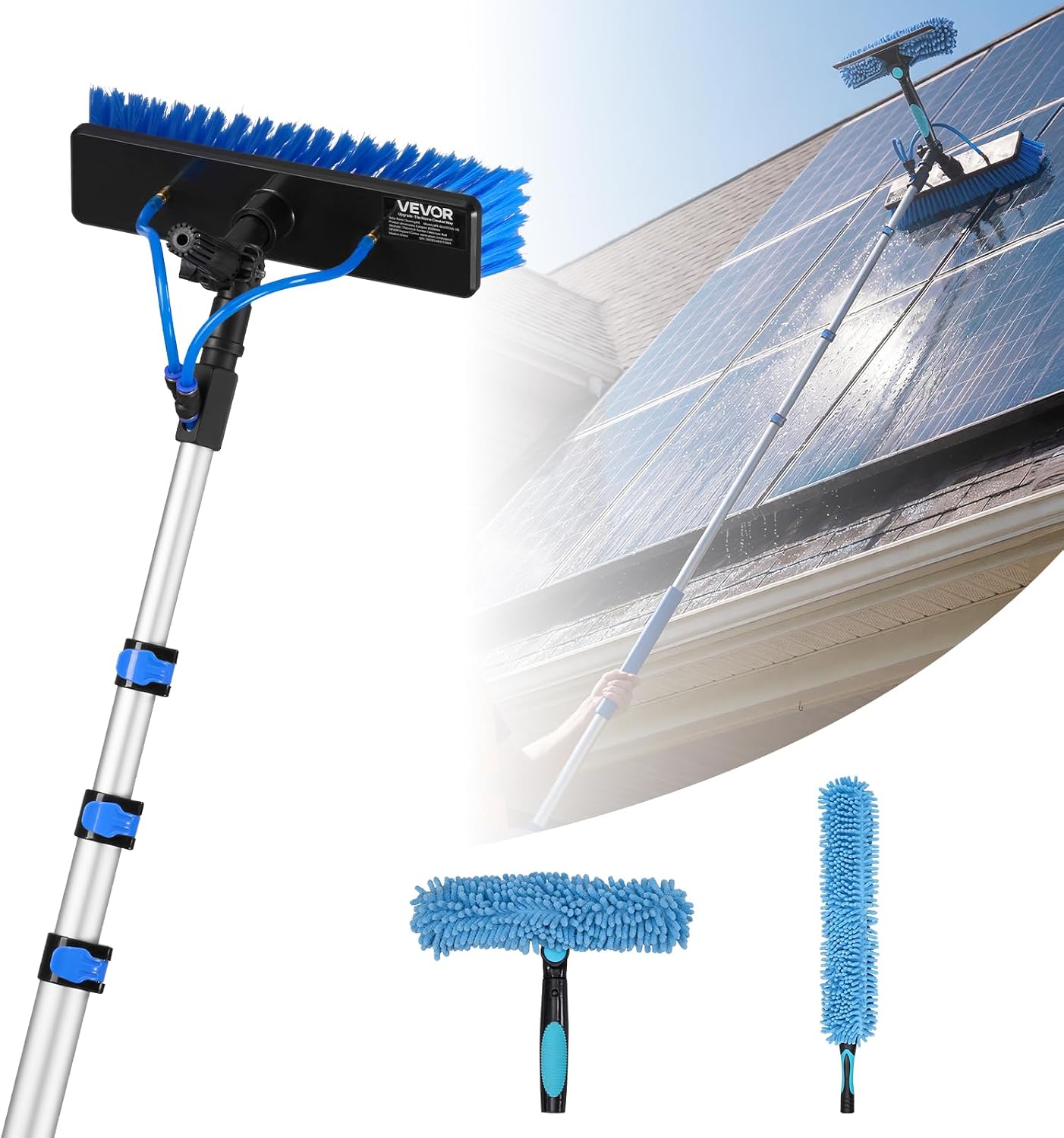
VEVOR 26 ft Solar Panel Cleaning Kit
4.2rating on AmazonFor single-story roofs and ground mounts: VEVOR's aluminum telescopic pole extends to 26 ft and feeds water to the brush through a 65.6 ft hose, so you stay off the ladder.
As an Amazon Associate I earn from qualifying purchases. Prices and availability live on Amazon.See price on AmazonListing checked September 5, 2026.Who should skip this
Skip this if the top row of your array sits two stories up — 26 ft of aluminum gets heavy fast at full extension, and a pole that just barely reaches means you'll end up on a ladder anyway. If your panels are on a low ground mount or a carport, the shorter EVERSPROUT squeegee and scrubber does the same work with less pole to wrestle. And if your roof is steep or tile, or your installer's warranty spells out professional cleaning, get a quote instead.
The full review
The VEVOR 26 ft kit is a plain, useful piece of gear: an aluminum telescopic pole that extends to 26 ft, a 180-degree rotating brush head, a soap dispenser and a 65.6 ft hose with quick connectors. It's aimed at homeowners with ground mounts, carports or single-story roofs who want the far row of panels reachable from a spot where both feet stay on the dirt. It is not a purified-water system, so whatever your hose delivers is what dries on your glass.
Why we picked it for the entry tier
Reach is the spec that decides whether a kit works for your house, and 26 ft is more than most budget poles offer. VEVOR states the pole is aluminum alloy with a buckle-style height adjustment, which is the usual tradeoff at this level: heavier than carbon fiber, cheaper to replace if you dent it.
The water-fed part is simple. A hose and quick connectors feed water to the brush head, and the dispenser lets you add soap. There's no filter in the description, so it belongs with the simpler kits and water-fed poles we compare rather than with pro deionizing rigs.
Will 26 feet actually reach my panels?
Pole length and working reach aren't the same number. VEVOR says the pole extends up to 26 ft; how much of your array you can actually scrub depends on where you stand, your roof pitch and how far the gutter edge sits from the panels.
A rough way to check before you buy:
- Measure gutter height from the ground, then add the distance from the eave to the top row of panels.
- Stand back far enough that the pole meets the glass at a shallow angle, not straight on.
- Add a few feet of slack — a fully extended pole flexes, and you'll be pushing, not just resting it.
- Single-story: usually comfortable. Two-story: expect to be at the limit, with a heavy pole overhead.
Aluminum at full extension is real work for shoulders and wrists. Plan on short sessions, and never let a wet pole near a service drop or overhead line.
What about water spots?
This kit runs on tap water unless you add your own purification. Tap water leaves dissolved minerals behind when it dries, which is why pro cleaners use deionized or RO water and let panels air-dry spot-free.
Two workable paths: wash and then squeegee or dry the glass before it sheets off, or add an inline filter or DI stage to the hose line. Our ground-cleaning guide walks through both, plus the timing that matters most — early morning, cool glass, no direct sun.
How does it fit a normal cleaning routine?
For most US homes, one or two washes a year is plenty unless you're near farmland, a highway, or under trees where pollen and bird droppings pile up. Rinse first, brush gently with the soft head, rinse again, and skip anything abrasive or solvent-based near the frame seals.
If you want to know whether a wash is even worth your Saturday, the soiling-loss calculator puts a dollar figure on the dirt. Dust films commonly cost panels 5-25% of output, and heavy droppings can knock out whole strings until they're cleaned off.
Verdict
Buy it if your panels are low, your budget is modest, and you're comfortable handling a long aluminum pole. Skip it if the top row of your array is two stories up, or if your warranty requires professional cleaning — in those cases a vetted local pro is money well spent. For everything in between, this kit does its one job: let the sun back in.
Specs
| Max pole length | 26 ft |
|---|---|
| Pole material | Aluminum alloy |
| Water fed | Yes |
| Brush included | Yes |
How it compares
| Product | Max pole length (ft) | Pole material | Water fed | Filtration | Brush included | Tier | What it doesn’t include |
|---|---|---|---|---|---|---|---|
| This pageVEVOR 26 ft Solar Panel Cleaning Kit | 26 ft | Aluminum alloy | Yes | Yes | Entry | ||
| XERO Pro Basic 30 ft Carbon Fiber Water Fed Pole | 30 ft | Carbon fiber | Yes | None | Yes | Pro | XERO's solar-specific pole-and-brush combo is sold only through WindowCleaner.com. This is the pole half; pair it with the Tucker Alpha Honey Badger brush. |
| Tucker Ultimate Residential Kit with Rival-V2 4-Stage RO/DI | 25 ft | 100% high-grade carbon fiber | Yes | RIVAL-V2 4-stage RO/DI cart | Yes | Pro | This is the Rival-V2 build. The Rival-V2 Basic 4-Stage kit (B0DK5XZLP1) is unavailable. |
| 24 ft Water Fed Pole Kit with Inline Water Filter and TDS Meter | 24 ft | Aerospace-grade aluminum | Yes | Inline mixed-bed resin filter, TDS meter | Yes | Mid | The Amazon listing is the 24 ft build, not the 20 ft. Correct every 20 ft reference on the page. |
| EVERSPROUT Swivel Squeegee & Microfiber Scrubber (5-12 ft pole) | 13 ft | Aluminum | No | None | No | Entry | This is a squeegee and microfiber scrubber on a 5-to-12 ft pole, not a complete kit. EVERSPROUT's Total Kit (B07N4BGFDL) is unavailable on Amazon. |
| 30 ft Reach Solar Panel Cleaning Brush Kit with Telescopic Pole | Mid | The Mr. LongArm 1009, 1005 and 1008 are all currently unavailable on Amazon. This is the closest 30 ft equivalent. Backup link if the 1009 restocks: https://amzn.to/4qGDmh4 | |||||
| Tucker Alpha Solar Brush (Honey Badger) | Yes | None | Yes | Pro | |||
| Unger HydroPower Ultra 3-Stage DI System (UHP03) | DI tank with integrated TDS meter | No | Pro | No Amazon bundle pairs the DI unit with the nLite pole. This is the DI half only — the pole is a separate purchase. |
Put your own panels into the soiling-loss calculator to see what dirty glass costs you each year. Then read Cleaning Solar Panels from the Ground: A Complete Guide.
Rather not DIY? Get free quotes from vetted local pros, the safer choice for anything above one story.