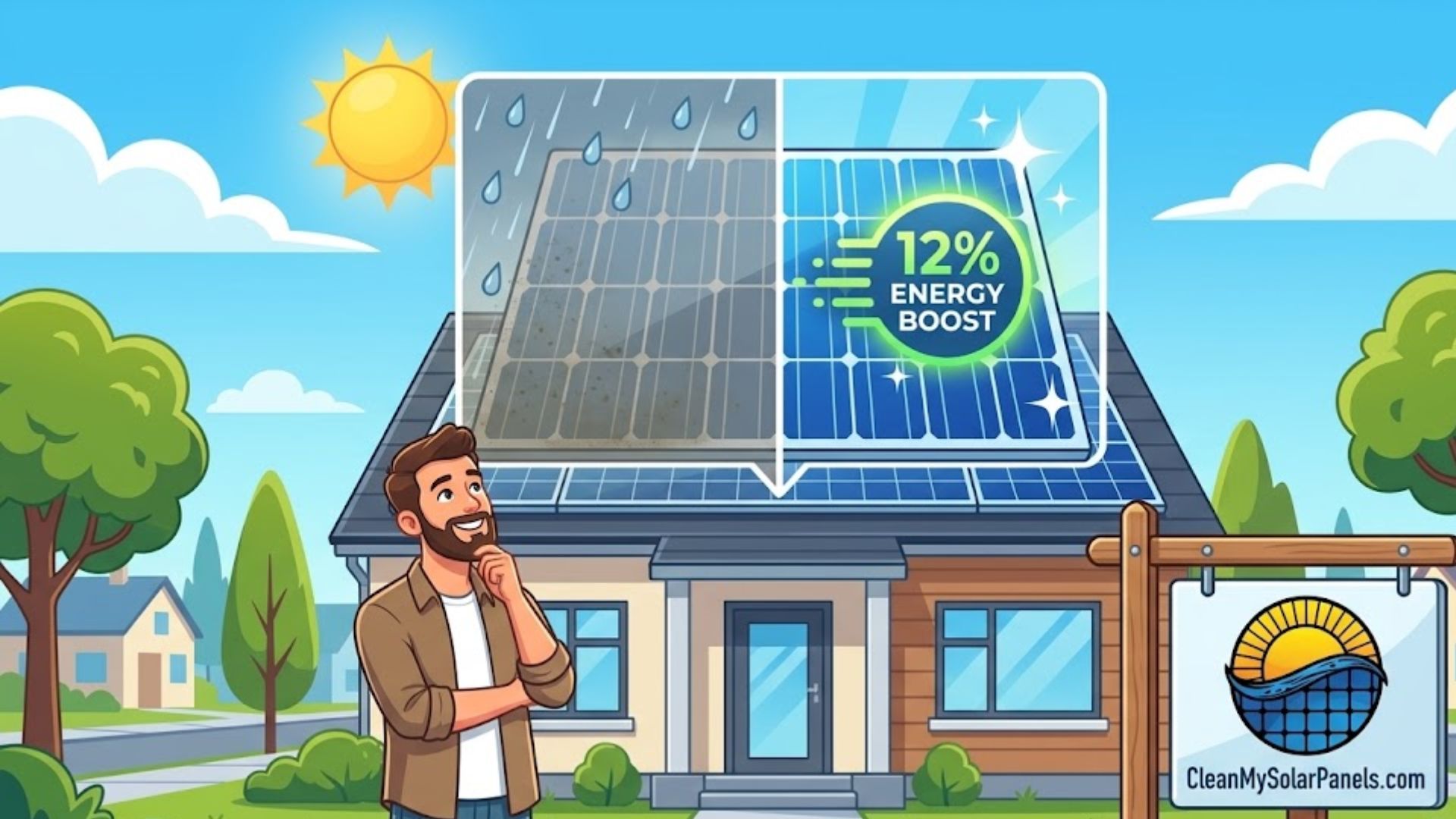
Do Solar Panels Really Need to Be Cleaned?
By Adam, Founder, CleanMySolarPanels · March 23, 2026
Yes, solar panels need cleaning — in Google's own test, washing flat panels that had been left to the rain for fifteen months doubled their output. Tilted rooftop panels fared better in that study because rain rinses ordinary dust off a pitched roof — but rain never removes the sticky stuff: sap, bird droppings, moss, and pollen. That residue is why NREL measures soiling losses of 2% to 7%, depending on how dusty your area is.
The fix is cheap relative to what dirt costs you. A professional cleaning typically runs $110–$320, restores lost output the same day, and prevents the localized hotspots that can permanently scorch panel cells.
Below: the rain myth, the Google data, the science of soiling losses, and the math on when cleaning pays for itself.
The Big One: Debunking the “Rain Myth”
The number one reason homeowners refuse to clean their solar panels is that they believe the weather will do it for them. “I don’t need to clean them,” the logic goes, “the next big rainstorm will just wash the dust away.”
This is the most pervasive myth in the solar industry, and unfortunately, it is entirely false.
“Thinking the rain will clean your solar panels is exactly like thinking the rain will wash your car. Rain moves dirt around, but it doesn’t wash it off.”
Think about your car after a long dry spell. It gets covered in a thin film of dust. When a light rainstorm rolls through, it doesn’t leave your car looking like it just came out of a professional car wash. Instead, the raindrops mix with the airborne dust, settle on the hood, and dry into muddy, spotted rings.
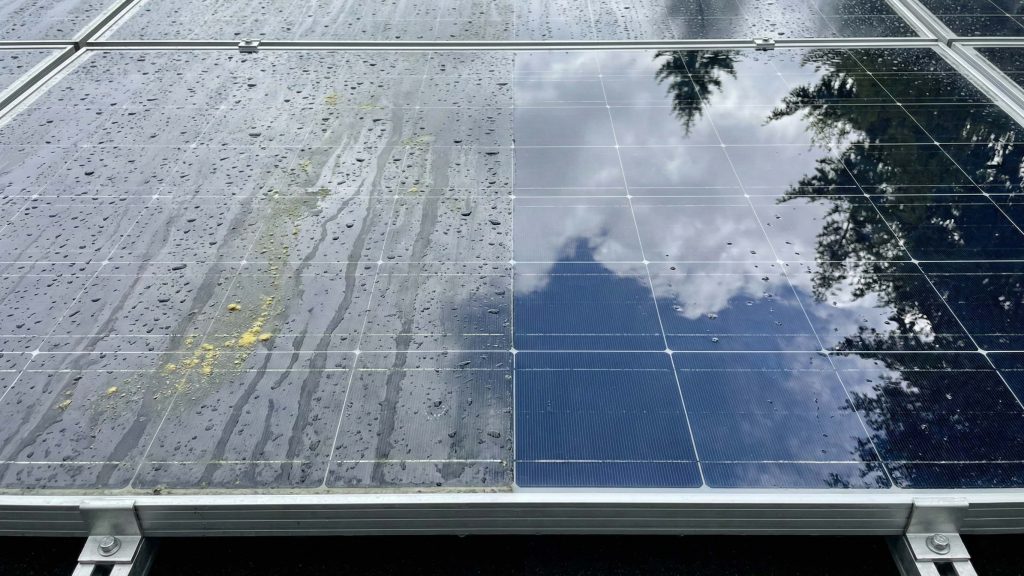
The exact same physical process happens to your solar panels. For example, homeowners in the Pacific Northwest often ask if the Beaverton rain is enough to keep their arrays clean. The answer is always no. Rain might rinse off loose leaves or heavy, loose dirt, but it leaves behind a sticky, baked-on layer of atmospheric grime, urban smog, and pollen. Over time, the sun bakes this residue into a hazy film that permanently blocks sunlight. Rain is not a cleaning agent; it is often just another source of dirty water.
The Google Efficiency Fact: Hard Data on Dirt
If you are still wondering, does cleaning solar panels help in any measurable way, you don’t have to take our word for it. You can look at one of the largest tech companies in the world: Google.
Google operates massive solar farms at their headquarters in Mountain View, California. Originally, their engineers operated under the same assumption as most homeowners—they assumed that the seasonal California rains would be enough to keep the panels relatively clean.
To test this theory, Google conducted a massive internal study. They left some panels entirely to the rain and professionally cleaned others. The results shocked them. The result is more useful than the version that gets repeated online, because it splits by roof angle. On Google’s flat carport panels, left fifteen months, the first cleaning doubled output and a second cleaning eight months later added 36%. On its tilted rooftop panels there was only a small gain — rain really was cleaning those adequately.
So the honest answer to “will rain do it?” depends on your tilt. If your panels lie flat or nearly flat, rain pools and dries in place and washing genuinely pays. If they sit at a normal roof pitch, rain handles most ordinary dust — and what it leaves behind is not dust. It is sap, bird droppings, moss and pollen, which are sticky or opaque and stay exactly where they are through a whole winter of Oregon rain.
Rain vs. Professional Cleaning: A Quick Comparison
To put this into perspective, here is exactly what happens when you rely on the weather versus trusting a local expert:
| Feature | Relying on the Rain | Professional Cleaning |
| Dirt Removal | Only rinses loose dust; leaves baked-on grime | Removes 100% of dust, sap, smog, and bird droppings |
| Efficiency Impact | Power output continues to drop over time | Instantly restores up to 12%-25% of lost power |
| Hotspot Prevention | None (bird droppings and sap remain) | Yes (completely eliminates localized shading) |
| Warranty Protection | Neutral / Risky | Yes (provides proof of proper maintenance) |
| Water Quality | Often leaves muddy, spotted residue | Uses Deionized (DI) water for a spotless, streak-free finish |
The Science of “Soiling Losses”
To understand why dirt is so detrimental, you need to understand how your panels work. Solar panels are coated in a highly sensitive anti-reflective layer. This layer is engineered to catch as much sunlight as possible and pull it directly into the photovoltaic cells beneath the glass.
In the solar industry, the barrier created by dirt is called a “soiling loss,” and its severity depends entirely on where you live. For instance, homeowners in coastal cities like Key West and Boca Raton battle sticky sea salt spray and heavy coastal bird droppings that aggressively coat the glass. Meanwhile, properties in dry, dusty climates like Bend accumulate a thick, light-blocking layer of dust much faster than the national average.
When your panels are covered in this regional debris, the sunlight hits that dirt and bounces off before it can ever reach the cells. Your system might be functioning flawlessly on a mechanical level, but it is effectively operating blindfolded.
A drop of 2% to 7% — NREL’s measured range, depending on how dusty your area is — might not sound like a crisis, but it translates directly to your utility bill. Every kilowatt-hour your dirty panels fail to produce is a kilowatt-hour you are forced to buy back from the local utility grid at premium prices. By ignoring the grime on your roof, you are throwing away the free energy you already paid to generate.
Avoiding Hotspots and Protecting Your Warranty
Aside from simple dust, there are more dangerous culprits on your roof. Bird droppings, thick patches of tree sap, and wet leaves create localized shading. Because the rest of the solar panel is working hard to produce electricity, the energy gets bottlenecked at these shaded, dirty spots.
This bottleneck acts as an electrical resistor, causing that specific spot on the panel to severely overheat. This creates what engineers call a “hotspot.” Hotspots can permanently scorch the internal cells of your solar panel, dramatically reducing its lifespan and potentially costing thousands of dollars to replace.
Furthermore, you cannot simply climb on your roof and scrub these off with a household sponge or dish soap. Solar glass scratches incredibly easily. If you use abrasive chemicals or hard tap water (which leaves chalky mineral stains), you will permanently damage the anti-reflective coating. The moment you scratch that glass, your expensive manufacturer warranty is instantly voided.
The Financial Verdict: Is Solar Panel Cleaning Worth It?
So, we come to the ultimate question for the skeptical homeowner: is solar panel cleaning worth it?
The answer is a resounding yes, provided you look at it as an investment with an immediate return, rather than a home maintenance chore.
Whether you are trying to offset massive summer air conditioning costs in Orlando or relying on a smaller array to power your home in Eugene, every bit of power matters. Let’s do some simple, conservative math. If your solar system normally saves you $2,000 a year on your electricity bills, but it is covered in baked-on dust and operating at a 15% loss, you are losing $300 a year to the utility company.
If you hire a local professional to clean your panels for $150, you instantly recover that lost power. The cleaning pays for itself, puts $150 of net profit back into your pocket, and protects your expensive equipment from permanent hotspot damage. It is one of the few home maintenance services that actively pays you back.
For a deeper dive into the specific math of these losses, check out our guide on the true cost of a dirty solar panel.
Why You Should Rely on CleanMySolarPanels.com
At the end of the day, climbing onto a slanted roof to wrestle with heavy, specialized cleaning equipment is incredibly dangerous and time-consuming. You bought solar panels to make your life easier, not to add a hazardous chore to your weekend to-do list.
That is exactly why CleanMySolarPanels.com exists. We are your ultimate matchmaker in the solar industry. We make it incredibly easy to find qualified, insured, and highly-rated solar cleaning professionals right in your specific neighborhood.
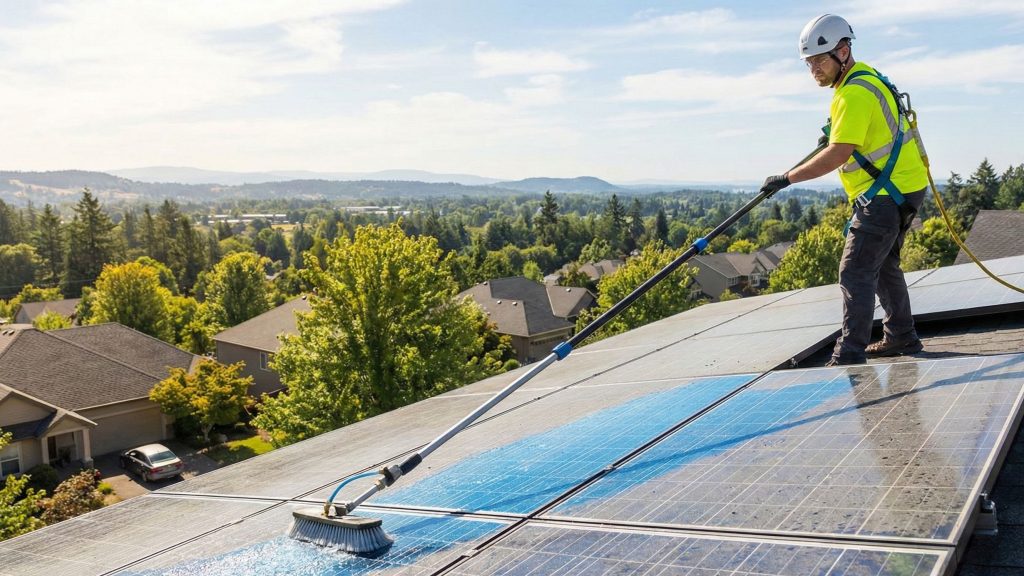
These local experts own the specialized deionized (DI) water filtration systems and the ultra-soft carbon-fiber brushes required to safely clean premium panels without scratching them or voiding your warranty.
Don’t let dirt eat your hard-earned profits.
Stop relying on the rain myth and start treating your solar array like the high-yield investment it is. Take a few seconds to compare quotes from local professionals to see your true ROI today.