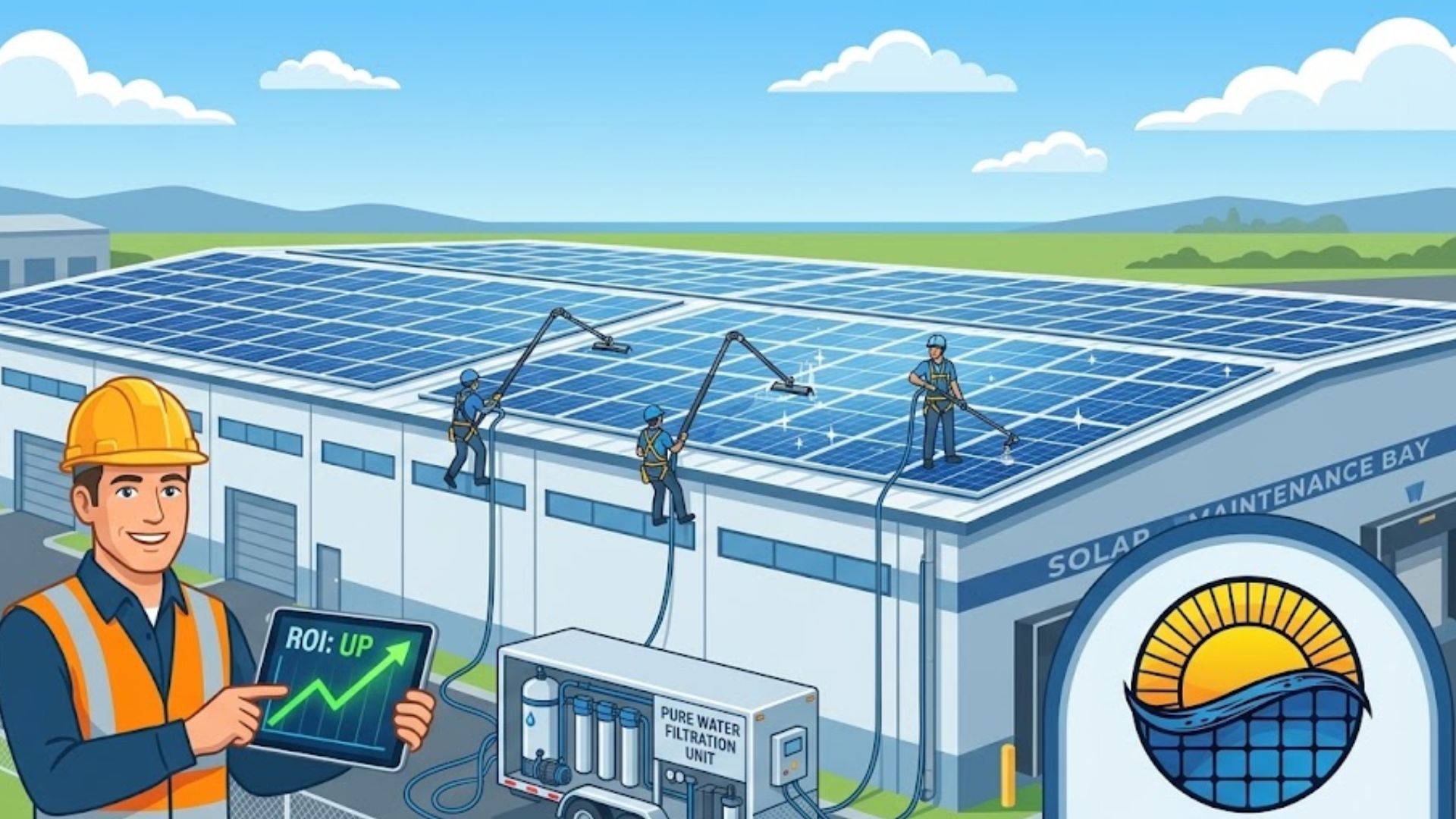
Commercial Solar Panel Cleaning: The ROI of Clean Energy
By Adam, Founder, CleanMySolarPanels · May 15, 2026 · Updated October 29, 2026
Commercial solar panel cleaning pays for itself on arrays over 100 kW, because the loss scales with size and the cost does not. NREL puts typical soiling loss at 5%, up to 25% in dusty regions. On a 1 MW array at $0.12 per kWh, 5% is $8,400 a year; Fresno pros recommend three or four cleanings a year.
A home system loses a few percent and a few hundred dollars. A warehouse roof, a carport or a 40-acre ground mount loses the same few percent of a much bigger number, and usually more, because flat roofs, highways, farms and birds all make commercial soiling worse. The NREL soiling map measures that loss at 255 sites.
This guide is for the people who sign the maintenance budget: facility managers, property managers, HOA boards, farm owners and small solar-farm owners. It covers why commercial arrays get dirtier, the ROI maths for 100 kW, 500 kW and 1 MW, pricing, frequency, methods, safety, contracts and choosing a contractor.
Why commercial arrays soil faster than homes
Residential panels sit on pitched roofs in suburbs. Commercial panels sit where the dirt is, at angles that hold it.
- Flat and low-tilt roofs. Ballasted arrays on warehouses are tilted 5° to 10°. Rain pools in the middle of each panel and along the bottom edge, then dries and leaves a ring of mud. A flat array in a mild climate can soil as badly as a pitched one in the desert.
- Carports. They sit under trees and under the birds that live in them. Droppings bake on, sap and leaf litter collect at the lower edge, and carports are the hardest arrays to reach from the ground. See removing tree sap for the dwell-time method.
- Warehouses near highways and industrial parks. Diesel soot and tyre dust are oily and bond to the glass. Pros in Newark and Detroit both list a late-summer particulate peak on top of spring pollen.
- Rooftop exhaust. Kitchen vents and process exhaust lay a greasy film that holds every other kind of dirt.
- Farms and solar farms. Tillage and harvest put topsoil, chaff and fertiliser dust in the air twice a year, and ground mounts also take mud splash-back from the rows beneath them. In Omaha, where pros recommend two cleanings a year, the peaks are April to May and September to October.
- Scale. A 1 MW array is 2,000 or more panels, so a loss invisible on one roof is a line item here. NREL also notes that its model does not fully capture pollen and biological soiling, so under trees the measured number is a floor.
The ROI maths: 100 kW, 500 kW and 1 MW
The formula is simple, and you should run it with your own numbers.
Annual soiling loss ($) = array size (kW) × annual yield (kWh per kW) × soiling loss (%) × electricity value ($ per kWh)
Two inputs here are assumptions, and both are easy to swap. The yield is set at 1,400 kWh per installed kW per year, a mid-range US figure; your monitoring portal shows your real one. The electricity value is set at $0.12 per kWh. Use your blended commercial rate, or your PPA rate if you sell the power; demand charges and time-of-use peaks can push the real value of a midday kWh well above the average.
The soiling percentages come straight from NREL: around 5% a year in a typical climate, 7% where it is dusty, 10% to 15% during pollen season, and up to 25% in the dustiest regions.
| Array size | Annual output at 1,400 kWh/kW | Annual value at $0.12/kWh | 5% soiling loss (typical) | 7% loss (dusty) | 25% loss (dustiest) |
| 100 kW | 140,000 kWh | $16,800 | $840 a year | $1,176 a year | $4,200 a year |
| 500 kW | 700,000 kWh | $84,000 | $4,200 a year | $5,880 a year | $21,000 a year |
| 1 MW | 1,400,000 kWh | $168,000 | $8,400 a year | $11,760 a year | $42,000 a year |
Read the table against your cleaning quote. If a 500 kW roof in a typical climate costs less than $4,200 a year to keep clean, cleaning is cash positive before you count anything else. In the desert, the Central Valley or farm country the 7% column is the baseline and the 25% column is a neglected array after a dry summer.
Three things the table does not show push the real return higher:
- The loss is not spread evenly. Soiling peaks in the sunniest months, so 5% a year is nearer 10% in the weeks that matter.
- Hot spots cost panels. A patch of droppings shades a few cells, the string pushes current through them, and they overheat. The Department of Energy describes the mechanism. A replaced panel costs more than a year of cleaning.
- Guarantees. If your installer or financier set a production guarantee, soiling is the gap between the model and the meter. Our guide to the true cost of a dirty panel goes deeper, and the savings calculator takes your own size and rate.
How commercial cleaning is priced
Residential cleaning is quoted in a national band of roughly $110–$320 per visit, about $6 to $16 per panel. Commercial work does not fit in a band, because two 500 kW arrays can take two very different days, so every commercial price is quoted per site after a walk-through. What drives the quote:
- Per panel, falling with volume. The per-panel rate on 2,000 panels is a fraction of the rate on 20, because the crew sets up once and works for a day.
- Per visit versus annual contract. A one-off visit is priced for the dirt that is there. An annual contract fixes two to four visits at a lower per-visit price and usually includes production reporting.
- Access. Ground mounts with drivable rows are cheapest. Flat roofs with a parapet and no anchors cost more. Carports need a lift or a long pole from a truck. Access is often the bigger line.
- Water. A crew with a truck-mounted RO/DI system makes its own pure water; a remote site may need it trucked in.
- Extras. Bird proofing, debris removal, thermal imaging and a written report are each a line.
The cost guide has the residential price for every city this directory covers, a sanity check on any per-panel rate you are quoted.
How often to clean, by environment
The schedule depends on where the array is and what is in the air. The city pages on this directory record what local pros recommend; a flat commercial roof needs the top of each range.
| Environment | Cleanings a year | Example cities (what local pros recommend) | Timing |
| Desert and Central Valley dust | 3 to 4 | Fresno (3–4), Las Vegas (3–4), Phoenix (2–4), Riverside (2–4) | Through the dry season, May to October, and after the monsoon |
| Coastal salt | 2 to 3 | Honolulu (2), Key West (2) | After the dry-season salt film, and after Saharan dust in Florida |
| Farm dust | 2 | Omaha (2), Des Moines (1–2), Wichita (2) | After planting and after harvest |
| Pollen belt | 1 to 2 | Houston (2), Atlanta (1–2) | As soon as the spring pollen ends, before peak summer sun |
| Wildfire and high desert | 2 to 3 | Salt Lake City (2–3), Boise (2–3) | Late spring, then as soon as the smoke clears |
| Industrial and highway | 2 | Newark (1–2), Detroit (1–2) | After pollen, and after the late-summer haze |
Dust. In Phoenix, where pros recommend two to four cleanings a year, and Las Vegas, where they recommend three or four, there is no rain from May to September to rinse anything. Fresno adds Central Valley farm dust and late-summer smoke to the same dry season, which is why it tops the Grime Index. A flat warehouse roof in these cities is a quarterly job.
Salt. In Honolulu, where pros recommend two cleanings a year, the dry season from May to September lays down salt spray and trade-wind dust. In Key West the salt film builds February to April, then Saharan dust arrives in June. Salt also attacks aluminium frames and connectors, so coastal cleaning is hardware maintenance too.
Farm dust. Des Moines pros say the autumn harvest is usually the worst, and in Wichita it is the June to September wheat harvest. Harvest dust is oily and sets hard once dew lands on it, so the post-harvest cleaning is the one not to skip. Our Willamette Valley farm guide works through the same calendar for vineyards and livestock barns.
Pollen. In Houston the pollen runs March to May and the dust July to September, so pros there recommend two visits. Atlanta pine and oak pollen peaks late March to April and leaves the yellow film behind NREL's 10% to 15% pollen-season figure. Clean the week it stops.
Every city this directory covers has its own page with the frequency, dust season and price band: browse all cities. The how often guide is the residential version.
Methods at scale
The residential method, purified water and a soft brush on a water-fed pole, is also the commercial method. Scale changes the delivery, not the chemistry. Our guide to cleaning panels from the ground has the basics.
- Water-fed poles from a truck. For rooftops and carports the crew runs pure water from a vehicle-mounted RO/DI unit up the pole. A carbon-fibre pole such as the XERO Pro Basic 30 ft reaches a single-storey carport from the ground; roofs need the crew up top. Our guide to the best soft brushes explains why bristle type matters.
- Rotating brush heads. A wide rotating brush like the Tucker Alpha Solar Brush covers more glass per hour. The speed comes from width, not pressure.
- Tractor-mounted brushes. On ground mounts with drivable rows a slow tractor carries a long rotating brush with a water feed along each row. It is how most utility-scale arrays are cleaned, and the cheapest per panel.
- Robots. Rail-mounted robots clean the same rows every night on large dusty ground mounts. They make sense on multi-megawatt sites, not on a rooftop with HVAC units in the way.
- Drone washing. Spray drones rinse hard-to-reach roofs and carports, but a rinse without brushing leaves bonded dirt in place, so ask what the drone does about the stubborn 20%.
- Waterless brushing. In drought regions crews dry-brush loose dust with ultra-soft rotating heads and reserve water for a periodic deep clean. It works on dry dust, not on pollen, sap or droppings.
Water use. Pure water is the only cleaning agent a warranty-safe method needs. Tap water leaves mineral spots, which is why crews deionise it and check it with a TDS meter before it goes up the pole. The water goes through a brush, not a spray, so use per panel is modest; on a farm, ask for the litres-per-panel figure. Pressure washing is never used: REC's cleaning guide says high-pressure hoses, pressure or steam cleaners and metallic sponges are not permitted and will invalidate the warranty.
Safety and compliance
Commercial cleaning is roof work, lift work and electrical-adjacent work at once. The contractor carries the risk; the site owner sets the rules.
- Fall protection. OSHA requires fall protection at four feet in general industry, six feet in construction. On a flat roof that means a guardrail, a designated area with a warning line, or anchors and harnesses near the edge and around skylights. A crew with a proper fall-protection kit should be able to show you its inspection log.
- Lifts. Boom and scissor lifts need operators with documented training. Ask for the cards.
- Electrical. A cleaning does not require a shutdown and lockout is not needed for washing glass; the panels keep producing DC in daylight whether or not the inverter is on, and nothing electrical is opened. Site rules may still require a permit to work. REC's guide notes that damaged panels are a shock hazard when wet, so a visual inspection for cracks comes before the water. See our guide on whether to turn the system off.
- The panels themselves. No one walks on the panels. REC's instruction is to never stand on, walk on, lean on or apply pressure to a module.
- Roof membrane. TPO and EPDM roofs puncture. Ask how the crew protects the membrane under hoses, poles and feet.
- Insurance. General liability and workers' compensation certificates naming your site, before anyone arrives.
- Site hours. Washing happens early or late in the day when the glass is cool. Agree the hours, the water point and where the truck parks.
What a good commercial cleaning contract includes
A commercial contract is an O&M document, not a receipt for a wash. Ask for each of these in writing:
- Before and after production report. Monitoring data for a clear day before and a clear day after, normalised for irradiance where the site has a sensor. This is the number that justifies the budget.
- Photos. Before and after, by roof section or row, timestamped.
- Inspection. A visual check for cracked glass, discoloured cells, loose connectors and shifted ballast. A thermal (IR) scan after cleaning finds hot spots that dirt was hiding.
- Bird and debris removal. Nesting material and droppings under the array, leaf litter at the lower edge, and whether bird proofing is needed.
- Damage reporting. Anything found is reported, photographed and left for the O&M provider. The cleaner does not open junction boxes.
- Cleaning agent spec. Pure water, deionised or RO/DI, to a stated TDS. No detergents, no acid or alkali cleaners, no abrasives.
- Method spec. Soft brush on a water-fed pole or soft rotating brush, no pressure washers, no walking on modules, ambient-temperature water on cool glass. The method should match the panel manufacturer's manual, because the warranty depends on it.
- Schedule and triggers. The fixed visits for the year, plus an agreed trigger for an extra visit after a dust storm, fire or harvest.
Cleaning as part of preventive maintenance
On a commercial array cleaning belongs in the O&M plan, next to inverter checks and vegetation control, not in a janitorial budget. The question is not whether to clean but when, and the better sites answer it with data.
Monitoring thresholds. Most commercial portals report a performance ratio or compare strings. Set a threshold, for example a sustained 5% drop on clear days that rain does not reverse, and let it trigger a cleaning. Our guide to the signs your panels need cleaning covers the visual checks.
Soiling sensors. Larger sites install a soiling station: two reference cells, one left to soil with the array and one washed daily, with software that reads the gap. The Department of Energy describes one such device that turns the measured soiling rate into a cleaning schedule balancing lost production against cleaning cost. On a dusty 1 MW site it replaces a guessed schedule with a measured one.
Rain is not a cleaning. Rain rinses loose dust and leaves everything bonded, and on a 5° roof it leaves a dirty puddle at the bottom edge of every panel; our guide to whether rain cleans solar panels explains why. Keep the dated reports from every clean: they are the maintenance history a warranty claim or a lender will ask for.
How to choose a commercial cleaning contractor
Residential pros can often do commercial work; the question is whether they have done it at your scale. Ask for:
- Insurance. Current general liability and workers' compensation certificates, with your site named.
- References on similar sites. A flat roof, a carport or a ground mount, whichever matches yours. Call them and ask about the production report.
- Method. Pure water and soft brushes, no pressure washing. A contractor who proposes detergent has not read the panel manual.
- Water quality. What TDS they wash at and how they make pure water. A crew that cannot answer will leave spots.
- Safety plan. Fall protection, lift training, the roof-membrane plan and the site induction they expect.
- Reporting and scheduling. A sample report, a commitment to the visits your environment needs, and a response time for trigger events.
Every city page on this directory lists the local pros, and many profiles state whether the company takes commercial work, including carports and ground mounts. Start with your city on the all cities page, or use the quote form with the array size, mount type and roof access, and the pros that serve your area respond with site-specific pricing. Pros adding commercial work can read our guides on starting a solar cleaning business and getting more leads, plus how to price the work.
Residential versus commercial cleaning
| Residential | Commercial | |
| Typical array | 5 to 15 kW, 15 to 40 panels, pitched roof | 100 kW to several MW, 250 to thousands of panels, flat roof, carport or ground mount |
| Main soiling | Seasonal pollen, dust, local birds | Pooling on low tilt, highway soot, exhaust film, farm dust, flock-scale droppings |
| Typical loss | Around 5% a year (NREL) | 5% to 7% baseline, 10% to 25% on neglected flat or dusty arrays |
| Pricing | $110–$320 per visit, about $6 to $16 per panel | Quoted per site; per-panel rate falls with volume; access and water are separate lines |
| Frequency | 1 to 2 a year in most cities, 2 to 4 in dusty ones | Top of the local range, 2 to 4 a year, plus trigger visits |
| Method | Pure water and soft brush on a water-fed pole from the ground | Same chemistry, delivered by truck-fed poles, rotating brushes, tractors, robots or drones |
| Safety | Stay off the roof; hire a pro for two storeys | OSHA fall protection, lift training, membrane protection, site induction |
| Paperwork | Before and after photos | Production report, photos, IR scan, damage log, insurance certificates |
| Who decides | Homeowner | Facility or asset manager, often against a production guarantee |
The is cleaning worth it guide runs the residential maths city by city, and the homeowner's maintenance guide covers a small system's upkeep. For a commercial array, your monitoring data finishes the sums above.
Frequently asked questions
Is commercial solar panel cleaning worth it?
Almost always, once the array is over 100 kW. NREL measures around 5% annual soiling loss in typical climates and up to 25% in the dustiest, so a 500 kW array at $0.12 per kWh loses $4,200 to $21,000 a year to dirt. Commercial cleaning is quoted per site, and on most sites it costs less than it recovers.
How much does commercial solar panel cleaning cost?
It is quoted per site, not from a price list. The per-panel rate falls with volume, access (lifts, roof anchors, carports, ground mounts) is priced separately, and annual contracts cost less per visit than one-off cleans. As a sanity check, residential cleaning runs $110–$320 per visit, about $6 to $16 per panel, and large commercial per-panel rates sit below that.
How often should a commercial array be cleaned?
Two to four times a year, at the top of what local pros recommend for the city. Pros in Fresno and Las Vegas recommend three or four cleanings a year, in Phoenix and Riverside two to four, in Omaha and Wichita twice around planting and harvest, in Houston twice after pollen and dust. Flat roofs and carports need the top of the range.
Do commercial panels need to be shut down for cleaning?
No. A cleaning touches only the glass and frames, and the panels keep producing DC in daylight whether or not the inverter is on, so lockout is not required for washing. Site rules may still call for a permit to work, and the manufacturer's manual applies. Damaged panels are a shock risk when wet, so a visual inspection comes first.
What does OSHA require for rooftop solar cleaning?
Fall protection at four feet in general industry and six feet in construction. On a flat roof that means guardrails, a designated area with warning lines, or anchors and harnesses near edges and skylights, plus trained operators on any lift. The contractor carries this, but the site owner should see the safety plan and insurance certificates first.
Can commercial panels be pressure washed?
No. Manufacturers such as REC state that high-pressure hoses, pressure or steam cleaners, blades and metallic sponges are not permitted and invalidate the warranty, because the pressure exceeds the certified load and forces water between glass and frame. Commercial crews use pure water through soft brushes on poles, rotating heads or tractors.
What should a commercial cleaning report include?
A before and after production comparison on clear days, timestamped photos by section, a visual or thermal inspection noting cracks, hot spots and loose connectors, a record of bird and debris removal, a damage log, and the cleaning agent and method used. That is the maintenance history a warranty claim or a production guarantee dispute will ask for.
How do soiling sensors decide when to clean?
A soiling station pairs a reference cell that soils with the array against one that is washed daily, and software reads the gap as the soiling rate. The Department of Energy describes a device of this kind that turns the measured rate into a cleaning schedule balancing lost production against cleaning cost. On large dusty sites it replaces a guessed calendar with a measured one.
Do ground-mounted solar farms need different cleaning?
The chemistry is the same, pure water and soft brushes, but the delivery is a tractor-mounted rotating brush run along each row, or a rail-mounted robot on large dusty sites. Farm dust peaks after planting and after harvest, so two cleanings a year is the usual floor, and the post-harvest visit is the one that matters most.
How do I find a contractor who cleans commercial arrays?
Start with your city page on this directory, where local pros list their services and many state whether they take commercial, carport and ground-mount work, or send one quote request with the array size, mount type and access. Ask each for insurance certificates, references on similar sites, their water TDS and a sample report.