
How Often Do Willamette Valley Farms Need Solar Cleaning?
By Adam, Founder, CleanMySolarPanels · April 17, 2026
Willamette Valley farms need professional solar cleaning twice a year — once in late June after planting, and once in late October after harvest. Barns housing livestock or poultry push that to three or four cleanings a year, because ventilation fans exhaust corrosive ammonia straight onto the roof-mounted panels.
Farm arrays get dirtier than anything in town. Tilling and harvest dust puts a working array near the harsh 7% end of NREL's measured soiling range, above the 5% national average — and across a large array, even a few percent is real money off a seasonal margin.
Below: the valley's dirt profile, why vineyards have it worse, the two-clean farming-calendar schedule, and why winter rain and well water both make things worse.
The Unique Dirt Profile of the Willamette Valley
When a residential homeowner in the suburbs ignores their solar panels, they are usually just dealing with a light dusting of atmospheric smog and the occasional bird dropping. When a farmer ignores their panels, they are dealing with industrial-scale “soiling losses.”
Farming the Willamette basin requires moving massive amounts of earth. Whether you are running a disc harrow in the spring or pulling a combine harvester in the fall, your heavy machinery kicks up localized dust storms. This agricultural dust is dense, heavy, and full of organic matter.
For example, if you operate south of Portland, Marion County solar dust is famously thick during the late summer grass seed harvest. Plumes of this heavy dust settle directly onto your solar arrays. When the cool Oregon morning dew rolls in, that dry dust turns into a sticky, muddy paste that bakes onto the solar glass as soon as the afternoon sun hits it.
This heavy, baked-on layer acts like a literal shade cloth. Agricultural dust is at the harsh end of what NREL measures — tilling season puts a working array nearer the 7% top of its range than the 5% national average, and ground-mounts sit lower and flatter, so they shed less of it. Across a large array even a few percent is real money off a seasonal margin. Understanding the scale of this loss is exactly why dirty panels are costing you money on a commercial level.
Vineyards and Specialty Crops: A Sticky Situation
The Willamette Valley is globally renowned for its Pinot Noir, and many vineyards have adopted solar energy to power their tasting rooms and irrigation systems. However, cleaning vineyard solar panels introduces a completely different set of challenges.
Vineyards are highly managed environments. Tractors are constantly driving up and down the narrow rows, spraying organic fungicides, applying fertilizers, and kicking up fine soil. Because vineyard solar arrays are often ground-mounted right next to the vines to save space, they are constantly caught in the crossfire of this agricultural spray.
Furthermore, vineyards are often surrounded by towering native trees. This means vineyard arrays are frequently bombarded by sticky tree sap and heavy spring pollen. When agricultural dust mixes with sticky sap, it creates a concrete-like film that standard rain will absolutely never wash away.
How Often Should You Clean Farm Solar Panels?
Because of the intense environmental factors, the standard “once-a-year” cleaning rule for residential homes does not apply to active farms. To maintain peak efficiency, Willamette Valley farms require a more aggressive, seasonally targeted approach.
For maximum ROI, we highly recommend an agricultural solar cleaning Oregon schedule based around the farming calendar:
1. The Post-Planting Clean (Late Spring / Early Summer)
Between April and June, the Willamette Valley explodes with activity. Tractors are tilling the fields, and the local tree canopy releases some of the highest pollen counts in the country. By the end of June, your panels will be coated in a thick, yellow-green film.
- The Goal: Cleaning your panels in late June washes away the spring pollen and planting dust right before the longest, sunniest, and most productive days of the Oregon summer.
2. The Post-Harvest Clean (Late Autumn)
August, September, and October are the dustiest months in the valley. Harvest machinery runs around the clock, kicking up massive clouds of dry topsoil, chaff, and exhaust soot.
- The Goal: Cleaning your panels in late October removes the thick, baked-on harvest grime. It ensures your panels are completely clear so they can capture every possible drop of sunlight during the short, overcast, and rainy Pacific Northwest winter.
💡 Pro Tip for Livestock Farms: If your solar array is mounted on a barn that houses livestock or poultry, the ventilation fans exhaust highly corrosive ammonia vapors and dander directly onto the roof. These specific arrays often require cleaning three to four times a year to prevent the ammonia from permanently etching the solar glass.
The “Rain is Enough” Myth in the Valley
Many Oregonians falsely believe that the heavy winter rains will naturally wash their solar panels. We frequently have to explain to residential homeowners why the rain is never enough to clean a roof. For a farmer, relying on the rain is an even worse financial mistake.
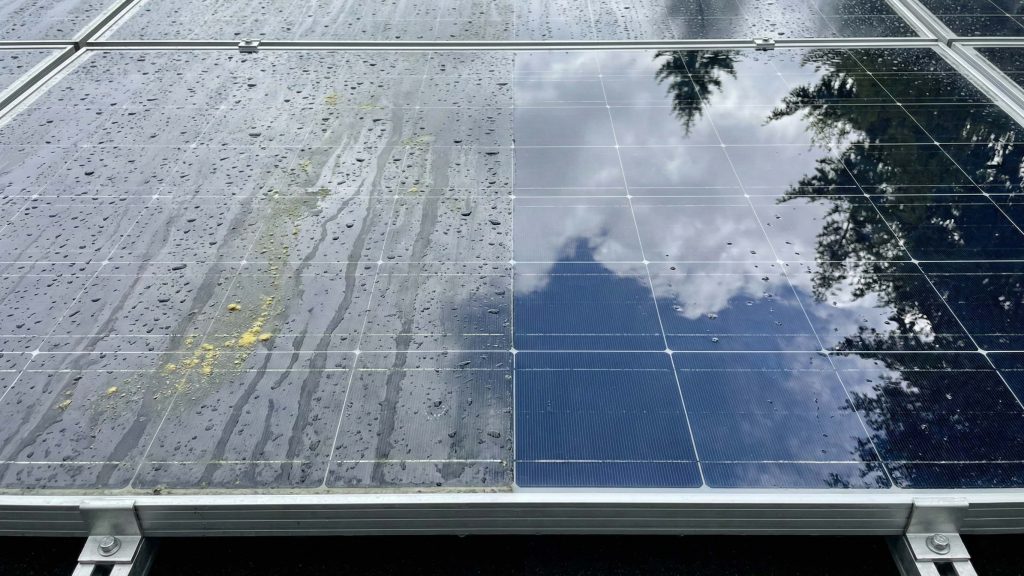
Rain does not have the friction required to scrub baked-on agricultural dust or sticky sap. Instead, the rain mixes with the thick dust on your farm panels and turns it into mud. As the water pools at the bottom edge of the panel frames, the mud dries, creating a thick, opaque barrier.
This is widely considered the dirty secret of solar power on farms. Because farm arrays often use string inverters, if the bottom row of your panels is heavily shaded by a mud dam, the energy production of the entire string drops to match that single dirty row.
Furthermore, allowing thick debris to pool under and around your arrays invites rodents and birds to nest, creating massive fire hazards. Staying proactive is the only way to manage the environment and clean safely under and around your solar panels.
The Danger of DIY: Why Well Water Ruins Solar Arrays
Farmers are the ultimate DIYers. You fix your own tractors, mend your own fences, and build your own barns. Naturally, your first instinct is to hook up a hose and wash the solar panels yourself.
However, if you run a rural farm, you are likely pulling water from a private agricultural well. Never spray well water onto your solar panels.
Agricultural well water is famously “hard.” It is packed with dissolved minerals, calcium, iron, and agricultural runoff. If you spray this hard water onto a hot solar panel, the water evaporates instantly, but the minerals do not. They bake into the glass, leaving a chalky, white mineral scale. This mineral scale permanently blocks sunlight. By trying to wash away the dust with a well hose, you will accidentally create a worse, more permanent “soiling loss.”
If you want a deeper dive into the mechanical and financial risks of using the wrong tools or ignoring the problem entirely, check out our comprehensive guide on how bad it is if you don’t clean your solar panels properly.
The Professional Solution: Deionized Water
To safely clean a multi-thousand-dollar agricultural array without voiding the manufacturer’s warranty, you must use 100% pure water.
When you hire a local Oregon professional who specializes in commercial and agricultural solar maintenance, they arrive with heavy-duty Deionized (DI) Water Filtration Systems. They run water through a specialized resin tank that strips out every single dissolved mineral.
They pump this pure water through lightweight, extendable carbon-fiber poles tipped with ultra-soft, scratch-free brushes. The pure water acts as a magnet for the agricultural dust, lifting it away safely. Because there are absolutely no minerals in the water, the panels are left to air-dry completely spotless, streak-free, and hyper-efficient.
Conclusion: Protect Your Agricultural Bottom Line
Your farm’s solar array is a high-yield financial asset designed to dramatically lower your overhead operating costs. However, that asset is constantly under attack from the very dirt and dust that makes the Willamette Valley so fertile.
When you review the true cost of a dirty solar panel driven by hard data, the math is undeniable. Even a few percent across a large agricultural array runs into real money over a season, and tilling dust puts a working farm at the harsh end of the measured range rather than the average. The affordable flat-fee of a professional, biannual cleaning literally pays for itself in recovered energy production.
Don’t let harvest dust eat your hard-earned profits.
Leave the specialized DI water systems and the delicate solar glass to the experts. Whether you need routine solar cleaning for your home near Eugene or specialized cleaning in the northern valley, CleanMySolarPanels.com makes it easy to find qualified, insured, and highly-rated commercial solar cleaners in your area.