
How Should I Price Solar Panel Cleaning in the Oregon Market?
By Adam, Founder, CleanMySolarPanels · April 24, 2026
In Oregon, price residential solar cleaning at $8–$15 per panel with a minimum call-out fee of $149–$199 — anything below that and drive time eats your margin. Established outfits often simplify this into flat tiers: $199 for up to 15 panels, $249 for 16–25, $349 for 26–40. Commercial arrays price differently, at $15–$25 per kW.
Oregon jobs run harder than sun-belt jobs. Slick, steep roofs justify a 20–30% surcharge, and heavy moss or lichen turns a standard clean into a restoration job billed at a higher per-panel or hourly rate.
Below: how to set your baseline from real operating costs, when to add the PNW difficulty premiums, and how to quote commercial and agricultural work.
The Baseline: Establishing Your Minimum Operating Cost
Before you can give a homeowner a quote, you have to know your exact numbers. Many new business owners make the critical mistake of pricing based on what the “other guy” is charging, without realizing the other guy might be operating at a loss.
Operating a professional solar cleaning business in Oregon carries specific overhead costs that must be baked into your baseline pricing:
- High-Grade DI Water Systems: Because Oregon homeowners are highly protective of their manufacturer warranties, you cannot use hard tap water. You must account for the cost of Deionized (DI) water resin replacement, which strips the minerals out of your water supply.
- Oregon Labor Rates: Oregon has one of the highest minimum wages in the country, especially within the Portland Metro boundary. If you plan to hire employees, your pricing must support a living wage, payroll taxes, and workers’ compensation.
- Premium Liability Insurance: You are working on wet, high-voltage electrical equipment on slanted roofs. Your liability and bonding insurance premiums will be significant, and every job you price must contribute to covering that monthly overhead.
As a general rule for 2026, your absolute minimum mobilization fee (just to show up at a property and unroll your hoses) should be between $149 and $199. If you price a job below this threshold, your drive time and setup time will eat your entire profit margin.
The “PNW Premium”: Factoring in Roof Difficulty
In dry climates, a standard 20-panel residential job on a flat roof might take 45 minutes from start to finish. In Oregon, that exact same 20-panel array could take two to three hours. Your pricing model must reflect the physical realities of the Pacific Northwest environment.
The Steep Pitch and Slick Roof Factor
When quoting a residential property, the very first thing you must assess is the roof pitch.
Oregon winters are notoriously damp. Even on a dry July morning, the marine layer and early dew leave asphalt shingles and metal roofs incredibly slick. When you add a steep 35-degree or 40-degree pitch to the equation, the job goes from a simple wash to a complex rope-access operation.
If you or your crew have to deploy OSHA-approved safety harnesses, roof anchors, and specialized anti-slip footwear, your pricing must reflect that added danger and time.
- Pricing Strategy: Establish a “Steep Roof Surcharge.” For any roof over a 6/12 pitch, add an automatic 20% to 30% premium to the total job cost.
The Moss, Algae, and Lichen Factor
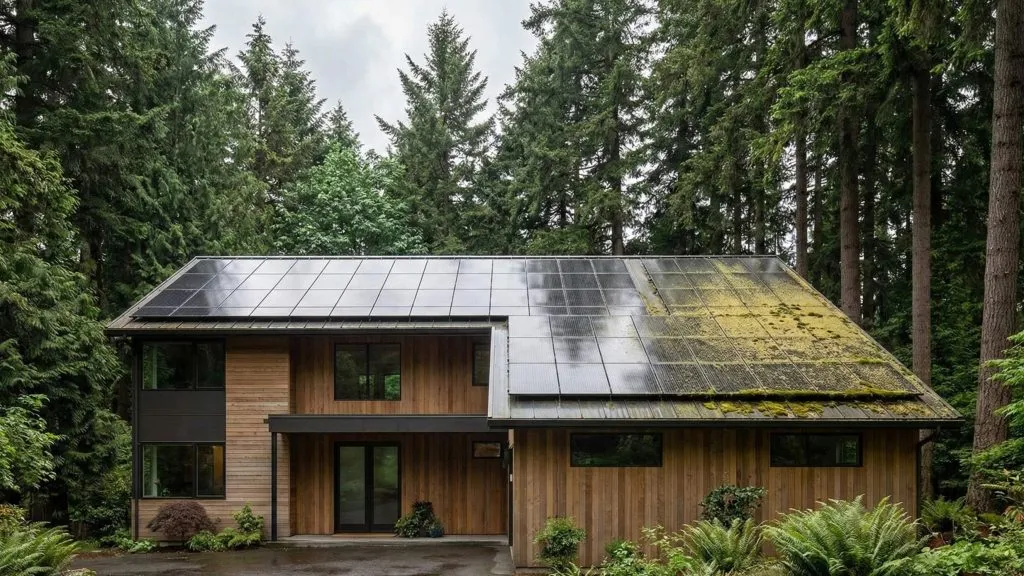
This is the ultimate defining characteristic of Portland solar maintenance pricing. In the damp, shaded neighborhoods of Multnomah and Washington counties, moss and lichen grow aggressively along the lower aluminum lips of solar panels.
Lichen literally roots itself into the micro-fissures of the glass. You cannot just quickly pass a water-fed pole over it and expect it to wash away. It requires intensive, slow, manual agitation with specialized soft-bristle brushes to safely remove without scratching the anti-reflective coating.
- Pricing Strategy: When a homeowner requests a quote, ask them to send a photo of the array or use satellite imagery to check for heavy tree shading. If the panels are framed in thick green moss or baked-on Douglas Fir sap, quote the job as a “Deep Restoration Clean” rather than a “Standard Maintenance Clean,” increasing your per-panel rate by $5 to $10. (For insights into exactly what you are up against, review our Portland solar maintenance guide).
Structuring Your Residential Pricing Models
Once you have assessed the difficulty of the roof and the condition of the panels, you have to present the quote to the homeowner. In the Oregon market, successful professionals typically use one of two pricing structures:
1. Per-Panel Pricing
This is the most transparent method and is excellent for aspiring cleaners just starting out. You charge a specific dollar amount for every panel on the roof.
- Standard Oregon Rate: $8 to $15 per panel.
- Example: A 24-panel system at $10 a panel equals a $240 job.
- The Catch: You must implement a minimum job fee. If a homeowner only has 8 panels, charging $80 will not cover your drive time and overhead. Apply a $150 minimum, effectively bumping the per-panel price up for very small arrays.
2. Tiered Flat-Rate Pricing
Many established professionals prefer tiered packages because it simplifies the sales process and is easier for homeowners to digest.
- Tier 1 (1 to 15 Panels): $199 Flat Rate
- Tier 2 (16 to 25 Panels): $249 Flat Rate
- Tier 3 (26 to 40 Panels): $349 Flat Rate
Quick Reference Pricing Table
To help you standardize your quoting process, here is a quick reference table outlining the average market rates across different job types in the Pacific Northwest:
| Job Type & Size | Pricing Structure | Average Oregon Rate | Key Variables to Consider |
| Small Residential (1-15 Panels) | Tiered Flat-Rate | $199 – $249 | Roof pitch, moss severity, accessibility |
| Large Residential (16-40 Panels) | Per-Panel Rate | $8 – $15 / panel | Travel distance out of city limits, heavy sap |
| Commercial Flat Roof | Per Kilowatt (kW) | $15 – $25 / kW | Roof water access, parapet walls, scale |
| Agricultural / Ground Mount | Custom Bid / Hourly | $150 – $250 / hour | Tractor dust, need for portable water trailers |
The Power of Upselling: Critter Guards & Gutters
If you want to maximize your revenue per address, you must offer add-on services. In Oregon, pine needles and wildlife are constant threats.
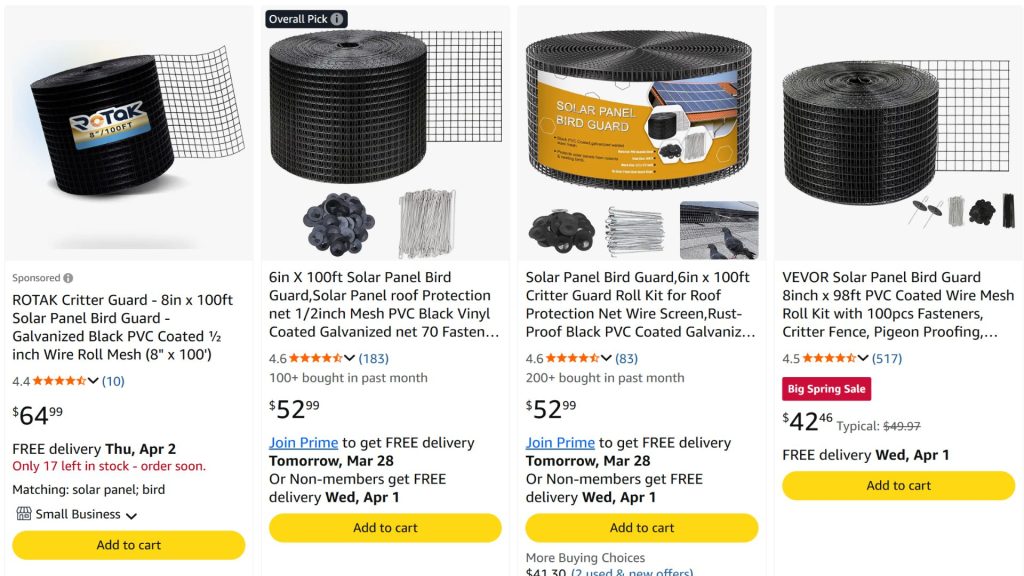
Squirrels and pigeons love to nest under warm panels, chewing wires and causing roof rot. While you are up on the roof, inspect the perimeter. If you see nesting materials, offer to install a PVC-coated galvanized wire mesh (Critter Guard) around the array. You can typically charge between $40 to $60 per linear foot of mesh installed, easily turning a standard $200 cleaning job into a highly profitable $1,200 invoice. (You can point your clients to our homeowner guide on how to stop pests from ruining your system to help close the sale).
Additionally, offer to clear out their gutters while you are already harnessed in. Gutter cleaning is a natural, highly demanded add-on in the rainy PNW that requires almost zero extra equipment.
Seasonal Pricing Strategies in the Pacific Northwest
Demand for solar cleaning in Oregon is not flat; it operates on a highly seasonal curve. Smart business owners adjust their pricing strategies based on the time of year to maximize profits during peak demand.
- The Spring Pollen Rush (April – June): This is your busiest season. As the Willamette Valley releases massive amounts of tree and grass pollen, homeowners will see their solar production drop rapidly. Because demand is incredibly high during these months, you can firmly hold your premium pricing. Do not offer deep discounts in the spring; your schedule will fill up organically.
- The Post-Harvest Push (September – October): Late summer brings heavy agricultural dust and wildfire ash across the state. This is an excellent time to run promotional pricing (e.g., “15% off a Pre-Winter Restoration Clean”) to fill your schedule before the heavy November rains make roof access dangerous.
Scaling Up: Pricing Commercial Solar Cleaning in Oregon
While residential jobs are the bread and butter of a new business, commercial contracts are how you build a scalable, high-revenue enterprise.
The market for commercial solar cleaning PDX (Portland International Airport area) and the surrounding industrial parks is massive. From the sprawling flat roofs of local breweries and tech centers in Hillsboro to the massive ground-mounted arrays on Willamette Valley vineyards, commercial jobs require a completely different pricing strategy.
Pricing by the Kilowatt (kW)
For massive commercial arrays (think 500 to 5,000+ panels), pricing per panel becomes incredibly tedious. Instead, commercial cleaners often price based on the system’s total Kilowatt (kW) or Megawatt (MW) size.
- Standard Commercial Rate: $15 to $25 per kW.
- Example: A 100 kW commercial roof system would be priced between $1,500 and $2,500.
Factoring in Commercial Logistics
Commercial jobs often seem easier because they are usually on flat, easy-to-walk TPO roofs or accessible ground mounts. However, the logistics are much more complex.
When establishing your commercial bids, you must factor in:
- Water Access: Does the facility have a reliable water spigot on the roof, or will you need to rent a water trailer and pump pure DI water up four stories? If you have to haul your own water, your bid must increase dramatically.
- Agricultural Hazards: If you are bidding on a farm array in the Willamette Valley, you are dealing with heavy, baked-on tractor dust and harvest chaff. This requires significantly more water and scrubbing than a standard flat roof in a suburban business park. For a deep dive into agricultural challenges, review our commercial breakdown of how often Willamette Valley farms need cleaning.
- Prevailing Wage Laws: If you are bidding on government buildings, public schools, or municipal utility arrays in Oregon, you may be required by law (via the Oregon Bureau of Labor & Industries) to pay your employees the state “prevailing wage” for that specific county, which is often significantly higher than standard minimum wage. Always check state contract requirements before submitting your bid.
Standing Out: Selling Value Over Price
As the Oregon solar cleaning market becomes more competitive, you will inevitably run into homeowners who say, “I found a guy on Craigslist who will do it for fifty bucks.”
Never race to the bottom. If you lower your prices to compete with uninsured amateurs using dish soap and tap water, you will bankrupt your business. Instead, justify your premium pricing by educating the customer on the value you provide.
Explain that you use 100% Deionized water that won’t leave hard mineral spots. Explain that your ultra-soft, flagged-bristle carbon fiber poles will not scratch their delicate anti-reflective coating. Remind them that you are fully insured, so if a slip happens on their slick Oregon roof, their homeowner’s insurance isn’t on the hook.
Educated homeowners understand that protecting a $30,000 energy asset requires professional care, and they are more than willing to pay a premium for peace of mind.
Frequently Asked Questions for Aspiring Pros
Should I charge extra for travel outside my main service area?
Absolutely. If your business is based in Beaverton but you receive a request for a property in rural Clackamas County or deep in the Columbia River Gorge, you must calculate your drive time and fuel. Implementing a “$1 per mile” surcharge outside a 20-mile radius is standard practice in Oregon to protect your margins.
How do I price jobs that require heavy moss removal?
Moss removal is extremely time-consuming because it requires delicate, manual agitation to avoid scratching the glass. Do not price this at your standard rate. Quote it as an hourly restorative service (typically $100 to $150 per hour) rather than a flat per-panel rate, as you never know exactly how stubborn the lichen will be until you start scrubbing.
What is the best way to secure recurring contracts?
Offer a “Bi-Annual Subscription” discount. If a homeowner agrees to lock in a spring and fall cleaning schedule, offer them 10% off the total price. This guarantees you predictable revenue during the slower months and keeps their system operating perfectly.

Join the CleanMySolarPanels.com Network
Pricing your services correctly is the foundation of a successful business, but securing a steady pipeline of high-intent, ready-to-buy customers is how you actually grow.
You didn’t start a solar cleaning business to spend 40 hours a week struggling with SEO, managing Google Ads, or door-knocking in the Portland rain. You started it to provide an excellent service and generate a profit.
That is where we come in. CleanMySolarPanels.com does the heavy lifting for you. We dominate the search engines for solar maintenance queries across Oregon and the entire country. Thousands of homeowners visit our site, realize the true financial cost of dirty panels, and search our directory for verified local experts.
Stop chasing leads. Let the jobs come to you.
Apply to join our directory, claim your map listing, and get your business in front of Oregon homeowners who are actively looking to hire a professional today.