What Does Solar Panel Maintenance Cost Per Year?
By Adam Walters, Founder, CleanMySolarPanels · November 24, 2026
Solar panel maintenance costs most homeowners between $0 and about $40 per kilowatt of system size per year, according to the National Laboratory of the Rockies. For a typical 8-kilowatt home system that is $0 to $320 a year, with a modeled average near $240. Most years cost far less, and the year an inverter is replaced costs far more.
How much does solar panel maintenance cost per year?
Solar panel maintenance costs about $30 per kilowatt per year on average, in the federal lab's own modeling. The National Laboratory of the Rockies' 2024 Annual Technology Baseline uses $30 per kilowatt for a residential system in 2023 and says real-world costs "can range from $0 to $40" per kilowatt per year.
On common home system sizes, that works out as follows. These are our arithmetic on the lab's per-kilowatt figures, not figures the lab publishes.
| System size | Low end ($0 per kW) | Modeled average ($30 per kW) | High end ($40 per kW) |
|---|---|---|---|
| 5 kW | $0 | $150 a year | $200 a year |
| 8 kW | $0 | $240 a year | $320 a year |
| 10 kW | $0 | $300 a year | $400 a year |
Two things about that average matter before you budget around it.
First, it is an average over the life of the system. The lab's figure spreads the cost of future part replacements across every year, so it is not what you should expect to pay in a normal year.
Second, it covers more than repairs. The lab lists what the number includes: "asset management (including compliance and reporting for incentive payments), insurance products, cleaning, vegetation removal, and component failure." It adds that not every system has all of those costs, which is why the low end of the range is zero.
What does the money actually go to?
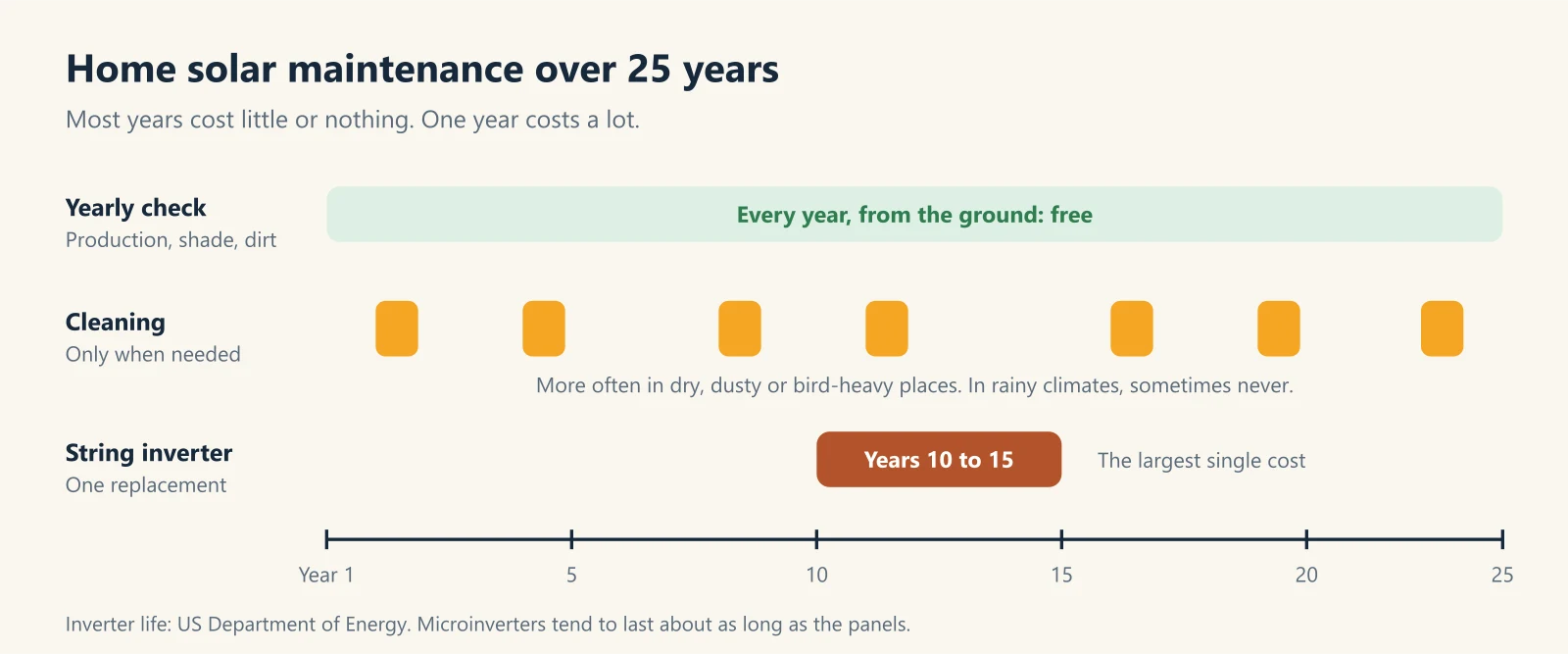
Solar panel maintenance money goes to four things for a typical homeowner: cleaning, replacing an inverter, keeping shade off the panels, and the occasional service call.
| Cost | How often | What to expect |
|---|---|---|
| Cleaning | Only when needed; in some regions never | $110 to $320 per professional visit across the cities CleanMySolarPanels tracks |
| String inverter replacement | Once, usually between years 10 and 15 | The single largest maintenance bill most systems see |
| Tree and shrub trimming | As growth requires | Your normal yard costs |
| Monitoring | Ongoing | Usually part of the inverter maker's app |
| Service call for a fault | Rarely | Varies by installer and by what failed |
Our solar panel cleaning cost guide breaks the cleaning figure down by city and by how the job is priced.
Is the inverter the biggest maintenance cost?
The inverter is the part of a home solar system most likely to need replacing, so for many owners it is the biggest maintenance cost. The Department of Energy's guide for buyers of homes with solar says "String inverters usually last between 10-15 years and may need to be replaced during the lifetime of the panels." The same guide puts panel life at 20 to 25 years, so a system with one central inverter should plan on replacing it once.
Microinverters, the small units mounted behind each panel, are different. The Department of Energy says they "tend to have lifetimes similar to the panels." Enphase, one maker, warrants its IQ microinverters for 25 years in the United States.
Read the labor terms, though. Enphase's limited warranty states that it "does not include any cost of labor related to (i) un-installing Covered Product; (ii) re-installing a repaired or replacement product". A free replacement part can still come with a bill for the roof visit, unless your installer's own workmanship warranty covers it.
How much of the lifetime total is the inverter? An older estimate cited in the national lab's operations guide put it at about half. That estimate dates from 2009, so treat it as a rough guide and not a current figure.
Do you have to pay for cleaning?
You do not have to pay for solar panel cleaning in every climate, and it is worth being honest about that. The national lab's operations and maintenance guide cites a study that "concluded that cleaning is not cost-effective for residential, commercial, nor utility-scale plants", and observes that most system owners "rely on rain to keep the array clean".
The same guide then explains where that stops being true. It reports that "Annual soiling losses are reported in a range from 4.3% to 7.5%", and it names the conditions that call for scheduled cleaning: heavy bird activity, nearby farming, construction dust and industrial fallout. Long dry seasons belong on that list too, because rain cannot rinse what it never reaches.
So the cleaning line in your budget depends on where you live:
- Regular rain, a steep roof, no birds: often nothing.
- A long dry season or a dusty area: one or two cleanings a year.
- Bird droppings, farm dust or nearby construction: clean when you can see the buildup.
To put a number on your own roof, our soiling loss calculator estimates what dirt is costing you, and how often you should clean your solar panels covers the schedule by climate. If the answer is that cleaning pays, you can compare local solar panel cleaning companies by state and city.
How can you keep solar maintenance costs down?
You keep solar maintenance costs down by catching problems early and by not paying for work the system does not need.
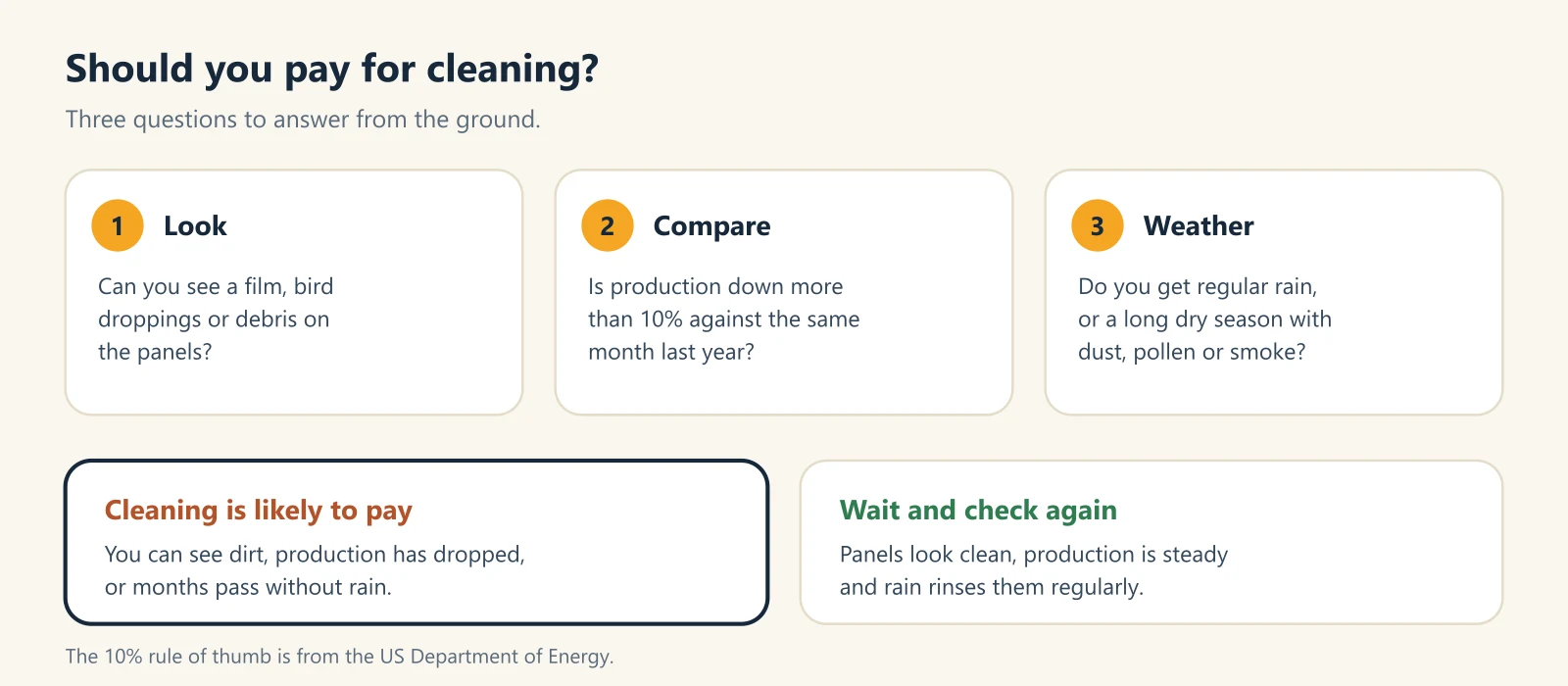
- Watch your production. The Department of Energy's rule of thumb is that "a drop in energy production higher than 10% from year to year" could indicate a maintenance issue. Compare the same month across two years, so a cloudy spell does not fool you.
- Keep shade off the panels. Trim trees and shrubs before they reach the array. Shade costs production every day and is the cheapest problem to fix.
- Clean when it is dirty, not on a calendar. Look at the panels after the dry season. If you can see a film or droppings, clean. If you cannot, wait.
- Keep the monitoring online. Enphase asks owners to keep the system "continuously connected to the internet during the warranty period". A gateway that has dropped off the network cannot report a fault.
- Stay off the roof. Anything that involves climbing is a job for someone with fall protection. Whether a cleaning or a visual check pays for itself is covered in is solar panel cleaning worth it.
Frequently asked questions
Do solar panels need maintenance every year?
Solar panels do not need paid maintenance every year. They have no moving parts, and in rainy climates many systems run for years with nothing more than a look at the monitoring app. A yearly check of production, shading and visible dirt is a sensible habit, and it costs nothing if you do it from the ground.
How much does it cost to replace a solar inverter?
The cost to replace a solar inverter depends on its type and size, and no single national price is reliable. The Department of Energy says string inverters usually last 10 to 15 years, so most systems with one will need a replacement once. Ask your installer for a current quote, and check whether the inverter is still under its maker's warranty.
Is solar panel maintenance covered by warranty?
Solar panel maintenance is mostly not covered by warranty. Warranties cover defective parts and guaranteed output. They generally do not cover cleaning, shading, or damage from improper cleaning. Some also exclude labor: Enphase's microinverter warranty, for example, does not include the cost of removing and reinstalling a unit.
Are solar panels expensive to maintain?
Solar panels are inexpensive to maintain compared with most home systems. The National Laboratory of the Rockies models residential upkeep at about $30 per kilowatt per year, and says real costs range from $0 to $40. The exception is the year a string inverter is replaced, which is the largest single bill most owners face.